
At its core, a muffle furnace is a system designed for high-temperature, indirect heating in a controlled environment. Its key components include an insulated inner chamber (the "muffle"), external heating elements that surround this chamber, and a sophisticated temperature control system that uses a sensor to regulate heat. A protective outer casing, a safety door, and often an exhaust port complete the assembly.
A muffle furnace's defining principle is isolation. By placing the heating elements outside the sample chamber, it prevents direct contact with flames or electrical radiation, ensuring uniform heating and preventing contamination of the material being processed.
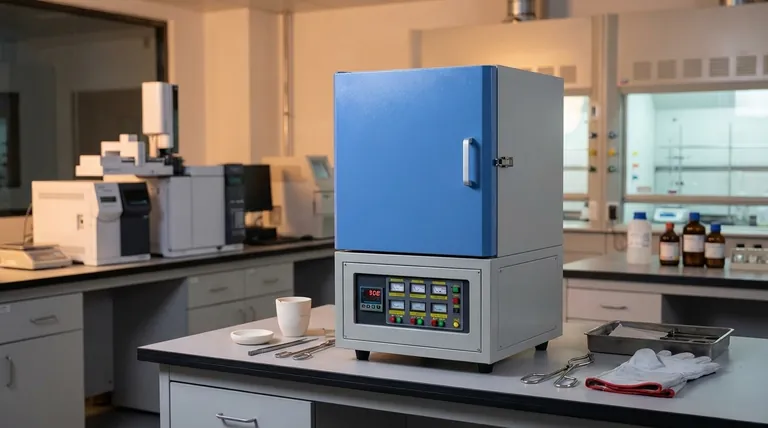
The Core Architecture: Chamber and Insulation
The physical structure of the furnace is designed for thermal efficiency and containment. Each layer serves a distinct purpose, working together to maintain extreme temperatures safely.
The Muffle (Inner Chamber)
This is the heart of the furnace and what gives it its name. The muffle is a box-like chamber that holds the material to be heated.
Its critical function is to isolate the workload from the heating elements. This prevents contamination and ensures even, radiant heating from all sides. Muffles are made from high-temperature refractory materials like ceramic, quartz, or alumina.
The Insulation Layer
Surrounding the muffle is a thick layer of insulation. This is typically made from high-grade materials like a ceramic fiber or glass wool blanket.
The insulation's job is to minimize heat loss, which ensures the furnace operates efficiently and maintains a stable temperature. It also keeps the outer surface of the furnace cool enough to be safe.
The Outer Casing
The final layer is the rigid outer shell, usually constructed from stainless steel or another durable metal. This casing provides structural integrity, protects the internal components from damage, and houses the user interface and electrical systems.
The Heating and Control System
This is the active part of the furnace, responsible for generating, measuring, and regulating the heat. The synergy between these components is what allows for precise thermal processing.
Heating Elements
These are the source of the heat. Unlike a conventional oven, the heating elements are positioned around the outside of the muffle chamber, not inside it.
They are made from high-resistance materials that glow red-hot when electricity passes through them. Common materials include Kanthal (iron-chromium-aluminum alloy), Nichrome, or silicon carbide for higher temperature applications.
The Thermocouple (The "Sensor")
A thermocouple is a temperature sensor that extends into the heating chamber. It constantly measures the internal temperature.
This data is the critical feedback mechanism for the entire system. Without an accurate temperature reading, precise control is impossible.
The Temperature Controller (The "Brain")
The controller is the user interface and the system's brain. The user sets a desired temperature (the "setpoint"), and the controller takes over.
It reads the temperature from the thermocouple and compares it to the setpoint. It then pulses power to the heating elements to maintain that temperature precisely. Modern furnaces use advanced PID controllers (Proportional-Integral-Derivative) for exceptional stability, preventing temperature overshooting and undershooting.
Safety and Environmental Controls
Beyond heating, a muffle furnace must manage safety and the byproducts of the heating process.
The Door and Safety Switch
The door provides access to the chamber and is lined with insulation to prevent heat escape.
Critically, all modern furnaces include a safety door switch. This switch immediately cuts power to the heating elements the moment the door is opened, protecting the operator from exposure to extreme temperatures.
The Exhaust System (Ventilation)
Many muffle furnaces include an exhaust port or vent, often located at the rear.
This allows for the safe removal of fumes, gases, or moisture that may be released from the sample during heating. In some applications, it can also be used to regulate the atmosphere inside the chamber.
Understanding the Key Trade-offs
Choosing or using a muffle furnace involves balancing performance, longevity, and cost, which are dictated by its components.
Heating Element Material vs. Temperature
The choice of heating element directly limits the furnace's maximum operating temperature. Kanthal and Nichrome are cost-effective and suitable for temperatures up to ~1200°C. For higher temperatures (up to 1800°C), more expensive and robust materials like silicon carbide (SiC) or molybdenum disilicide (MoSi2) are required.
Chamber Material vs. Application
A standard ceramic muffle is excellent for most general-purpose heating and ashing. However, if you are working with materials that could react with or degrade ceramics, a quartz muffle offers superior chemical resistance, though it may be more susceptible to thermal shock.
Control System vs. Precision
A simple on/off controller is cheap but results in significant temperature fluctuations. A PID controller provides vastly superior precision by learning the furnace's thermal behavior. For applications requiring strict temperature stability, a PID controller is not a luxury—it is a necessity.
Making the Right Choice for Your Goal
Understanding these components allows you to select the right tool for your specific thermal processing task.
- If your primary focus is high-temperature metallurgy (>1200°C): You need a furnace with silicon carbide or MoSi2 heating elements and high-alumina refractory insulation.
- If your primary focus is general lab use (e.g., ashing, heat treating): A standard furnace with Kanthal elements, ceramic fiber insulation, and a reliable PID controller is the ideal workhorse.
- If your primary focus is processing sensitive or reactive materials: Prioritize a furnace with an inert quartz muffle and an effective ventilation system to manage off-gassing.
By understanding how these core components function and interact, you are empowered to operate the equipment safely and achieve precise, repeatable results.
Summary Table:
| Component | Function | Common Materials |
|---|---|---|
| Muffle (Inner Chamber) | Isolates sample for uniform, contamination-free heating | Ceramic, quartz, alumina |
| Heating Elements | Generates heat externally around the muffle | Kanthal, Nichrome, silicon carbide |
| Temperature Controller | Regulates heat using PID for precision | PID controllers |
| Insulation Layer | Minimizes heat loss for efficiency | Ceramic fiber, glass wool |
| Outer Casing | Provides structural integrity and safety | Stainless steel |
| Safety Door Switch | Cuts power when opened for operator protection | Integrated switch |
| Exhaust System | Removes fumes and gases during heating | Ventilation port |
Ready to elevate your lab's thermal processing? At KINTEK, we leverage exceptional R&D and in-house manufacturing to provide advanced high-temperature furnace solutions tailored to your needs. Our product line includes Muffle, Tube, Rotary Furnaces, Vacuum & Atmosphere Furnaces, and CVD/PECVD Systems, all backed by strong deep customization capabilities to precisely meet your unique experimental requirements. Whether you're in metallurgy, general lab work, or handling sensitive materials, we ensure precise temperature control, uniform heating, and enhanced safety. Contact us today to discuss how our furnaces can optimize your processes and deliver reliable, repeatable results!
Visual Guide

Related Products
- 1400℃ Muffle Oven Furnace for Laboratory
- 1700℃ High Temperature Muffle Oven Furnace for Laboratory
- 1800℃ High Temperature Muffle Oven Furnace for Laboratory
- 1200℃ Muffle Oven Furnace for Laboratory
- High Temperature Muffle Oven Furnace for Laboratory Debinding and Pre Sintering
People Also Ask
- How does a high-temperature laboratory muffle furnace affect material properties? Transform Anodic Oxide Films Fast
- What is the primary function of a high-temperature laboratory muffle furnace in chemical synthesis? Achieve Precision.
- What role does a muffle furnace play in refractory bricks? Enhance Performance and Durability Testing
- How does a muffle furnace facilitate Ag/ATP catalyst preparation? Optimize Calcination for Superior Performance
- How does a laboratory high-temperature muffle furnace contribute to the final formation of Bismuth Oxide nanosheets?



















