
The primary benefit of using a muffle furnace for aluminum-based self-lubricating composites is the optimization of mechanical properties through precise solution treatment and artificial aging. By maintaining strict temperature controls (often around 540°C), the furnace allows reinforcement particles and alloying elements to fully dissolve into the aluminum matrix. This process, followed by quenching, triggers the precipitation of strengthening phases that significantly enhance hardness and wear resistance.
Core Insight While muffle furnaces can serve various roles from melting to stress relief, their critical value in this context is microstructural engineering. They enable the phase transformations necessary to harden the matrix, ensuring the composite resists deformation and maintains its self-lubricating properties under friction.
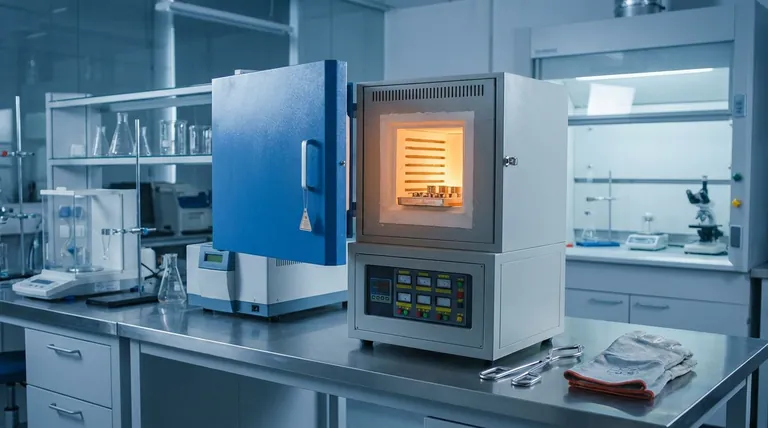
Enhancing Mechanical Performance
The effectiveness of a self-lubricating composite depends heavily on the strength of its aluminum matrix.
Precise Solution Treatment
Muffle furnaces provide the high-temperature environment required for solution treatment (e.g., 540°C for Al2024).
This heat allows alloying elements and reinforcement particles to dissolve completely into the aluminum matrix.
Precipitation of Strengthening Phases
Following the heating phase, water quenching and natural (or artificial) aging are employed.
This sequence induces the precipitation of specific strengthening phases within the metal.
Resistance to Deformation and Wear
The resulting microstructure significantly increases the matrix hardness.
A harder matrix provides better support for lubricants, optimizing the material's anti-deformation capabilities and reducing wear during friction.
Versatility Across Processing Stages
Beyond hardening, the muffle furnace supports critical preparatory and manufacturing steps.
Matrix Liquefaction for Distribution
In the preparation phase, the furnace can function as core melting equipment (e.g., at 690°C for 6061 alloy).
It ensures the matrix reaches a fully liquefied, low-viscosity state, which is essential for the uniform distribution of reinforcement particles.
Stress Relief and Stabilization
The furnace is also effective for pre-heat treatments at lower temperatures (around 300°C).
This stabilizes the material structure, releases internal stresses, and adjusts the crystalline state of oxides prior to further processing like carbon coating.
Understanding the Trade-offs
While muffle furnaces are versatile, they have distinct limitations compared to other industrial heating methods.
The Risk of Oxidation
Unlike vacuum furnaces, standard muffle furnaces typically operate with an air atmosphere.
This can lead to surface oxidation or scaling, whereas vacuum furnaces prevent chemical reactions to achieve a bright, purified finish.
Temperature Control vs. Interface Reactions
Precise control is vital; excessive temperatures in a muffle furnace during liquid infiltration can promote the formation of brittle Aluminum Carbide (Al4C3).
Alternative methods, such as Vacuum Hot Pressing (VHP), utilize lower-temperature solid-state sintering to specifically prevent these brittle interfaces.
Making the Right Choice for Your Goal
- If your primary focus is Matrix Hardening: Utilize the muffle furnace for solution treatment and aging to maximize wear resistance and load-bearing capacity.
- If your primary focus is Particle Distribution: Use the furnace to achieve a low-viscosity melt (approx. 690°C) to ensure uniform mixing of reinforcements.
- If your primary focus is Surface Purity: Consider that a muffle furnace may require post-processing to remove oxidation, unlike vacuum heat treatment options.
By leveraging the muffle furnace for specific thermal cycles, you transform a raw aluminum mixture into a robust, wear-resistant engineering material.
Summary Table:
| Process Step | Temperature Range | Key Benefit to Composite |
|---|---|---|
| Matrix Liquefaction | ~690°C | Ensures low viscosity for uniform reinforcement distribution. |
| Solution Treatment | ~540°C | Dissolves alloying elements into the matrix for maximum strength. |
| Stress Relief | ~300°C | Stabilizes structure and releases internal stresses before coating. |
| Aging/Hardening | Variable | Induces precipitation phases to improve wear and deformation resistance. |
Upgrade Your Material Science with KINTEK Precision
Maximize the mechanical performance of your self-lubricating composites with KINTEK’s advanced thermal solutions. Backed by expert R&D and manufacturing, KINTEK offers a comprehensive range of Muffle, Tube, Rotary, Vacuum, and CVD systems, all fully customizable to meet your specific research or production needs.
Whether you require precise atmosphere control to prevent oxidation or high-temperature stability for matrix hardening, our lab furnaces deliver the reliability your project deserves.
Ready to optimize your heat treatment process? Contact us today to discuss your unique requirements with our technical specialists!
References
- Huifeng Ning, Litian Hu. Modeling and prediction of tribological properties of copper/aluminum-graphite self-lubricating composites using machine learning algorithms. DOI: 10.1007/s40544-023-0847-2
This article is also based on technical information from Kintek Furnace Knowledge Base .
Related Products
- High Temperature Muffle Oven Furnace for Laboratory Debinding and Pre Sintering
- 1200℃ Muffle Oven Furnace for Laboratory
- 1400℃ Muffle Oven Furnace for Laboratory
- Laboratory Muffle Oven Furnace with Bottom Lifting
- 1800℃ High Temperature Muffle Oven Furnace for Laboratory
People Also Ask
- What thermal phenomena occur during polymer binder burnout in ceramic green bodies? Lab Furnace Guide
- What role does a high-temperature muffle furnace play in STFO synthesis? Achieve Pure Perovskite Results
- Why is controlled heat treatment in a muffle furnace necessary for calcined clay? Achieve Optimal Pozzolanic Activity
- How does a high-temperature muffle furnace facilitate the formation of LaNbxAl1−xO3+δ perovskite structures? Key Roles
- What role does a high-temperature muffle furnace play in the multi-stage synthesis of Li0.5MnFe1.5O4? Key to Pure Spinel



















