
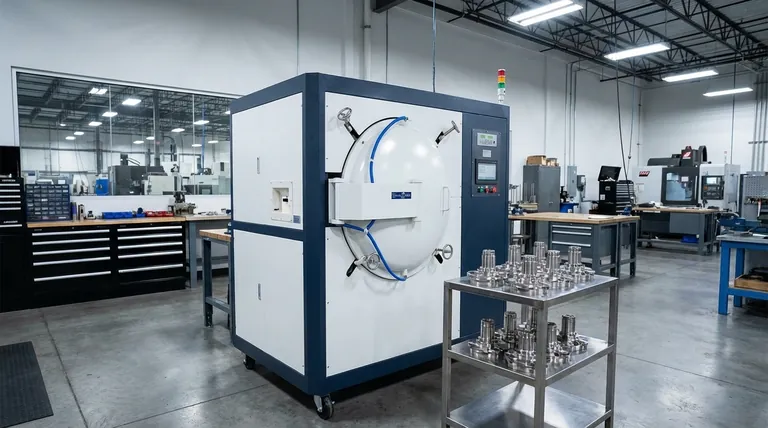
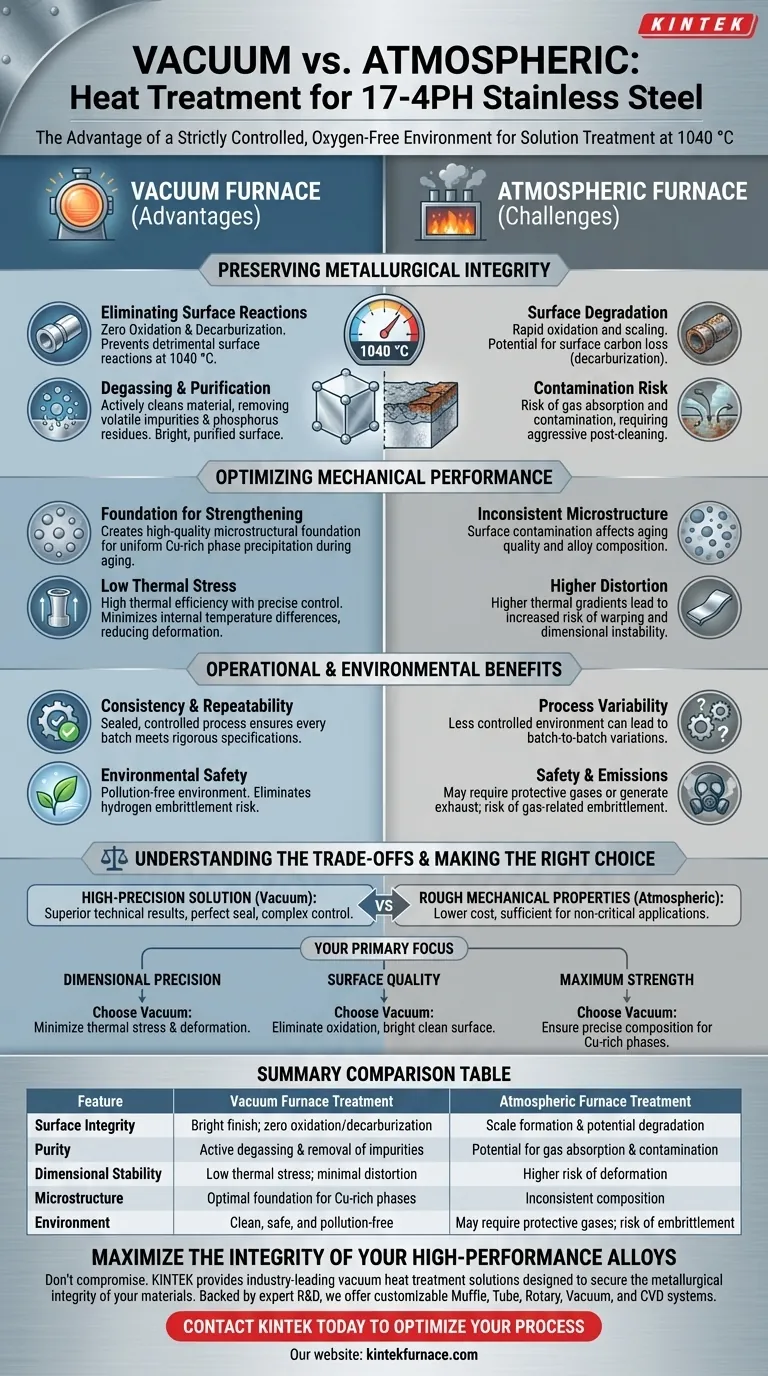
The primary advantage of using a vacuum heat treatment furnace for 17-4PH stainless steel is the creation of a strictly controlled, oxygen-free environment. This prevents detrimental surface reactions such as oxidation and decarburization while the metal is held at the critical solution temperature of 1040 °C.
Core Takeaway: The value of a vacuum furnace extends beyond simple cleanliness; it secures the metallurgical integrity of the alloy. By preventing surface degradation and ensuring precise composition control during solution treatment, you establish the essential microstructural foundation required for the uniform precipitation of strengthening copper-rich phases during subsequent aging.
Preserving Metallurgical Integrity
Eliminating Surface Reactions
At the high solution treatment temperature of 1040 °C, 17-4PH steel is highly reactive to oxygen. Atmospheric furnaces can lead to rapid oxidation and scaling.
A vacuum furnace removes oxygen from the equation. This effectively prevents surface oxidation and decarburization (the loss of carbon from the surface), ensuring the material retains its intended chemical composition throughout the part.
Degassing and Purification
Beyond preventing reactions, the vacuum environment actively cleans the material. The process provides degassing and degreasing effects, removing volatile impurities from the surface.
References indicate this process can specifically assist in removing surface contaminants, such as phosphorus residues, resulting in a bright, purified surface finish that requires less post-processing.
Optimizing Mechanical Performance
Foundation for Strengthening Phases
The ultimate strength of 17-4PH comes from the precipitation of copper-rich (Cu-rich) phases during the aging process. The quality of this aging is directly dependent on the quality of the preceding solution treatment.
By maintaining surface integrity and alloy composition during the solution stage, the vacuum furnace creates a high-quality microstructural foundation. This allows for the high-density, uniformly distributed precipitation of these strengthening phases later in the process.
Reducing Thermal Stress and Distortion
Vacuum furnaces offer high thermal efficiency with the ability to control temperature increases and decreases rapidly.
Workpieces heated in this environment experience a smaller internal temperature difference compared to atmospheric heating. This results in low thermal stress, which significantly minimizes deformation and warping—a critical factor for precision components.
Operational Benefits
Consistency and Repeatability
The vacuum process is noted for its stability. Because the environment is sealed and controlled electronically, it offers excellent process invariance and repeatability. This ensures that every batch of 17-4PH components meets the same rigorous specifications.
Environmental Safety
Unlike some atmospheric processes that may require protective gases or generate exhaust, vacuum heat treatment provides a safe working environment without pollution. It eliminates the risk of hydrogen embrittlement caused by gas absorption, a common issue in high-performance alloys.
Understanding the Trade-offs
Equipment Complexity vs. Necessity
While vacuum heat treatment offers superior technical results, it represents a "high-precision" solution. The equipment relies on maintaining a perfect vacuum seal and managing complex programmable cooling rates.
If a project requires only rough mechanical properties without strict dimensional tolerances or surface finish requirements, the superior capabilities of a vacuum furnace—such as precise temperature uniformity and purification—may exceed the application's actual needs.
Making the Right Choice for Your Goal
When deciding if vacuum heat treatment is necessary for your 17-4PH components, consider your specific performance targets:
- If your primary focus is Dimensional Precision: Choose vacuum treatment to minimize thermal stress and internal temperature differences, resulting in the lowest possible deformation.
- If your primary focus is Surface Quality: Rely on the vacuum environment to eliminate oxidation and decarburization, yielding a bright, clean surface that eliminates the need for aggressive post-cleaning.
- If your primary focus is Maximum Strength: Use vacuum treatment to ensure the alloy composition remains precise, creating the optimal foundation for the precipitation of copper-rich strengthening phases.
The vacuum furnace is not just a heating tool; it is a precision instrument that guarantees the structural and surface integrity of high-performance alloys.
Summary Table:
| Feature | Vacuum Furnace Treatment | Atmospheric Furnace Treatment |
|---|---|---|
| Surface Integrity | Bright finish; zero oxidation/decarburization | Scale formation and potential surface degradation |
| Purity | Active degassing and removal of volatile impurities | Potential for gas absorption and contamination |
| Dimensional Stability | Low thermal stress; minimal distortion/warping | Higher risk of deformation due to thermal gradients |
| Microstructure | Optimal foundation for Cu-rich phase precipitation | Inconsistent composition affecting aging quality |
| Environment | Clean, safe, and pollution-free | May require protective gases; risk of embrittlement |
Maximize the Integrity of Your High-Performance Alloys
Don't let surface oxidation or thermal distortion compromise the strength of your 17-4PH components. KINTEK provides industry-leading vacuum heat treatment solutions designed to secure the metallurgical integrity of your materials.
Backed by expert R&D and manufacturing, KINTEK offers Muffle, Tube, Rotary, Vacuum, and CVD systems, all fully customizable to meet your unique laboratory or production needs. Whether you require precise solution treatment for aerospace components or specialized high-temp furnaces for advanced research, our team is ready to deliver the precision you demand.
Contact KINTEK Today to Optimize Your Heat Treatment Process
Visual Guide
References
- Chengshuang Zhou, Lin Zhang. The Effect of Aging Treatment on the Corrosion Behavior of 17-4PH Stainless Steel. DOI: 10.3390/ma18081823
This article is also based on technical information from Kintek Furnace Knowledge Base .
Related Products
- Vacuum Heat Treat Furnace with Ceramic Fiber Liner
- 2200 ℃ Graphite Vacuum Heat Treat Furnace
- Molybdenum Vacuum Heat Treat Furnace
- 2200 ℃ Tungsten Vacuum Heat Treat and Sintering Furnace
- Vacuum Heat Treat Sintering Furnace with Pressure for Vacuum Sintering
People Also Ask
- How does vacuum heat treating affect the grain structure of metal alloys? Achieve Precise Microstructure Control
- What are the benefits of using vacuum heat treating furnaces for metal alloys? Achieve Superior Metal Properties and Performance
- What is one of the most important uses of vacuum heat treating furnaces in aerospace? Achieve Superior Strength in Aircraft Alloys
- How does a vacuum heat treat furnace work? Achieve Pristine, High-Performance Results
- What is the difference between heat treat and vacuum heat treat? Achieve Superior Metal Properties with Pristine Finishes



















