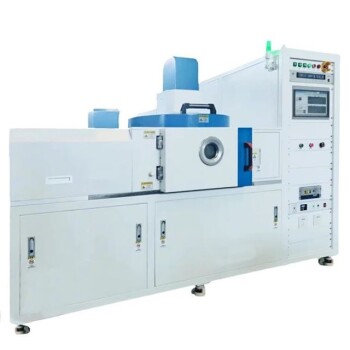
Spark Plasma Sintering (SPS) offers a distinct advantage over traditional methods by utilizing pulsed direct current and high axial pressure to achieve rapid internal heating. For copper sulfide specifically, this technique enables high-density sintering in extremely short durations—often as fast as five minutes—which is critical for manipulating the material's microstructure to enhance thermoelectric performance.
The core advantage of SPS lies in its ability to densify materials rapidly before grains can coarsen. This preserves essential microscopic defects—such as nano-precipitates and dislocations—which are necessary for minimizing lattice thermal conductivity and maximizing thermoelectric efficiency.
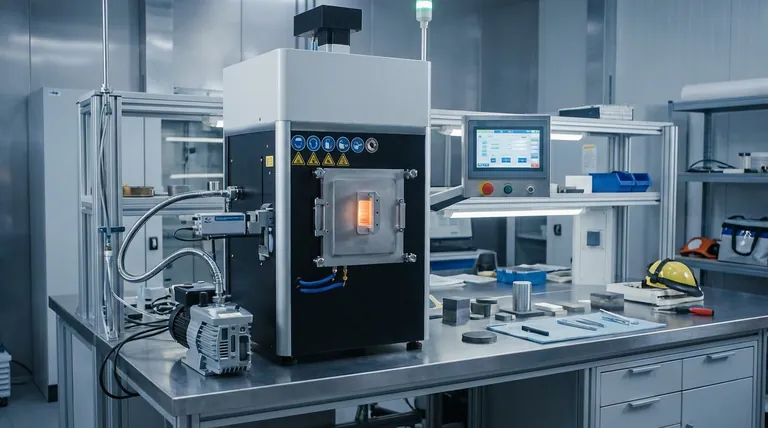
The Mechanism of Rapid Densification
Internal Joule Heating
Unlike traditional sintering, which relies on external heating elements to warm the sample from the outside in, SPS generates heat internally. By applying pulsed electric current directly between the powder particles, SPS utilizes Joule heating and plasma discharge effects. This results in extremely fast heating rates, often reaching 100°C/min or higher.
Simultaneous Axial Pressure
The SPS process combines this thermal energy with a mechanical force, specifically an axial pressure of 50 MPa. This pressure promotes densification through plastic flow and atomic diffusion at significantly lower temperatures than conventional methods require. The combination of internal heat and pressure allows the material to reach near-theoretical density (often exceeding 94%) in a fraction of the time.
Preserving Nanostructure for Thermoelectric Efficiency
Inhibiting Abnormal Grain Growth
The most critical challenge in sintering thermoelectric materials is preventing the grains (crystals) from growing too large, which degrades performance. Because the SPS process is so fast (completed in minutes rather than hours), it effectively inhibits abnormal grain growth. This results in a fine-grained structure that is superior to the coarse structures typical of slow, traditional sintering.
Retention of Microscopic Defects
For copper sulfide to function effectively as a thermoelectric material, it must maintain specific microscopic imperfections. SPS maximizes the retention of nano-precipitates, dislocations, and nanopores. In traditional slow-heating processes, these beneficial defects would likely anneal out or disappear.
Lowering Lattice Thermal Conductivity
The preservation of these defects is not accidental; it is a strategic goal. These microscopic features act as scattering centers for phonons (heat carriers). By retaining these defects, SPS ensures the material maintains an extremely low lattice thermal conductivity. This is a fundamental requirement for high-efficiency thermoelectric energy conversion.
Operational Requirements and Trade-offs
Reliance on Specialized Tooling
The precision of the SPS process is heavily dependent on the tooling. It requires high-purity graphite molds, which serve a dual purpose: they define the shape of the sample and act as resistive heating elements to transfer thermal energy. This adds a layer of operational complexity compared to simple atmospheric furnaces.
Precision Process Control
While SPS allows for superior material properties, it demands rigorous control over process parameters. To achieve the specific "fine microstructure" required for thermoelectrics, the coordination of pulse current, mechanical pressure, and temperature must be exact. Deviation in these parameters can lead to either incomplete densification or the unwanted annealing of the critical nanodefects.
Making the Right Choice for Your Goal
While SPS is generally superior for advanced thermoelectrics, your specific optimization goals will dictate the process parameters.
- If your primary focus is Maximizing Thermoelectric Efficiency: Prioritize short sintering times to retain nano-precipitates and dislocations, which lower thermal conductivity.
- If your primary focus is Mechanical Stability: Leverage the 50 MPa axial pressure to achieve high-density compaction and eliminate macro-porosity, ensuring structural integrity.
SPS converts the sintering process from a simple heating step into a precise microstructural engineering tool, allowing you to decouple densification from grain growth.
Summary Table:
| Feature | Traditional Sintering | Spark Plasma Sintering (SPS) |
|---|---|---|
| Heating Method | External radiation (slow) | Internal Joule heating (rapid) |
| Heating Rate | Low (typically <10°C/min) | High (up to 100°C/min+) |
| Process Time | Several hours | Minutes (approx. 5 min) |
| Microstructure | Coarse grains | Fine grains + nanodefects |
| Densification | Thermal diffusion only | Thermal + 50 MPa axial pressure |
| TE Efficiency | Lower (defect annealing) | Higher (phonon scattering) |
Elevate Your Material Research with KINTEK Precision
Unlock the full potential of your thermoelectric materials with Spark Plasma Sintering technology. KINTEK provides industry-leading thermal solutions backed by expert R&D and manufacturing. Whether you require advanced SPS capabilities, Vacuum, CVD systems, or Muffle and Tube furnaces, our equipment is fully customizable to meet your unique laboratory needs.
Maximize your densification efficiency and preserve critical nanostructures today.
References
- Yixin Zhang, Zhen‐Hua Ge. Synergistically optimized electron and phonon transport in high-performance copper sulfides thermoelectric materials via one-pot modulation. DOI: 10.1038/s41467-024-47148-0
This article is also based on technical information from Kintek Furnace Knowledge Base .
Related Products
- Spark Plasma Sintering SPS Furnace
- 915MHz MPCVD Diamond Machine Microwave Plasma Chemical Vapor Deposition System Reactor
- RF PECVD System Radio Frequency Plasma Enhanced Chemical Vapor Deposition
- Vacuum Heat Treat Sintering Furnace with Pressure for Vacuum Sintering
- 9MPa Air Pressure Vacuum Heat Treat and Sintering Furnace
People Also Ask
- Why is it necessary to maintain a high vacuum environment during the SPS of SiC? Key to High-Density Ceramics
- How does the heating mechanism of Spark Plasma Sintering (SPS) function? Enhance TiC/SiC Composite Fabrication
- What are the technical advantages of using an SPS sintering furnace? Elevate Al2O3-TiC Material Performance
- What are the steps in the discharge plasma sintering process? Master Fast, High-Density Material Consolidation
- What are the advantages of spark plasma sintering (SPS) over traditional forging? Precision Microstructural Control