
At its core, a vertical furnace using electromagnetic induction heating with a graphite barrel is employed for scaled-up magnesium smelting because it solves the two most significant problems of traditional methods: poor energy efficiency and rapid equipment degradation. This design uses the graphite barrel as a highly efficient internal heating element, which directly heats the material, eliminating massive heat loss and removing the need for expensive, consumable steel retorts that fail under continuous operation.
This advanced furnace configuration represents a strategic shift from heating the container to heating the contents. It directly addresses the core operational bottlenecks of efficiency and durability that prevent traditional methods from being viable for continuous, industrial-scale production.
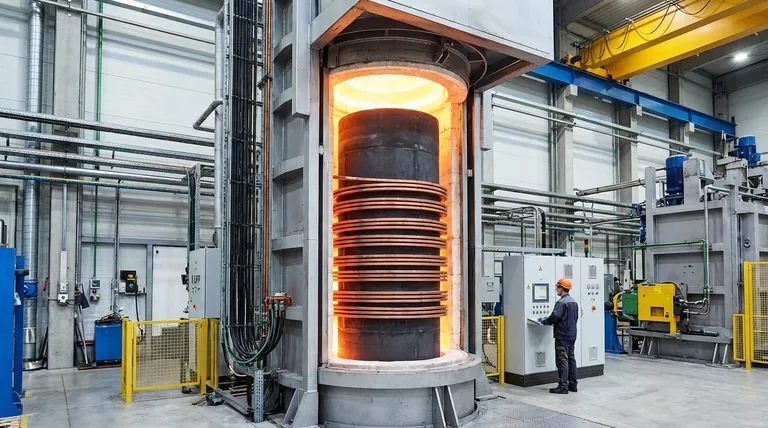
The Principle: Internal vs. External Heating
The fundamental advantage of this design lies in how it generates and delivers heat. Understanding this difference is key to appreciating its impact.
How Induction Heating Works
An induction coil generates a powerful, alternating electromagnetic field around the furnace. The graphite barrel is placed within this field.
Graphite is an excellent electrical conductor and an ideal susceptor. This means it readily absorbs the electromagnetic energy and efficiently converts it into thermal energy—in other words, it gets very hot, very quickly.
The Power of Internal Heating
Because the graphite barrel is the heating element, it radiates heat directly to the materials inside it. This internal heating method is fundamentally more efficient than traditional approaches.
The Weakness of External Heating
Traditional furnaces use external heating, where burners or resistive elements heat the outside of a steel container (a retort). A significant amount of energy is lost heating the furnace walls and the surrounding air before the heat can slowly conduct through the retort to the materials.
Overcoming Critical Production Bottlenecks
For a process to be truly continuous and scaled-up, it must be reliable and cost-effective. The induction-heated graphite design directly targets the primary failure points of older systems.
The Problem: Consumable Steel Retorts
In traditional pidgeon processes, the reaction occurs inside expensive, heat-resistant steel retorts. Under the extreme temperatures required for magnesium smelting, these steel retorts degrade, warp, and ultimately fail.
This requires frequent and costly replacement, creating significant downtime and making a truly continuous operation nearly impossible to sustain economically.
The Solution: A Durable, Integrated System
The graphite barrel design eliminates this reliance on a separate, consumable steel retort. The graphite itself is robust at these temperatures and serves as both the reaction chamber and the heat source.
This integrated approach drastically reduces a major recurring operational cost and removes the most common point of mechanical failure, paving the way for sustained, uninterrupted production.
Understanding the Trade-offs
While highly effective, this advanced furnace design comes with its own set of considerations that differ from traditional methods.
High Initial Capital Cost
The upfront investment for high-power induction heating systems and large, high-purity graphite components is typically greater than for a simpler, externally-fired furnace.
System Complexity
Induction heating requires sophisticated power electronics and control systems to manage the electromagnetic field and regulate temperature precisely. This adds a layer of complexity compared to conventional heating technologies.
Material Compatibility
The entire process must be compatible with a high-temperature graphite environment. While ideal for many carbothermic reactions like magnesium smelting, it may not be suitable for all metallurgical processes.
Making the Right Choice for Your Goal
The decision to adopt this technology is driven entirely by the intended scale and mode of operation.
- If your primary focus is continuous, large-scale industrial production: The induction-heated graphite barrel is the definitive choice, as it provides the high thermal efficiency and equipment longevity required for economic viability.
- If your primary focus is small-batch research or intermittent, low-volume production: The higher operating costs and maintenance burdens of a traditional externally-heated retort system might be acceptable to avoid a larger initial capital investment.
Ultimately, selecting this furnace design is an engineering decision to prioritize long-term operational efficiency and reliability over short-term capital savings.
Summary Table:
| Feature | Traditional Furnace | Induction + Graphite Furnace |
|---|---|---|
| Heating Method | External (heats container) | Internal (directly heats material) |
| Energy Efficiency | Low (significant heat loss) | High (direct energy transfer) |
| Core Component | Consumable steel retorts | Durable graphite barrel |
| Operational Downtime | High (frequent retort replacement) | Low (robust, integrated system) |
| Best For | Small-batch, intermittent production | Continuous, large-scale production |
Ready to Scale Up Your Metallurgical Processes?
Choosing the right furnace technology is critical for achieving efficient, continuous production. The vertical induction furnace with a graphite barrel represents the pinnacle of design for overcoming the limitations of traditional methods.
KINTEK's advanced furnace solutions are engineered for performance and durability. Backed by expert R&D and manufacturing, we offer Muffle, Tube, Rotary, Vacuum, and CVD systems, including custom high-temperature furnaces tailored for demanding applications like magnesium smelting.
Let us help you build a more reliable and cost-effective operation. Our team can work with you to design a system that meets your specific production goals.
Contact KINTEK today to discuss your project and discover the benefits of our customizable furnace technology.
Visual Guide

Related Products
- Magnesium Extraction and Purification Condensing Tube Furnace
- Vacuum Induction Melting Furnace
- 2200 ℃ Graphite Vacuum Heat Treat Furnace
- Vertical Laboratory Quartz Tube Furnace Tubular Furnace
- Vacuum Heat Treat Sintering Furnace with Pressure for Vacuum Sintering
People Also Ask
- What are the advantages of using a condensing tube furnace for magnesium extraction? Achieve High Purity and Efficient Metal Recovery
- Why use nitrogen atmosphere control in chromite reduction? Ensure Process Integrity and Prevent Oxidation
- What environmental benefits do tube furnaces provide? Boost Efficiency and Drive Sustainable Innovation
- Why is a N2 Atmosphere Required for Calcining Doped Carbon Nitride? Protect Purity & Boost Crystallinity
- Why is a tube furnace with nitrogen flow necessary for BaFe2-xCoxFe16O27 ceramics? Master Iron Valence Engineering



















