
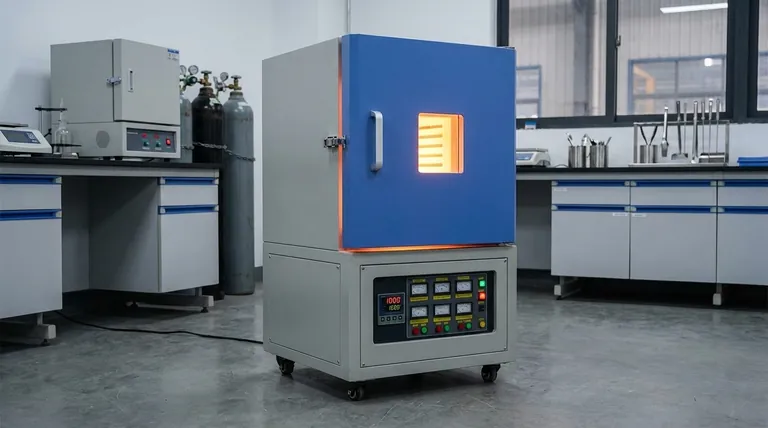
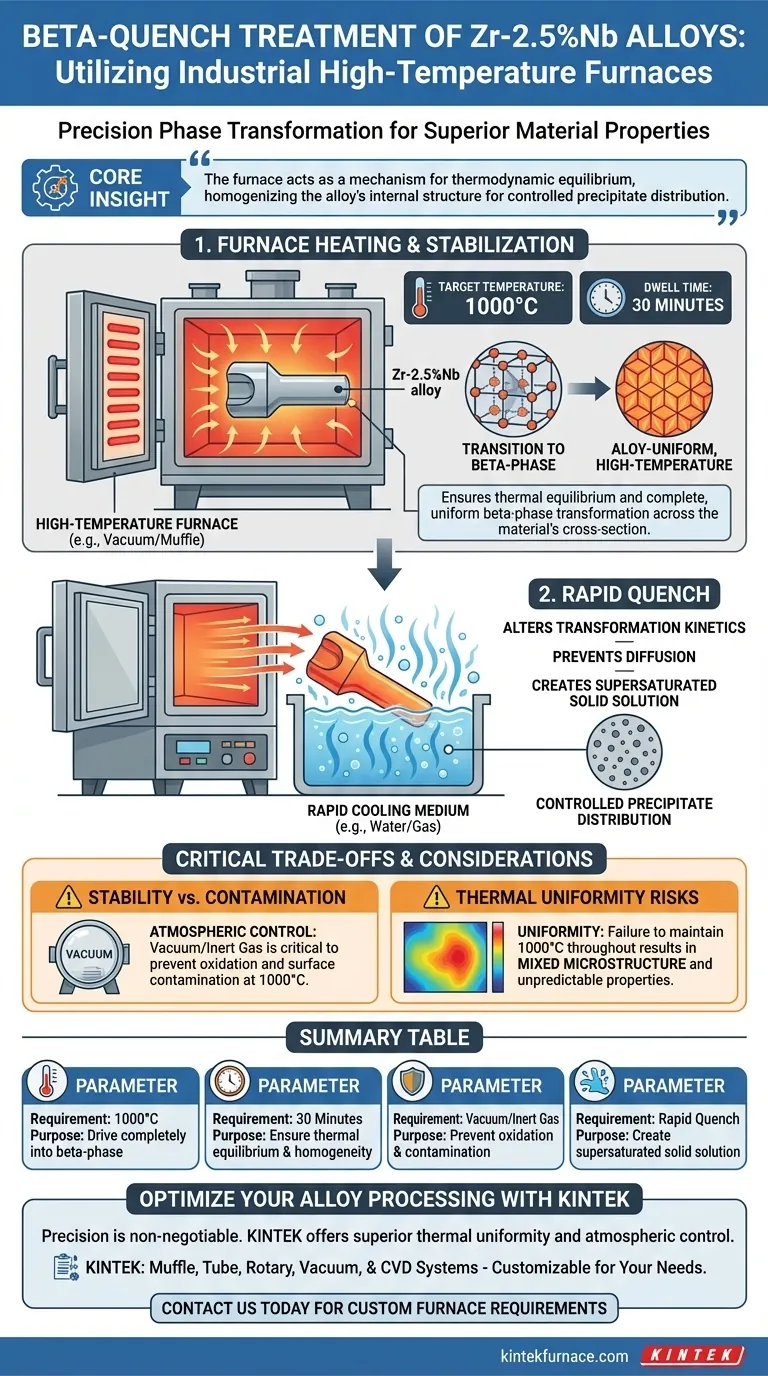
An industrial high-temperature furnace functions as a precision environment to force phase transformation in Zr-2.5%Nb alloys, specifically by maintaining a stable temperature of 1000°C for a duration of 30 minutes. This controlled heating period is essential to drive the alloy completely into the beta-phase region, acting as the prerequisite step before rapid cooling locks in the desired supersaturated solid solution structure.
Core Insight The furnace is not merely a heating element; it is a mechanism for thermodynamic equilibrium. By sustaining a specific temperature and dwell time, it homogenizes the alloy's internal structure, enabling the subsequent quench to effectively control the distribution of precipitate phases and define the material's final properties.
The Mechanics of Beta-Phase Stabilization
The primary role of the furnace in this treatment is to alter the crystalline structure of the zirconium alloy through precise thermal application.
Reaching the Beta-Phase Region
To achieve the necessary microstructural change, the furnace must elevate the alloy's temperature to 1000°C. At this specific thermal threshold, the Zr-2.5%Nb alloy transitions into the beta-phase, a high-temperature crystal structure distinct from its room-temperature state.
The Importance of Dwell Time
Reaching temperature is not enough; the furnace must maintain this environment for 30 minutes. This "holding" or dwell period ensures that the entire cross-section of the material—not just the surface—reaches thermal equilibrium. It guarantees that the transformation to the beta-phase is complete and uniform throughout the component.
Conditioning for the Quench
The furnace treatment is the setup; the quench is the trigger. The furnace prepares the atomic structure for the rapid cooling that follows.
Altering Transformation Kinetics
By holding the alloy in the beta-phase, the furnace sets the stage for rapid cooling. When the material is removed from the stable furnace environment and quenched, the sudden drop in temperature prevents the atoms from diffusing back to their equilibrium positions.
Creating a Supersaturated Solid Solution
The combination of furnace heating and subsequent quenching traps the alloying elements in a supersaturated solid solution. This non-equilibrium structure is critical because it creates a specific atomic arrangement that would not exist if the material were allowed to cool slowly in the furnace.
Controlling Precipitate Distribution
The ultimate goal of this thermal cycle is to dictate the distribution of precipitate phases. By ensuring a complete entry into the beta-phase within the furnace, engineers can predict and control how these strengthening particles disperse, directly influencing the alloy's mechanical performance.
Critical Trade-offs and Considerations
While the primary reference focuses on temperature and time, industrial application requires managing external variables.
Stability vs. Contamination
Industrial furnaces, particularly vacuum or muffle types, are designed to minimize surface contamination. Zirconium alloys are reactive at high temperatures; therefore, the furnace must provide an environment (often vacuum or inert gas) that prevents oxidation while maintaining the strict 1000°C requirement.
Thermal Uniformity Risks
If the furnace fails to maintain the 1000°C target across the entire workload, the alloy may not fully enter the beta-phase. This results in a mixed microstructure after quenching, leading to unpredictable mechanical properties and inconsistent precipitate distribution.
Ensuring Process Success
To effectively utilize a high-temperature furnace for Zr-2.5%Nb alloys, you must align the equipment capabilities with your material goals.
- If your primary focus is Structural Homogeneity: Ensure the furnace can hold a strictly uniform 1000°C for the full 30 minutes to guarantee complete beta-phase transformation.
- If your primary focus is Material Hardness and Strength: Prioritize the transfer speed from the furnace to the cooling medium to maximize the formation of the supersaturated solid solution.
Success in beta-quenching lies in the precision of the heating cycle, as it defines the potential of the final microstructure.
Summary Table:
| Process Parameter | Requirement | Purpose in Beta-Quench Treatment |
|---|---|---|
| Target Temperature | 1000°C | Drive alloy completely into the beta-phase region |
| Dwell Time | 30 Minutes | Ensure thermal equilibrium and structural homogeneity |
| Atmosphere | Vacuum/Inert Gas | Prevent oxidation and surface contamination of Zr-alloys |
| Post-Heating Action | Rapid Quench | Create supersaturated solid solution and control precipitates |
Optimize Your Alloy Processing with KINTEK
Precision is non-negotiable when performing beta-quench treatments on sensitive materials like Zr-2.5%Nb. At KINTEK, we understand that maintaining a strict 1000°C environment requires superior thermal uniformity and atmospheric control.
Backed by expert R&D and manufacturing, KINTEK offers Muffle, Tube, Rotary, Vacuum, and CVD systems, all customizable for your unique laboratory or industrial needs. Whether you are stabilizing beta-phases or developing new superalloys, our high-temperature furnaces provide the reliability you need to lock in perfect material properties every time.
Ready to elevate your material science? Contact us today to discuss your custom furnace requirements.
Visual Guide
References
- Arnomitra Chatterjee, R.N. Singh. Exploring Anisotropy in Zr-2.5%Nb Pressure Tube Material through Hardness Measurements: Role of Microstructure and Hydrogen Concentration. DOI: 10.1007/s11665-025-11744-y
This article is also based on technical information from Kintek Furnace Knowledge Base .
Related Products
- 1400℃ High Temperature Laboratory Tube Furnace with Alumina Tube
- 1700℃ High Temperature Laboratory Tube Furnace with Alumina Tube
- 1800℃ High Temperature Muffle Oven Furnace for Laboratory
- 1700℃ High Temperature Muffle Oven Furnace for Laboratory
- 2200 ℃ Tungsten Vacuum Heat Treat and Sintering Furnace
People Also Ask
- How does zone-melting in tube furnaces synthesize bismuth micro-wires? Master Single-Crystal Thermoelectric Growth
- How do high-temperature laboratory tube furnaces ensure environmental stability? Precision Thermal Reduction Tips
- How are high-temp tube furnaces used to measure diffusion coefficients per Fick's law? Master Precision Annealing
- How are high-temperature laboratory tube furnaces applied in long-term vacuum homogenization heat treatments for intermetallic samples?
- How are high-temperature tube furnaces applied in testing ceramic-supported alloy membranes? Insights



















