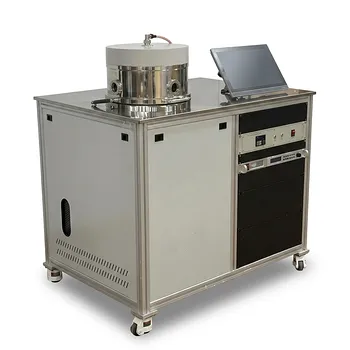
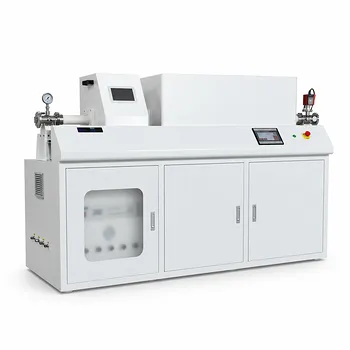
A vertical tube furnace functions as a high-precision thermal reactor used to activate and evaluate the catalytic efficiency of materials derived from electroplating sludge. By providing a strictly controlled atmosphere and programmed temperature ramps, it allows researchers to convert waste precursors into active metallic states and measure their effectiveness in degrading pollutants like NOx.
The vertical tube furnace is the primary tool for bridging the gap between raw waste material and a functional catalyst, providing the exact thermal and chemical conditions required to establish a catalyst's optimal operating window and long-term stability.
Facilitating Catalyst Activation and Pretreatment
Creating Active Metallic Sites
Before testing, electroplating sludge-derived catalysts often require a reduction activation process to become functional. The furnace maintains a consistent flow of reducing gases, such as an H2/He mixture, to transform metal precursors into an active state.
Controlling Heating Rates
The ability to program precise heating rates and isothermal holding times is critical during pretreatment. This ensures that the supported metals, such as Ru0, are distributed correctly across the carrier without sintering or losing surface area.
Establishing Chemical Readiness
By carefully managing the internal environment, the furnace ensures the catalyst has a sufficient density of active sites. This preparation is vital for subsequent reactions, including complex processes like plastic hydrocracking or gas-phase pollutant removal.
Quantifying Performance and Thermal Stability
Monitoring NOx Degradation in Real-Time
The vertical configuration allows for the steady flow of reactant gases through the catalyst bed to monitor NOx degradation rates. This setup provides a clear picture of how the catalyst performs under specific simulated industrial conditions.
Mapping the Temperature Window
Testing typically occurs across a wide thermal range, often spanning from 100 °C to 500 °C. By observing activity at each increment, researchers can identify the optimal reaction temperature window where the catalyst reaches its peak efficiency.
Assessing Upper Thermal Limits
The furnace is used to push the catalyst to its physical limits to determine thermal stability. Understanding the point at which the sludge-derived material begins to deactivate or degrade is essential for determining its viable lifespan in industrial applications.
Understanding the Trade-offs
Scale vs. Precision
While a tube furnace offers exceptional environmental control, the results are generated on a laboratory scale. The gas flow dynamics within a narrow tube may not perfectly replicate the turbulence found in large-scale industrial reactors.
Mass Transfer Limitations
In a fixed-bed tube furnace, the physical packing of the sludge-derived catalyst can lead to pressure drops or channeling. These factors can sometimes mask the true intrinsic activity of the catalyst if the bed is not prepared with high technical precision.
Thermal Gradients
Despite advanced controllers, slight thermal gradients can exist between the center of the catalyst bed and the tube wall. Researchers must calibrate the equipment carefully to ensure the recorded temperature reflects the actual kinetic environment of the reaction.
How to Apply This to Your Research Goal
To get the most accurate assessment of your electroplating sludge-derived catalysts, tailor your furnace parameters to your specific analytical objective.
- If your primary focus is catalyst synthesis: Prioritize the precise control of gas flow ratios (like H2/He) and slow heating ramps to ensure maximum dispersion of active metal sites.
- If your primary focus is operational efficiency: Conduct steady-state activity tests at 50 °C intervals between 100 °C and 500 °C to accurately map the light-off curve and peak performance zones.
- If your primary focus is durability testing: Utilize the furnace for extended isothermal runs at the upper limit of your temperature window to observe deactivation trends over time.
By systematically utilizing the vertical tube furnace for both activation and evaluation, you can transform industrial waste into a high-value environmental solution with proven performance metrics.
Summary Table:
| Process Stage | Key Parameters | Research Outcome |
|---|---|---|
| Catalyst Activation | Gas Flow (H2/He), Heating Rate | Creation of active metallic sites |
| Performance Testing | 100 °C - 500 °C Range | NOx degradation rate & peak efficiency |
| Stability Analysis | Isothermal Holding Time | Thermal limits & deactivation trends |
| Atmosphere Control | Reducing/Inert Gases | Prevents sintering & ensures dispersion |
Elevate Your Catalyst Research with KINTEK Precision
Transform industrial waste into high-value environmental solutions with KINTEK’s advanced vertical tube furnaces. Designed for high-precision thermal processing, our furnaces provide the exact atmospheric control and temperature stability required for catalyst activation and performance evaluation.
Why Choose KINTEK?
- Comprehensive Range: From tube and muffle furnaces to specialized vacuum, CVD, and induction melting systems.
- Fully Customizable: Tailored dimensions and atmosphere controls to meet your specific laboratory requirements.
- Proven Reliability: Engineered for long-term stability and uniform heating to ensure reproducible research results.
Ready to optimize your material testing? Contact our technical experts today to find the perfect high-temperature furnace for your laboratory!
References
- Ju Gao, Yufeng Zhang. Sludge Recycling from Non-Lime Purification of Electrolysis Wastewater: Bridge from Contaminant Removal to Waste-Derived NOX SCR Catalyst. DOI: 10.3390/catal14080535
This article is also based on technical information from Kintek Furnace Knowledge Base .
Related Products
- Vertical Laboratory Quartz Tube Furnace Tubular Furnace
- Custom Made Versatile CVD Tube Furnace Chemical Vapor Deposition CVD Equipment Machine
- Vacuum Sealed Continuous Working Rotary Tube Furnace Rotating Tube Furnace
- Slide PECVD Tube Furnace with Liquid Gasifier PECVD Machine
- Split Chamber CVD Tube Furnace with Vacuum Station CVD Machine
People Also Ask
- What are the key differences between single-zone and multi-zone vertical tube furnaces? Choose the Right Furnace for Your Lab
- Why is a vertical tube furnace preferred for quenching tests? Achieve Rapid, Repeatable Cooling for Accurate Results
- How does a vertical single-temperature zone tube furnace facilitate the growth of high-quality PdSe2 single crystals?
- How are wafers loaded and unloaded in a vertical tube furnace? Achieve Precision and Purity in Wafer Processing
- How do heat treatment processes influence the configuration of a vertical tube furnace? Optimize for Quenching, Annealing, and More