
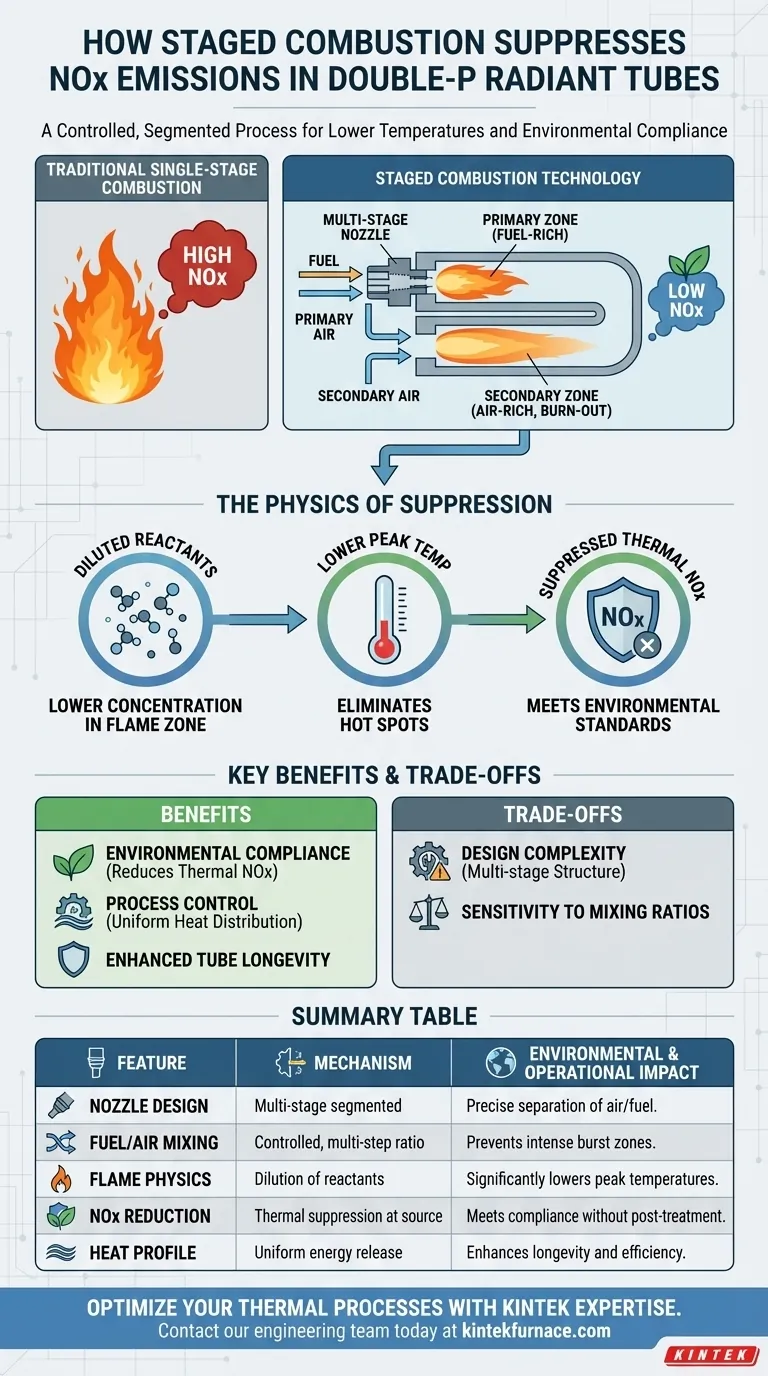
Staged combustion technology suppresses NOx emissions by implementing a controlled, segmented burning process within double-P radiant tubes. Instead of combusting fuel in a single, intense burst, this system utilizes a multi-stage nozzle to precisely manage the mixing ratios of fuel with both primary and secondary air.
By diluting the concentration of reactants in the flame zone, this technology lowers the maximum temperature at the flame's center, effectively removing the thermal conditions necessary for NOx formation.
The Mechanics of Segmented Combustion
To understand how this technology works, you must look at how it fundamentally changes the environment inside the radiant tube. It moves away from chaotic combustion toward a highly engineered, multi-step process.
The Multi-Stage Nozzle Structure
The heart of this system is the multi-stage nozzle. Unlike standard burners that mix air and fuel immediately, this component is designed to physically separate the introduction of combustion elements.
It allows for a segmented combustion process. This mechanical separation is critical for controlling exactly when and where the fuel interacts with the oxidizer.
Controlling Air and Fuel Ratios
The system distinguishes between primary and secondary air. By controlling the ratio of fuel mixed with these two distinct air streams, the burner dictates the pace of combustion.
This prevents the fuel from burning all at once. Instead, it creates a staged release of energy that is more manageable and thermally uniform.
The Physics of Suppression
The reduction of emissions is not a chemical filtration process, but a result of altering the physics of the flame itself.
Diluting Reactant Concentration
By staging the air entry, the system effectively dilutes the concentration of reactants in the critical flame zone.
When the concentration of fuel and oxygen is lower during the initial ignition phase, the combustion intensity is reduced. This prevents the immediate, violent reactions that characterize high-emission burners.
Lowering Peak Flame Temperatures
The primary driver of thermal NOx is heat. Specifically, it is the maximum temperature at the center of the flame that causes atmospheric nitrogen to oxidize.
Staged combustion mechanically lowers this peak temperature. by spreading the heat release over a larger area (or time), the system eliminates the "hot spots" responsible for the majority of NOx generation.
Understanding the Trade-offs
While staged combustion provides significant environmental benefits, it introduces specific engineering considerations that must be managed.
Complexity of Design
The reliance on a multi-stage nozzle structure implies a higher degree of mechanical complexity compared to single-stage burners. The hardware must be precisely engineered to maintain the correct separation of primary and secondary air.
Sensitivity to Mixing Ratios
The system's effectiveness relies entirely on the precise control of mixing ratios. If the balance between fuel, primary air, and secondary air drifts, the benefits of reactant dilution and temperature suppression can be lost.
Making the Right Choice for Your Goal
To determine if this technology aligns with your operational requirements, consider your specific constraints regarding emissions and thermal profile.
- If your primary focus is Environmental Compliance: This technology is ideal as it mechanically inhibits thermal NOx at the source, reducing the need for post-combustion treatment.
- If your primary focus is Process Control: The ability to lower peak flame temperatures offers a way to manage heat distribution more evenly within the radiant tube, protecting equipment longevity.
Staged combustion transforms the burner from a simple heat source into a precision instrument that manages flame chemistry to minimize environmental impact.
Summary Table:
| Feature | Staged Combustion Mechanism | Environmental & Operational Impact |
|---|---|---|
| Nozzle Design | Multi-stage segmented nozzle | Enables precise separation of primary and secondary air |
| Fuel/Air Mixing | Controlled, multi-step ratio management | Prevents intense, single-burst combustion zones |
| Flame Physics | Dilution of reactants in flame zone | Significantly lowers peak center temperatures |
| NOx Reduction | Thermal suppression at the source | Meets strict environmental compliance without post-treatment |
| Heat Profile | Uniform energy release | Enhances radiant tube longevity and thermal efficiency |
Optimize Your Thermal Processes with KINTEK Expertise
Are you looking to reduce emissions while maintaining peak thermal performance? Backed by expert R&D and manufacturing, KINTEK offers high-performance Muffle, Tube, Rotary, Vacuum, and CVD systems, along with customizable lab high-temp furnaces tailored to your unique specifications. Our advanced heating technologies ensure you meet environmental standards without sacrificing process control.
Ready to upgrade your lab or industrial furnace? Contact our engineering team today to discuss how our precision-engineered systems can enhance your operational efficiency.
Visual Guide
References
- Chien-Cheng Lin, Chien-Hsiung Tsai. Simulation of Staged Combustion Function in Double P-Type Radiant Tubes. DOI: 10.3390/engproc2025092094
This article is also based on technical information from Kintek Furnace Knowledge Base .
Related Products
- Magnesium Extraction and Purification Condensing Tube Furnace
- Split Multi Heating Zone Rotary Tube Furnace Rotating Tube Furnace
- Multi Heating Zones CVD Tube Furnace Machine for Chemical Vapor Deposition Equipment
- Multi Zone Laboratory Quartz Tube Furnace Tubular Furnace
People Also Ask
- What are the advantages of using a condensing tube furnace for magnesium extraction? Achieve High Purity and Efficient Metal Recovery
- Why is a tube furnace with nitrogen flow necessary for BaFe2-xCoxFe16O27 ceramics? Master Iron Valence Engineering
- Why is aluminum foil used during selenization and carbonization? Unlock Superior ZnSe Nanoparticle Synthesis
- How does a tube furnace contribute to the ammonia reduction annealing process for (NiZnMg)MoN catalysts? Optimize Phase Transitions
- How do tube furnaces contribute to transport reactions and crystal production? Master High-Purity Synthesis with Precision Control



