
High vacuum thermal evaporation equipment drives the Physical Vapor Deposition (PVD) stage by utilizing high-current heating to vaporize Cu2–Sn precursor powders directly onto glass substrates. This process occurs within a strictly controlled low-pressure environment, typically maintained at approximately 5.0 x 10⁻⁶ mbar.
The core function of this equipment is to eliminate atmospheric interference during the vapor transport phase. By sustaining a high vacuum, it prevents the oxidation of metal vapors, ensuring the deposited precursor layer remains dense, chemically pure, and oxide-free.
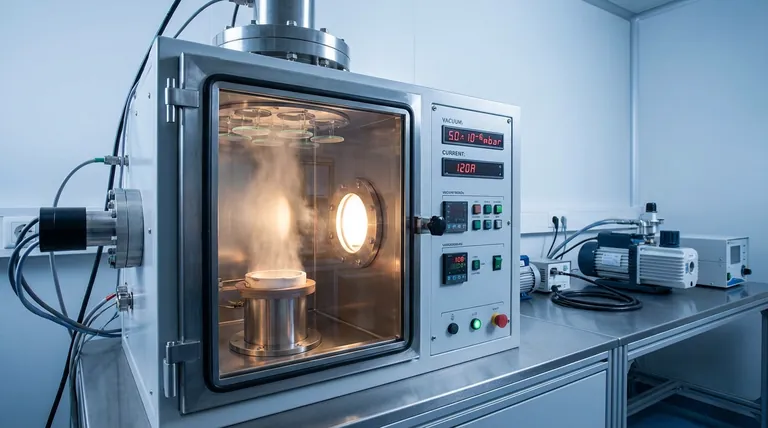
Creating the Ideal Deposition Environment
The Critical Role of Vacuum Pressure
For Cu2SnS3 (CTS) preparation, the equipment must achieve a base vacuum of roughly 5.0 x 10⁻⁶ mbar.
At atmospheric pressure, gas molecules are dense and collide frequently. By reducing the pressure to this high-vacuum level, the equipment significantly reduces the density of residual gas molecules inside the chamber.
Enhancing the Mean Free Path
The reduction in gas density increases the "mean free path" of the vaporized atoms.
This allows the Cu and Sn atoms to travel from the source to the substrate in a straight line without colliding with air molecules. This direct path minimizes scattering, ensuring that the material arrives at the substrate with its kinetic energy intact.
Preventing Chemical Oxidation
The primary threat to CTS thin film quality is the oxidation of the metallic precursors during transit.
Copper and Tin are reactive; if they interact with oxygen before hitting the substrate, the film's electrical and structural properties are compromised. The high vacuum environment effectively removes oxygen from the equation, guaranteeing that the deposited layer is composed strictly of the intended precursor metals.
Mechanism of Film Formation
High-Current Thermal Vaporization
The equipment uses high-current heating to thermally incite the source material.
This energy input converts the solid Cu2–Sn precursor powders into a vapor state. The precise control of this current allows for the regulation of the evaporation rate, which is critical for film consistency.
Ensuring Film Density and Purity
Because the vapor deposits without gas interference or oxidation, the resulting structure is highly dense.
A dense precursor layer provides a robust physical foundation for the final thin film. It ensures that subsequent processing steps (such as sulfurization) act upon a uniform, high-quality metallic base rather than a porous or contaminated one.
Understanding the Trade-offs
Line-of-Sight Limitations
Thermal evaporation is primarily a "line-of-sight" process.
While this ensures direct deposition, it can lead to shadowing effects if the substrate creates complex geometries or if the angle of incidence is not optimized. Uniformity relies heavily on the relative positioning of the source and the substrate.
Sensitivity to Vacuum fluctuations
The process is intolerant of vacuum leaks or pump instability.
Even a minor rise in pressure (loss of vacuum) introduces oxygen instantly. This can result in immediate impurity contamination, rendering the precursor layer unusable for high-performance semiconductor applications.
Making the Right Choice for Your Goal
To optimize the PVD stage for CTS thin films, prioritize the following based on your specific requirements:
- If your primary focus is Chemical Purity: Ensure your pumping system can reliably maintain a baseline pressure of 5.0 x 10⁻⁶ mbar or lower to strictly prohibit oxidation.
- If your primary focus is Film Density: Focus on the stability of the high-current heating source to maintain a consistent evaporation rate, which promotes a packed, non-porous structure.
Success in CTS preparation relies not just on heating the material, but on aggressively clearing the path for it to travel.
Summary Table:
| Key Feature | Impact on CTS Thin Film Preparation |
|---|---|
| Vacuum Level (5.0 x 10⁻⁶ mbar) | Prevents oxidation and ensures chemical purity of Cu and Sn precursors. |
| High-Current Heating | Regulates evaporation rates for consistent film thickness and density. |
| Increased Mean Free Path | Enables line-of-sight travel to prevent scattering and energy loss. |
| Atmospheric Control | Eliminates interference from residual gas molecules for a non-porous structure. |
Elevate Your Thin Film Research with KINTEK
Precise control over vacuum environments and thermal evaporation rates is essential for high-performance Cu2SnS3 (CTS) semiconductors. Backed by expert R&D and manufacturing, KINTEK offers specialized Muffle, Tube, Rotary, Vacuum, and CVD systems, alongside customizable high-temperature lab furnaces designed to meet your unique thin film preparation needs.
Ensure maximum purity and density for your next project. Contact our technical experts today to find the perfect thermal processing solution for your laboratory.
References
- Tanguy Bernard, Paolo Scardi. Environmentally friendly p-type CTS-based thin-film thermoelectric generator. DOI: 10.1007/s10853-024-10104-w
This article is also based on technical information from Kintek Furnace Knowledge Base .
Related Products
- Molybdenum Vacuum Heat Treat Furnace
- 2200 ℃ Tungsten Vacuum Heat Treat and Sintering Furnace
- 2200 ℃ Graphite Vacuum Heat Treat Furnace
- Vacuum Heat Treat Sintering Furnace Molybdenum Wire Vacuum Sintering Furnace
- Vacuum Hot Press Furnace Machine for Lamination and Heating
People Also Ask
- How does vacuum heat treating work in terms of temperature and time control? Master Precise Material Transformations
- What is the primary application of vacuum heat treating furnaces in aerospace? Enhance Component Performance with Precision
- Why are vacuum heat treating furnaces essential for aerospace? Ensure Superior Material Integrity for High-Stakes Applications
- What is the process of vacuum heat treating? Achieve Superior Metallurgical Properties
- How does a vacuum heat treating furnace improve the condition of metal alloys? Achieve Superior Metal Performance



















