
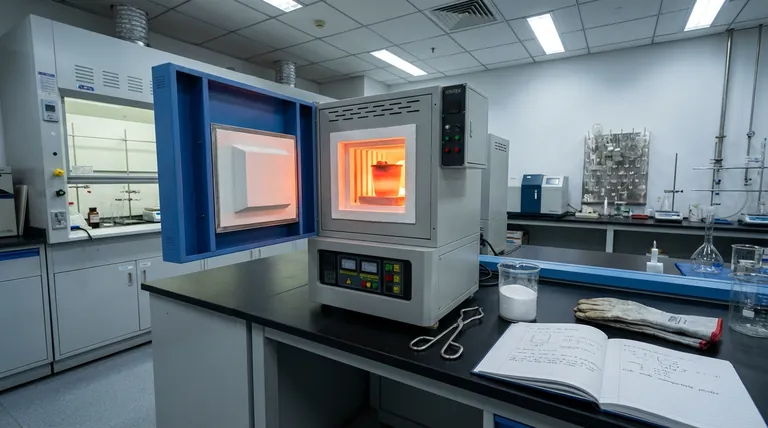
High-temperature calcination acts as the definitive processing step that converts raw chemical precipitates into stable, functional oxide nanoparticles. By providing a strictly controlled thermal environment—typically ranging from 300°C to 900°C—a muffle furnace drives thermal decomposition to strip away volatile components and force the remaining atoms into a specific, crystalline lattice structure.
The muffle furnace provides the precise thermal energy required to decompose precursor materials and thoroughly oxidize organic impurities. This process facilitates atomic rearrangement, converting unstable precipitates into highly crystalline, phase-pure metal oxides with defined structural properties.
The Mechanics of Thermal Decomposition
Removing Volatile Components
The primary function of the muffle furnace is to facilitate thermal decomposition. As the temperature rises, the furnace effectively drives off volatile byproducts inherent in the precipitate.
This includes the removal of moisture, carbon dioxide, and residual solvents. By eliminating these non-essential components, the process isolates the target metal atoms, setting the stage for oxide formation.
Eliminating Organic Impurities
Beyond simple volatiles, high-temperature air environments are critical for burning off complex organic residues. This often includes surfactants, ligands, or dried gel precursors that were used during the synthesis phase.
Extended heating, sometimes lasting up to 24 hours, ensures that organic contaminants like oleylamine or nitrates are completely oxidized. This step is non-negotiable for achieving high-purity final powders.
Driving Chemical Oxidation
The furnace environment supports oxidation-reduction reactions essential for certain materials. By exposing the precipitate to heat in an air atmosphere, the furnace converts intermediate products—such as hydroxides or salts—into stable oxides.
For example, this mechanism transforms copper hydroxide precursors into stable monoclinic copper oxide nanoparticles.
Crystallization and Phase Transformation
Atomic Rearrangement
Once impurities are removed, the thermal energy forces the remaining atoms to rearrange. This is the moment where the material transitions from an amorphous or intermediate state into a defined crystal structure.
This rearrangement is central to achieving specific phases, such as the face-centered cubic structure often sought in nickel oxide production.
Stabilizing the Crystal Phase
The uniform thermal field of a muffle furnace ensures that the phase transformation is complete and consistent throughout the sample. This prevents the formation of mixed phases that could degrade the material's performance.
Proper calcination yields chemically stable structures, such as cubic-phase cobalt oxide or wurtzite zinc oxide, which are necessary for catalytic or electronic applications.
Understanding the Trade-offs
Temperature vs. Grain Size
While high temperatures improve crystallinity and purity, they also promote grain growth. If the temperature is too high, nanoparticles may sinter together, increasing their size and reducing their active surface area.
Duration vs. Defects
Extended calcination times ensure the complete removal of impurities but can lead to a reduction in surface defects. While this improves structural stability, some applications actually require surface defects for catalytic activity, making the duration a critical variable to balance.
Making the Right Choice for Your Goal
To optimize your nanoparticle synthesis, you must tune the furnace parameters to your specific performance metrics:
- If your primary focus is high purity: Select higher temperatures (e.g., 900°C) or longer durations to fully decompose stubborn organic surfactants and stabilize the oxide phase.
- If your primary focus is small particle size: Utilize the lowest effective temperature (e.g., 300°C - 450°C) that still achieves decomposition to minimize grain growth and sintering.
- If your primary focus is specific catalytic properties: Precisely control the temperature window to balance the degree of crystallinity with the retention of necessary surface defects.
By manipulating the thermal profile of the muffle furnace, you dictate the final purity, size, and phase of your nanomaterials.
Summary Table:
| Process Phase | Primary Action | Resulting Impact |
|---|---|---|
| Thermal Decomposition | Removal of volatiles and solvents | Isolation of target metal atoms |
| Oxidization | Elimination of organic residues/ligands | High-purity final powders |
| Phase Transformation | Atomic rearrangement into lattice structures | Formation of crystalline metal oxides |
| Grain Growth Control | Tuning temperature (300°C - 900°C) | Balancing purity vs. nanoparticle size |
Elevate Your Nanomaterial Synthesis with KINTEK
Achieving the perfect balance between crystallinity and particle size requires unmatched thermal precision. Backed by expert R&D and manufacturing, KINTEK offers high-performance Muffle, Tube, Rotary, Vacuum, and CVD systems designed for the rigorous demands of calcination and material science.
Whether you are synthesizing catalytic metal oxides or advanced ceramics, our customizable high-temperature furnaces provide the uniform heating and atmospheric control necessary for your unique research goals.
Ready to optimize your nanoparticle production? Contact KINTEK today to find your custom furnace solution!
References
- Zahraa H. Athab, Nadhir Al‐Ansari. Comparison activity of pure and chromium-doped nickel oxide nanoparticles for the selective removal of dyes from water. DOI: 10.1038/s41598-024-53490-6
This article is also based on technical information from Kintek Furnace Knowledge Base .
Related Products
- 1700℃ High Temperature Muffle Oven Furnace for Laboratory
- 1800℃ High Temperature Muffle Oven Furnace for Laboratory
- 1200℃ Muffle Oven Furnace for Laboratory
- 1400℃ Muffle Oven Furnace for Laboratory
- High Temperature Muffle Oven Furnace for Laboratory Debinding and Pre Sintering
People Also Ask
- What is the primary function of a high-temperature laboratory muffle furnace in chemical synthesis? Achieve Precision.
- How does a high-temperature laboratory muffle furnace affect material properties? Transform Anodic Oxide Films Fast
- What role does a muffle furnace play in BCZY712 electrolyte powder production? Achieve Perfect Phase Purity
- How does the two-stage sintering process contribute to the synthesis of MeCuFeO3 perovskite? Optimize crystal purity.
- What is the role of a high-temperature muffle furnace in guava leaf carbonization? Master Precise Pyrolysis Control



















