
In short, uniform heating is critical in a muffle furnace because it guarantees that every part of your material receives the exact same thermal treatment. This consistency is the foundation of reliable, repeatable, and accurate results, whether you are conducting a sensitive laboratory experiment or running a large-scale industrial process.
Uniform heating is not merely a feature; it is the core principle that ensures the integrity of your work. Without it, localized hot or cold spots can compromise your sample, leading to incomplete reactions, skewed analytical data, or flawed industrial parts.
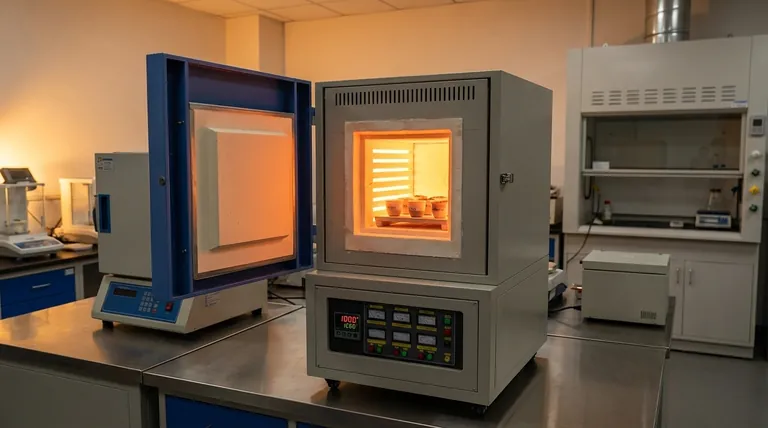
How a Muffle Furnace Achieves Uniform Heating
A muffle furnace's design is intentionally engineered to create an even temperature environment. This is accomplished through a combination of indirect heating and strategic component placement.
The Principle of Indirect Heating
The material you are heating is placed inside a sealed chamber, known as the muffle. This chamber isolates your sample from direct contact with the heating elements or any combustion byproducts.
This separation is the furnace's defining characteristic and is essential for preventing contamination and hot spots that would occur from direct exposure to a heat source.
Strategic Placement of Heating Elements
The heating elements, typically made of high-resistance materials like Kanthal or nichrome, are embedded within the furnace's insulated walls, surrounding the muffle chamber.
When electricity passes through these elements, they generate intense heat. Because they are positioned around the chamber, they radiate heat inward from multiple directions.
The Role of Radiant Heat and Insulation
This radiated energy heats the walls of the muffle chamber, which then transfers the heat uniformly to the air and the sample inside. This radiant heating method ensures the material is heated evenly from all sides.
High-quality insulation contains this energy, minimizing heat loss and helping the entire chamber stabilize at the target temperature set by the controller.
The Critical Impact of Uniformity on Results
Temperature variance of even a few degrees can have a significant impact on outcomes. Uniform heating is what separates a successful process from a failed one.
For Scientific and Analytical Work
In applications like ashing, gravimetric analysis, or materials testing, the entire sample must reach and hold a specific temperature for a set duration.
If part of the sample is cooler, the chemical reaction or physical change may be incomplete. This leads to inaccurate measurements and invalid experimental data.
For Industrial Materials Processing
In processes like annealing, hardening, or tempering metals, uniform temperature is paramount for structural integrity.
An unevenly heated part can develop internal stresses, weak spots, or warping. This can result in premature component failure, compromising product quality and safety.
For Consistency and Quality Control
Uniform heating ensures that a process is repeatable. You can be confident that the batch you run today will have the same properties as the batch you run tomorrow. This is the cornerstone of any effective quality control system.
Understanding the Trade-offs and Limitations
While modern muffle furnaces are designed for uniformity, perfect heat distribution is an ideal that can be affected by design, cost, and use.
Furnace Quality and Design
The degree of temperature uniformity varies between models. High-end furnaces often feature more advanced insulation, better-calibrated controllers, and more strategic placement of heating elements to minimize temperature gradients. Less expensive models may present a greater risk of hot or cold zones.
The Impact of Sample Loading
How you load the furnace matters. Overloading the chamber or placing a single, large, dense object inside can obstruct airflow and heat radiation, creating cold spots and undermining the furnace's inherent uniformity.
Proper loading technique, allowing for air circulation around the sample, is crucial for achieving the best results.
Making the Right Choice for Your Goal
To ensure success, match your furnace's capabilities and your operational procedure to your primary objective.
- If your primary focus is analytical precision (e.g., ashing, trace element analysis): Uniformity is non-negotiable; verify the furnace's temperature uniformity specifications and never overload the chamber.
- If your primary focus is materials treatment (e.g., annealing, tempering): Uniform heating directly determines the final product's structural quality, so invest in a furnace known for its robust design and temperature stability.
- If your primary focus is general-purpose heating or drying: While still important, minor temperature variances may be acceptable, but always be mindful of how sample placement can impact evenness.
Ultimately, understanding and controlling for uniform heating is the key to mastering your thermal processing application.
Summary Table:
| Aspect | Impact of Uniform Heating |
|---|---|
| Scientific Analysis | Prevents incomplete reactions and skewed data in ashing, gravimetric analysis, and materials testing. |
| Industrial Processing | Avoids internal stresses, warping, and weak spots in annealing, hardening, and tempering of metals. |
| Quality Control | Ensures repeatable results and consistent batch properties for reliable outcomes. |
| Furnace Design | Achieved through indirect heating, strategic element placement, radiant heat, and insulation for even temperature distribution. |
Unlock Precision in Your Thermal Processes with KINTEK!
Are you striving for flawless, repeatable results in your laboratory or industrial applications? Uniform heating is key, and KINTEK delivers exactly that. Leveraging exceptional R&D and in-house manufacturing, we provide diverse laboratories with advanced high-temperature furnace solutions. Our product line—including Muffle, Tube, Rotary Furnaces, Vacuum & Atmosphere Furnaces, and CVD/PECVD Systems—is designed for superior performance and backed by strong deep customization capabilities to precisely meet your unique experimental requirements.
Don't let temperature inconsistencies compromise your work. Contact us today to discuss how our tailored furnace solutions can enhance your efficiency, accuracy, and overall success!
Visual Guide

Related Products
- 1400℃ Muffle Oven Furnace for Laboratory
- 1700℃ High Temperature Muffle Oven Furnace for Laboratory
- 1800℃ High Temperature Muffle Oven Furnace for Laboratory
- 1200℃ Muffle Oven Furnace for Laboratory
- High Temperature Muffle Oven Furnace for Laboratory Debinding and Pre Sintering
People Also Ask
- What is the primary function of a high-temperature laboratory muffle furnace in chemical synthesis? Achieve Precision.
- How does a high-temperature laboratory muffle furnace affect material properties? Transform Anodic Oxide Films Fast
- What is the function of a muffle furnace in MOF-derived zirconia conversion? Optimize Phase & Pore Engineering
- How is a laboratory high-temperature muffle furnace utilized to achieve the specific crystalline structure of LaFeO3 catalysts?
- How does a muffle furnace facilitate Ag/ATP catalyst preparation? Optimize Calcination for Superior Performance



















