
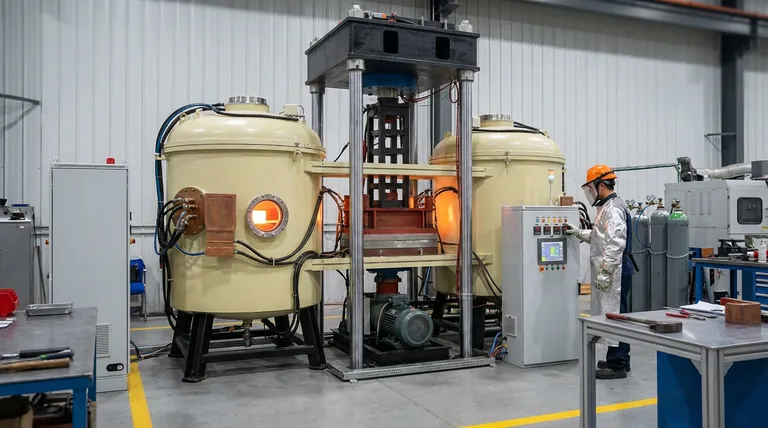
Industrial high-temperature heat treatment furnaces ensure material performance by creating a stable, uniform thermal field that forces the chemical equalization of the steel matrix. By subjecting billets to long-duration soaking at temperatures often exceeding 1200°C, these furnaces provide the necessary kinetic energy for alloying elements to diffuse fully, eliminating the inconsistencies inherent in the casting process.
The furnace acts as a thermodynamic reset button. It utilizes precise temperature control and extended soak times to dissolve unstable precipitates and erase compositional segregation, ensuring the steel's final properties are defined by its intended chemistry rather than its casting history.
The Mechanics of Homogenization
Eliminating Compositional Segregation
Raw steel billets often suffer from segregation, where chemical elements clump together unevenly during the initial cooling of continuous casting or forging.
The furnace counteracts this by maintaining a uniform thermal field at high temperatures, such as 1200°C.
This environment forces the unevenly distributed elements to migrate from areas of high concentration to low concentration, effectively leveling the chemical composition across the entire cross-section.
Maximizing Elemental Diffusion
For experimental grades, simply reaching temperature is not enough; the material must be held there to allow for diffusion within the austenite matrix.
Furnaces are programmed for long-duration soaking, typically ranging from 5 to 15 hours depending on the alloy complexity.
This extended exposure ensures that alloying elements are fully dissolved into the matrix, setting the stage for a uniform microstructure during subsequent cooling or phase transformations.
Advanced Control for Complex Alloys
Dissolving Stubborn Precipitates
High-performance steels, such as H13, often contain complex carbonitrides that are difficult to break down.
The furnace provides the specific kinetic conditions required to dissolve unstable vanadium-rich carbonitrides.
Simultaneously, the sustained heat at temperatures like 1250°C drives the morphological evolution and decomposition of tougher titanium-rich carbonitrides, preventing brittle spots in the final product.
Protecting Surface Integrity
At these extreme temperatures, steel is highly susceptible to reacting with oxygen, leading to scale and carbon loss.
To prevent this, advanced furnaces often utilize a low-flow argon atmosphere.
This inert environment effectively prevents oxidation and decarburization, ensuring the surface chemistry of alloys (like Fe60) remains pure throughout the recrystallization process.
Understanding the Trade-offs
Balancing Diffusion against Grain Growth
While extended soaking is necessary for homogenization, excessive time at high temperatures can lead to grain coarsening.
If the grains grow too large, the material's toughness and yield strength may be compromised, even if the chemistry is chemically uniform.
Energy Consumption and Efficiency
Operating at temperatures above 1200°C for up to 15 hours represents a significant energy investment.
Operators must calculate the minimum soak time required to achieve homogenization to avoid unnecessary energy waste and equipment wear.
Making the Right Choice for Your Goal
To optimize the homogenization process for your specific experimental steel grade:
- If your primary focus is microstructural uniformity: Prioritize extended soaking times (5–15 hours) at temperatures above 1200°C to ensure the dissolution of complex carbonitrides.
- If your primary focus is surface quality and chemistry: Ensure your furnace utilizes a protective atmosphere (such as argon) to prevent oxidation and decarburization during the heating cycle.
True material performance is achieved not just by reaching a target temperature, but by precisely controlling the time and atmosphere in which the steel resides.
Summary Table:
| Feature | Function in Homogenization | Key Benefit |
|---|---|---|
| High-Temp Soaking | Provides kinetic energy for elemental diffusion | Eliminates chemical segregation |
| Precise Thermal Control | Maintains uniform field (e.g., 1200°C+) | Consistent microstructure across billets |
| Atmosphere Control | Uses low-flow Argon/Inert gas | Prevents oxidation and decarburization |
| Extended Soak Times | 5 to 15 hours of sustained heating | Dissolves stubborn carbonitride precipitates |
Elevate Your Material Research with KINTEK
Precise homogenization is the difference between experimental success and material failure. Backed by expert R&D and manufacturing, KINTEK offers high-performance Muffle, Tube, Rotary, Vacuum, and CVD systems, as well as other lab high-temperature furnaces—all fully customizable to meet your unique metallurgical needs.
Our advanced thermal solutions provide the stable environments and atmosphere controls necessary to optimize diffusion while protecting surface integrity. Contact us today to discuss how our customized furnace technology can enhance your lab's heat treatment precision and efficiency.
References
- Impact Toughness and Fatigue Crack Propagation in Carbide‐Free Bainite: The Adverse Role of Retained Austenite and Martensite‐Austenite Islands. DOI: 10.1111/ffe.70025
This article is also based on technical information from Kintek Furnace Knowledge Base .
Related Products
- 2200 ℃ Graphite Vacuum Heat Treat Furnace
- 2200 ℃ Tungsten Vacuum Heat Treat and Sintering Furnace
- Molybdenum Vacuum Heat Treat Furnace
- 1400℃ High Temperature Laboratory Tube Furnace with Alumina Tube
- 1700℃ High Temperature Laboratory Tube Furnace with Alumina Tube
People Also Ask
- Why are vacuum heat treating furnaces essential for aerospace? Ensure Superior Material Integrity for High-Stakes Applications
- What is the primary application of vacuum heat treating furnaces in aerospace? Enhance Component Performance with Precision
- How does vacuum heat treating work in terms of temperature and time control? Master Precise Material Transformations
- How does a vacuum heat treating furnace improve the condition of metal alloys? Achieve Superior Metal Performance
- What is the process of vacuum heat treating? Achieve Superior Metallurgical Properties



















