
In the field of environmental science, a laboratory tube furnace is a specialized high-temperature oven used for two primary purposes: simulating industrial processes like incineration to analyze pollutants, and testing the heat and corrosion resistance of materials to see how they hold up in extreme environments. Its value comes from its ability to create a precisely controlled environment for repeatable experiments.
A tube furnace's core contribution is providing a miniature, highly controlled environment that replicates extreme conditions. This allows scientists to safely study pollutant behavior and material stability in a way that generates the reliable, repeatable data essential for environmental protection and innovation.
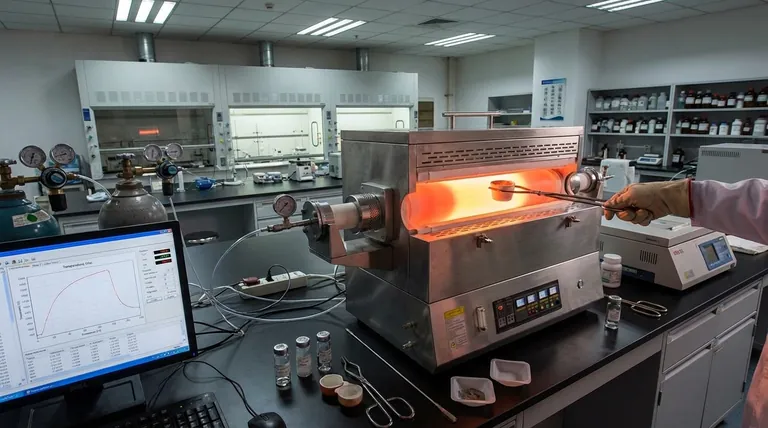
The Core Function: Creating Controlled Environments
A laboratory tube furnace is more than just a simple oven. Its design is centered on creating a highly specific and uniform experimental environment, which is critical for scientific validity.
High-Temperature Simulation
The most basic function is achieving and maintaining extremely high temperatures, often exceeding 1000°C. This allows researchers to mimic conditions found inside industrial incinerators, power plants, or even geological formations.
Atmospheric Control
A sealed tube, typically made of quartz or ceramic, runs through the center of the furnace. This tube isolates the sample from the outside air, enabling scientists to introduce specific gases and create a controlled atmosphere. This could be an inert atmosphere (like nitrogen or argon) to prevent oxidation, or a reactive one to simulate specific chemical processes.
Precision and Uniformity
The heating elements are designed to distribute heat evenly along the length of the tube. This temperature uniformity ensures that the entire sample experiences the same conditions, eliminating variables and leading to more consistent and trustworthy results.
Key Applications in Environmental Science
The ability to control temperature and atmosphere makes the tube furnace an indispensable tool for tackling specific environmental challenges.
Analyzing Pollutant Behavior
By heating waste materials or chemical compounds in a controlled atmosphere, scientists can study how pollutants are formed or destroyed. This is crucial for optimizing incineration processes to minimize the release of toxic emissions like dioxins or heavy metals.
Testing Material Stability
Environmental solutions often require materials that can withstand harsh conditions for long periods. A tube furnace can test the high-temperature and corrosion resistance of new alloys for geothermal energy plants or advanced ceramics intended for encapsulating nuclear waste, ensuring their long-term safety and stability.
Understanding the Trade-offs and Limitations
While powerful, a laboratory tube furnace is a specialized tool with inherent limitations that are important to recognize.
Sample Size Constraints
These furnaces are designed for small, laboratory-scale samples. The results are excellent for analysis and research but do not replicate the sheer volume or complex fluid dynamics of a full-scale industrial facility.
Batch Processing, Not Continuous
Experiments are run one batch at a time. This is ideal for careful analysis but is a fundamentally different workflow from a continuous industrial process, which can impact how some chemical reactions unfold.
Simplified Environments
While atmospheric control is a key feature, it's still a simplified version of reality. A real-world environment, like a wildfire or an industrial smokestack, has dynamic, fluctuating conditions that can be difficult to perfectly replicate in a sealed tube.
Making the Right Choice for Your Research
Your specific research goal will determine how you leverage the capabilities of a tube furnace.
- If your primary focus is pollutant analysis: Use its ability to simulate combustion and thermal decomposition in a controlled atmosphere to understand how toxic compounds form and break down.
- If your primary focus is materials science for environmental applications: Use its precise temperature control to test the durability and corrosion resistance of materials, predicting their long-term stability in extreme settings.
Ultimately, the laboratory tube furnace serves as a critical bridge between theoretical modeling and real-world environmental phenomena.
Summary Table:
| Aspect | Contribution |
|---|---|
| High-Temperature Simulation | Mimics industrial processes like incineration for pollutant study. |
| Atmospheric Control | Allows inert or reactive gas environments to prevent oxidation or simulate reactions. |
| Precision and Uniformity | Ensures even heat distribution for reliable, repeatable experimental data. |
| Pollutant Analysis | Helps optimize incineration to reduce toxic emissions such as dioxins. |
| Material Stability Testing | Assesses heat and corrosion resistance for applications like geothermal energy. |
Elevate your environmental research with KINTEK's advanced high-temperature furnace solutions! Leveraging exceptional R&D and in-house manufacturing, we provide diverse laboratories with precise tools like Tube Furnaces, Muffle Furnaces, Rotary Furnaces, Vacuum & Atmosphere Furnaces, and CVD/PECVD Systems. Our strong deep customization capability ensures we can tailor solutions to your unique experimental needs, helping you achieve reliable data for pollutant analysis and material testing. Contact us today to discuss how we can support your environmental science projects!
Visual Guide

Related Products
- 1400℃ High Temperature Laboratory Tube Furnace with Alumina Tube
- Laboratory Quartz Tube Furnace RTP Heating Tubular Furnace
- Laboratory Vacuum Tilt Rotary Tube Furnace Rotating Tube Furnace
- 1700℃ High Temperature Laboratory Tube Furnace with Alumina Tube
- Vertical Laboratory Quartz Tube Furnace Tubular Furnace
People Also Ask
- How do high-temperature laboratory tube furnaces ensure environmental stability? Precision Thermal Reduction Tips
- How are high-temperature laboratory tube furnaces applied in long-term vacuum homogenization heat treatments for intermetallic samples?
- How are high-temperature tube furnaces applied in testing ceramic-supported alloy membranes? Insights
- What is the mechanism of a high-temperature furnace in Bi-2223 sintering? Achieve Precision Phase Transformation
- How does a laboratory high-temperature tube furnace contribute to the conversion of electrospun fibers? Expert Insights



















