
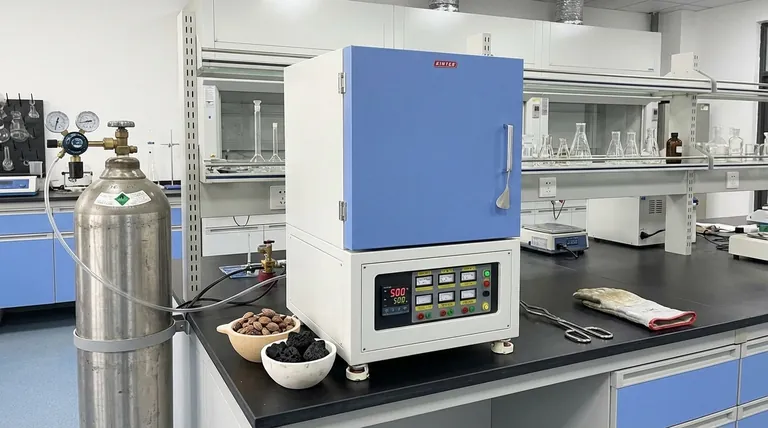
A laboratory muffle furnace facilitates plum stone pyrolysis by providing a strictly controlled, oxygen-free thermal environment that triggers the decomposition of organic polymers. By regulating precise temperature ramping and isothermal holding times, the furnace drives the discharge of volatile compounds and the reorganization of the carbon skeleton. This process transforms the raw biomass into a stable, porous biochar characterized by high aromaticity and increased carbon content.
The muffle furnace serves as a precision reactor that enables slow pyrolysis by maintaining high temperatures (typically 500°C) under an inert atmosphere. This specific environment prevents combustion while maximizing the development of the biochar’s internal pore structure and adsorption capacity.
Thermal Regulation: The Catalyst for Decomposition
Driving Polymer Breakdown
The furnace provides the high-temperature environment (typically 500 °C to 800 °C) necessary to break the molecular bonds of cellulose, hemicellulose, and lignin. As these components decompose, the furnace facilitates the removal of moisture and organic volatiles from the plum stone.
Precision Heating and Ramping
A muffle furnace supports programmed temperature ramping, often at rates like 10 °C min⁻¹. This gradual increase is critical for ensuring uniform heat distribution throughout the biomass, preventing "cold spots" that could lead to incomplete carbonization.
Isothermal Holding and Residence Time
Once the target peak temperature is reached, the furnace maintains a constant residence time (e.g., 1 hour). This stable holding period allows for the complete reorganization of the carbon skeleton, ensuring the resulting biochar reaches its intended level of stability and crystallinity.
Atmospheric Control: Preventing Oxidative Combustion
Establishing an Anaerobic Environment
A critical function of the furnace system is the introduction of a continuous flow of nitrogen gas. This process purges oxygen from the chamber, creating an inert or anaerobic atmosphere that is essential for pyrolysis.
Preventing Direct Combustion
Without this oxygen-limited environment, the plum stones would undergo oxidative combustion (burning) rather than pyrolysis. The muffle furnace ensures the material is "baked" in a sealed environment, maximizing carbon retention instead of turning the biomass into ash.
Regulating Surface Chemistry
The controlled atmosphere also manages the density of surface functional groups. By excluding oxygen, the furnace prevents unwanted oxidation, allowing for the precise tuning of the biochar's chemical properties for specific adsorption tasks.
Structural Evolution: Optimizing Porosity and Surface Area
Pore Structure Development
As volatiles are discharged, the furnace’s heat creates a well-developed pore structure within the plum stone. This transition from a dense organic material to a highly porous biochar is what gives the final product its adsorption capabilities.
Carbon Skeleton Reorganization
High temperatures (specifically around 600 °C) provide the energy needed to increase the crystallinity of the carbon. This reorganization transforms the biomass into a material with high aromaticity, making it chemically stable and resistant to degradation.
Deep Modification Potentials
In specialized setups, the furnace environment allows for the use of agents like zinc chloride (ZnCl₂). Under high heat, these agents act as dehydrating catalysts that etch the carbon skeleton, significantly increasing the specific surface area and introducing nanoparticles for enhanced performance.
Understanding the Trade-offs and Pitfalls
The Risk of Overheating
While higher temperatures generally increase surface area, excessive heat (beyond 900 °C) can cause the carbon skeleton to crack or collapse. This structural failure reduces the quality of the biochar and degrades its adsorption activity.
Heating Rate Sensitivity
If the heating rate is too fast, the rapid discharge of volatiles can create internal pressure that ruptures the pores. Conversely, a rate that is too slow may lead to lower yields of certain functional groups, requiring a balanced thermal strategy tailored to the plum stone's density.
Oxygen Leaks and Contamination
Even a minor leak in the furnace seal or a failure in the nitrogen flow can introduce oxygen. This results in partial combustion, which lowers the fixed carbon content and produces biochar with inconsistent chemical properties.
How to Apply This to Your Biochar Production
To achieve the best results when using a muffle furnace for plum stone biochar, align your settings with your specific material goals.
- If your primary focus is maximizing surface area and lead adsorption: Target a pyrolysis temperature of 600 °C with a steady nitrogen flow to ensure a highly developed microporous structure.
- If your primary focus is increasing fixed carbon content: Utilize a slow carbonization approach between 300 °C and 400 °C to break molecular bonds while minimizing the loss of solid mass.
- If your primary focus is deep chemical modification: Introduce catalytic agents like ZnCl₂ during the heating phase to etch the carbon and improve specific surface area through dehydration.
By mastering the furnace's temperature and atmospheric controls, you can precisely engineer the physical and chemical architecture of plum stone biochar for any technical application.
Summary Table:
| Pyrolysis Stage | Temperature Range | Process Outcome |
|---|---|---|
| Polymer Breakdown | 500°C - 800°C | Decomposes cellulose, hemicellulose, and lignin |
| Carbonization | 300°C - 400°C | Maximizes solid mass and fixed carbon content |
| Structural Optimization | 600°C | Develops high porosity and surface area for adsorption |
| Advanced Modification | Variable | Chemical etching (e.g., ZnCl₂) to enhance reactivity |
Elevate Your Biochar Research with KINTEK
Precision is the key to engineering high-performance biochar. Backed by expert R&D and world-class manufacturing, KINTEK provides high-temp Muffle, Tube, Rotary, Vacuum, and CVD systems designed to meet the rigorous demands of laboratory pyrolysis. Our customizable solutions ensure uniform heating and perfect atmospheric control for your unique biomass applications.
Ready to optimize your carbonization process? Contact us today to find the perfect furnace for your lab!
References
- Zorica Lopičić, Jelena Avdalović. Efficient Removal of Water Soluble Fraction of Diesel Oil by Biochar Sorption Supported by Microbiological Degradation. DOI: 10.3390/pr12050964
This article is also based on technical information from Kintek Furnace Knowledge Base .
Related Products
- Laboratory Muffle Oven Furnace with Bottom Lifting
- 1400℃ Muffle Oven Furnace for Laboratory
- 1800℃ High Temperature Muffle Oven Furnace for Laboratory
- 1700℃ High Temperature Muffle Oven Furnace for Laboratory
- 1200℃ Muffle Oven Furnace for Laboratory
People Also Ask
- Why is a high-temperature muffle furnace required for FeOx-MOx/TiO2? Engineering High-Performance Nanocomposites
- What is the importance of the calcination process? Master High-Purity Calcium Phosphate Nanopowder Production
- What function does a muffle furnace perform in Ba0.75Ca0.25TiO3 calcination? Ensure Phase Purity & Synthesis
- Why is a high-temperature laboratory muffle furnace essential for the alkali fusion process in zeolite synthesis?
- What are the primary functions of a high-temperature laboratory muffle furnace in the preparation of biosorbent materials?



















