
A high-temperature sintering furnace ensures structural integrity through the execution of a precise, programmable temperature control curve designed to manage internal material stress. By utilizing a slow heating rate of 1.3 °C per minute, the system gently expels organic binders before the material softens, effectively preventing structural cracking caused by the violent release of gases.
The core mechanism involves decoupling the binder removal phase from the sintering phase through strict thermal management. By ensuring organic materials are fully evacuated below the glass transition temperature, the furnace produces a dense, transparent solid with porosity as low as 0.27%.
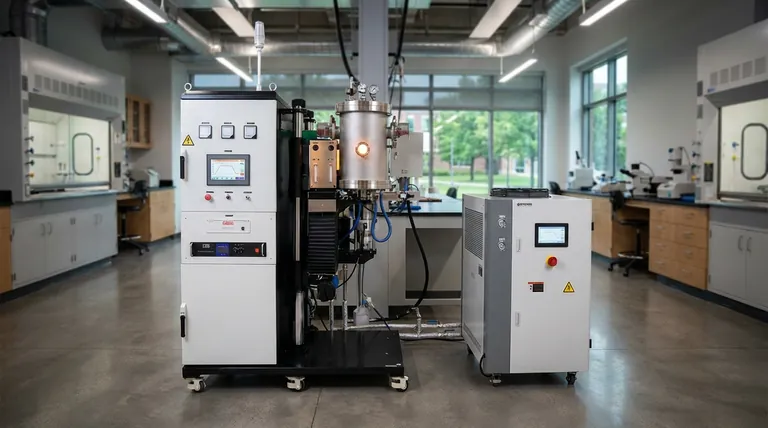
The Mechanics of Defect Prevention
To understand how the furnace protects the glass structure, one must look at the two distinct phases of the thermal cycle.
Controlled Binder Removal
The primary threat to structural integrity during post-processing is the rapid expansion of gases.
The furnace mitigates this by applying a slow heating rate (specifically 1.3 °C per minute). This gradual increase allows organic binders to decompose and exit the structure gently rather than explosively.
The Critical Temperature Range
Crucially, this binder removal process is programmed to occur below the glass transition temperature.
If the glass were to soften and seal the surface while binders were still decomposing inside, trapped gases would shatter the structure. By keeping the material rigid during outgassing, the furnace maintains the object's shape and internal cohesion.
Achieving Density and Transparency
Once the structure is free of organic contaminants, the focus shifts from preservation to consolidation.
Uniform Thermal Fields
The furnace generates a highly uniform thermal field throughout the heating chamber.
This consistency ensures that every part of the glass structure reaches the same temperature simultaneously, preventing warping or internal stress caused by uneven heating.
Viscous Flow Sintering
At high temperatures, the furnace promotes viscous flow sintering.
This process causes the glass particles to soften and flow into one another, eliminating voids between particles.
Minimizing Porosity
The result of this controlled fusion is a significant reduction in porosity.
The final structure achieves a dense, transparent state with a porosity of approximately 0.27%, indicating a nearly solid, defect-free material.
Understanding the Trade-offs
While this process is essential for quality, it presents specific operational constraints.
Time vs. Integrity
The necessity of a 1.3 °C per minute heating rate dictates a significantly longer processing time.
Attempting to accelerate this curve to save time introduces a high risk of "violent gas release," which compromises the yield. High structural integrity in phosphate glass is inversely proportional to processing speed.
Making the Right Choice for Your Goal
To maximize the effectiveness of a high-temperature sintering furnace, align your process parameters with your specific quality requirements.
- If your primary focus is Structural Survival: Strictly adhere to the slow heating rate (approx. 1.3 °C/min) below the glass transition temperature to ensure safe binder evacuation.
- If your primary focus is Optical Transparency: Prioritize a uniform thermal field and sufficient hold times at peak temperature to drive viscous flow and minimize porosity to 0.27%.
Precision in thermal programming is the difference between a shattered failure and a transparent, high-density success.
Summary Table:
| Process Phase | Mechanism | Impact on Structural Integrity |
|---|---|---|
| Binder Removal | 1.3 °C/min slow heating rate | Prevents structural cracking from violent gas release |
| Thermal Field | Uniform heating distribution | Eliminates warping and internal material stress |
| Viscous Flow | Controlled softening/fusion | Maximizes density and minimizes porosity to 0.27% |
| Outgassing | Decoupling below transition temp | Prevents trapped gas from shattering the structure |
Elevate Your Material Integrity with KINTEK Precision
Don't let thermal stress compromise your research or production yields. KINTEK provides industry-leading thermal solutions backed by expert R&D and manufacturing. Our diverse range of Muffle, Tube, Rotary, Vacuum, and CVD systems are engineered for the rigorous precision required in phosphate glass sintering and beyond.
Whether you need custom temperature curves to manage complex binder removal or highly uniform thermal fields for optical clarity, our lab high-temp furnaces are fully customizable to meet your unique specifications.
Ready to achieve defect-free results? Contact KINTEK today to discuss your specialized requirements with our technical experts.
References
- Highly Stable Low‐Temperature Phosphate Glass as a Platform for Multimaterial 3D Printing of Integrated Functional Microfluidic Devices. DOI: 10.1002/adem.202501603
This article is also based on technical information from Kintek Furnace Knowledge Base .
Related Products
- 2200 ℃ Graphite Vacuum Heat Treat Furnace
- High Temperature Muffle Oven Furnace for Laboratory Debinding and Pre Sintering
- 2200 ℃ Tungsten Vacuum Heat Treat and Sintering Furnace
- Vacuum Heat Treat Sintering Furnace Molybdenum Wire Vacuum Sintering Furnace
- 1200℃ Muffle Oven Furnace for Laboratory
People Also Ask
- Why are vacuum heat treating furnaces essential for aerospace? Ensure Superior Material Integrity for High-Stakes Applications
- What is the primary application of vacuum heat treating furnaces in aerospace? Enhance Component Performance with Precision
- How does vacuum heat treating work in terms of temperature and time control? Master Precise Material Transformations
- How does a vacuum heat treating furnace improve the condition of metal alloys? Achieve Superior Metal Performance
- What is the process of vacuum heat treating? Achieve Superior Metallurgical Properties



















