
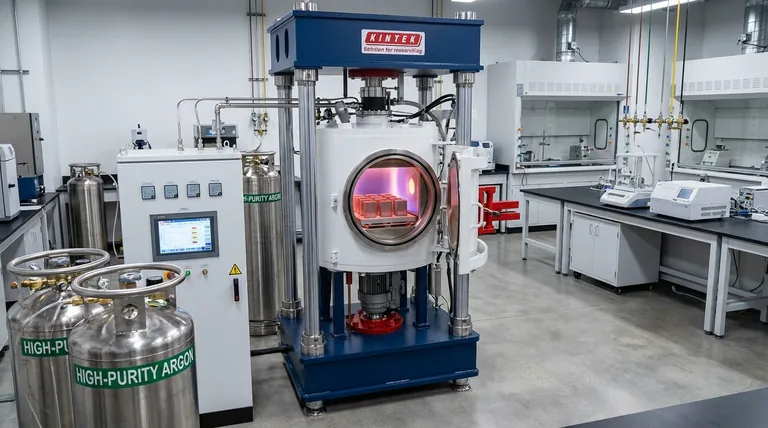
High-purity argon acts as a critical protective shield during the sintering of 316L stainless steel porous electrodes. By displacing reactive gases at temperatures reaching 1260°C, it prevents oxidation and enables the formation of pure metallurgical bonds between metal particles. This inert environment is essential for achieving the specific electrical conductivity and mechanical strength required for electrodes, while simultaneously preserving the furnace's heating elements.
The use of a high-purity argon atmosphere is not merely about preventing surface rust; it is the fundamental enabler of metallurgical necks between steel particles. Without this inert environment, the formation of conductive, chemically stable porous electrodes would be impossible due to rapid oxidation at sintering temperatures.
Preserving Material Integrity at High Temperatures
Preventing Oxidation of 316L Stainless Steel
Sintering 316L stainless steel requires processing temperatures around 1260°C. At these extreme heat levels, the metal becomes highly reactive to oxygen.
High-purity argon creates an inert barrier that completely displaces the atmosphere within the furnace. This prevents the oxidation of the alloy elements that would otherwise occur instantly in air.
By maintaining this oxygen-free environment, the chemical stability of the stainless steel is preserved throughout the thermal cycle.
Eliminating Oxide Inclusions
If oxygen were present, oxide layers would form on the surface of the metal particles. These layers act as contaminants, known as oxide inclusions.
Argon prevents these inclusions from forming. This ensures that the material remains pure 316L stainless steel, rather than a composite of steel and brittle oxides.
Enhancing Electrode Performance
Facilitating Metallurgical Bonding
The core purpose of sintering is to fuse loose powder particles into a coherent structure. This fusion occurs at contact points called metallurgical bonding necks.
High-purity argon ensures these necks are formed from pure metal. Because there are no oxide layers interfering with the contact points, the particles can fuse cleanly and completely.
Guaranteeing Conductivity and Strength
For a porous electrode, performance is defined by how well it conducts electricity and how well it holds together.
Because the bonding necks are pure metal, they provide excellent electrical conductivity. There is no resistive oxide barrier between the particles to impede electron flow.
Simultaneously, these clean, metallic bonds provide superior mechanical strength, ensuring the porous structure is durable and resistant to wear.
Protecting the Furnace Infrastructure
Shielding Heating Elements
The benefits of an argon environment extend beyond the product to the machinery itself. The heating elements inside a sintering furnace are often susceptible to oxidative degradation.
By enveloping the furnace interior in high-purity argon, the heating elements are protected from corrosion.
Reducing Maintenance Requirements
This protective atmosphere prolongs the operational lifespan of the heating components.
Consequently, this reduces the frequency of expensive replacements and minimizes maintenance downtime, contributing to a more efficient production cycle.
Understanding the Trade-offs
Gas Purity vs. Process Quality
While argon provides an excellent protective environment, the effectiveness of the process is entirely dependent on the purity level of the gas.
If the argon contains trace impurities (moisture or oxygen), the "protective" atmosphere fails. Even minor contamination can lead to weak bonding necks and reduced conductivity.
Argon vs. Vacuum Sintering
It is worth noting that a high-vacuum environment can achieve similar results by lowering oxygen partial pressure, as seen in vacuum hot press sintering.
However, argon sintering offers distinct operational dynamics. It typically involves positive pressure, which can actively exclude leaks from the outside environment, whereas vacuum relies on the integrity of the seal to keep oxygen out.
Optimizing Your Sintering Strategy
To maximize the performance of your 316L stainless steel electrodes, consider how the atmosphere aligns with your specific production goals:
- If your primary focus is electrical conductivity: Ensure your argon source is certified high-purity to guarantee oxide-free metallic necks, which are the pathways for electron flow.
- If your primary focus is equipment longevity: Monitor the furnace pressure to ensure a consistent argon blanket protects expensive heating elements from degradation.
Ultimately, high-purity argon is the invisible component that transforms loose steel powder into a robust, high-performance electrode capable of withstanding demanding applications.
Summary Table:
| Feature | Impact of High-Purity Argon | Benefit for 316L Electrodes |
|---|---|---|
| Atmosphere Control | Displaces oxygen and moisture at 1260°C | Prevents brittle oxide inclusions |
| Particle Fusion | Enables clean metallurgical neck formation | Maximizes mechanical strength and durability |
| Electrical Path | Eliminates resistive surface layers | Guarantees high electrical conductivity |
| Equipment Life | Shields furnace heating elements | Reduces maintenance costs and downtime |
| Process Stability | Maintains positive pressure barrier | Ensures consistent, repeatable sintering results |
Elevate Your Sintering Precision with KINTEK
Are you looking to optimize the conductivity and durability of your 316L stainless steel electrodes? KINTEK provides the specialized technology needed for high-performance material processing. Backed by expert R&D and manufacturing, we offer a comprehensive range of Muffle, Tube, Rotary, Vacuum, and CVD systems, as well as other lab high-temperature furnaces—all fully customizable to meet your unique sintering requirements.
Don't let impurities compromise your results. Let our engineering team help you design the perfect thermal environment for your application.
Contact KINTEK Today to Discuss Your Custom Furnace Solution
References
- Investigation of Pore Size on the Hydrogen Evolution Reaction of 316L Stainless Steel Porous Electrodes. DOI: 10.3390/catal15010038
This article is also based on technical information from Kintek Furnace Knowledge Base .
Related Products
- Vacuum Heat Treat Sintering Furnace with Pressure for Vacuum Sintering
- Spark Plasma Sintering SPS Furnace
- Vacuum Heat Treat Sintering Furnace Molybdenum Wire Vacuum Sintering Furnace
- Small Vacuum Heat Treat and Tungsten Wire Sintering Furnace
- Vacuum Dental Porcelain Sintering Furnace for Dental Laboratories
People Also Ask
- What are the benefits of using vacuum heat treating furnaces for metal alloys? Achieve Superior Metal Properties and Performance
- What is one of the most important uses of vacuum heat treating furnaces in aerospace? Achieve Superior Strength in Aircraft Alloys
- How does vacuum heat treating affect the grain structure of metal alloys? Achieve Precise Microstructure Control
- What are the key components of a vacuum sintering furnace? Essential Parts for Precision Material Processing
- What is the purpose of setting a mid-temperature dwell stage? Eliminate Defects in Vacuum Sintering



















