
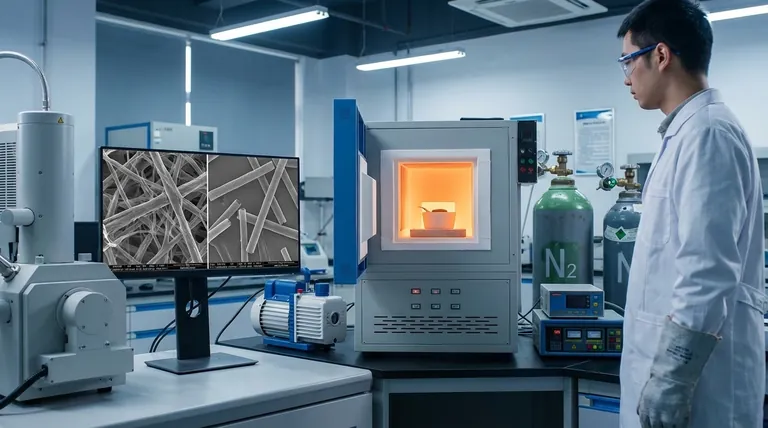
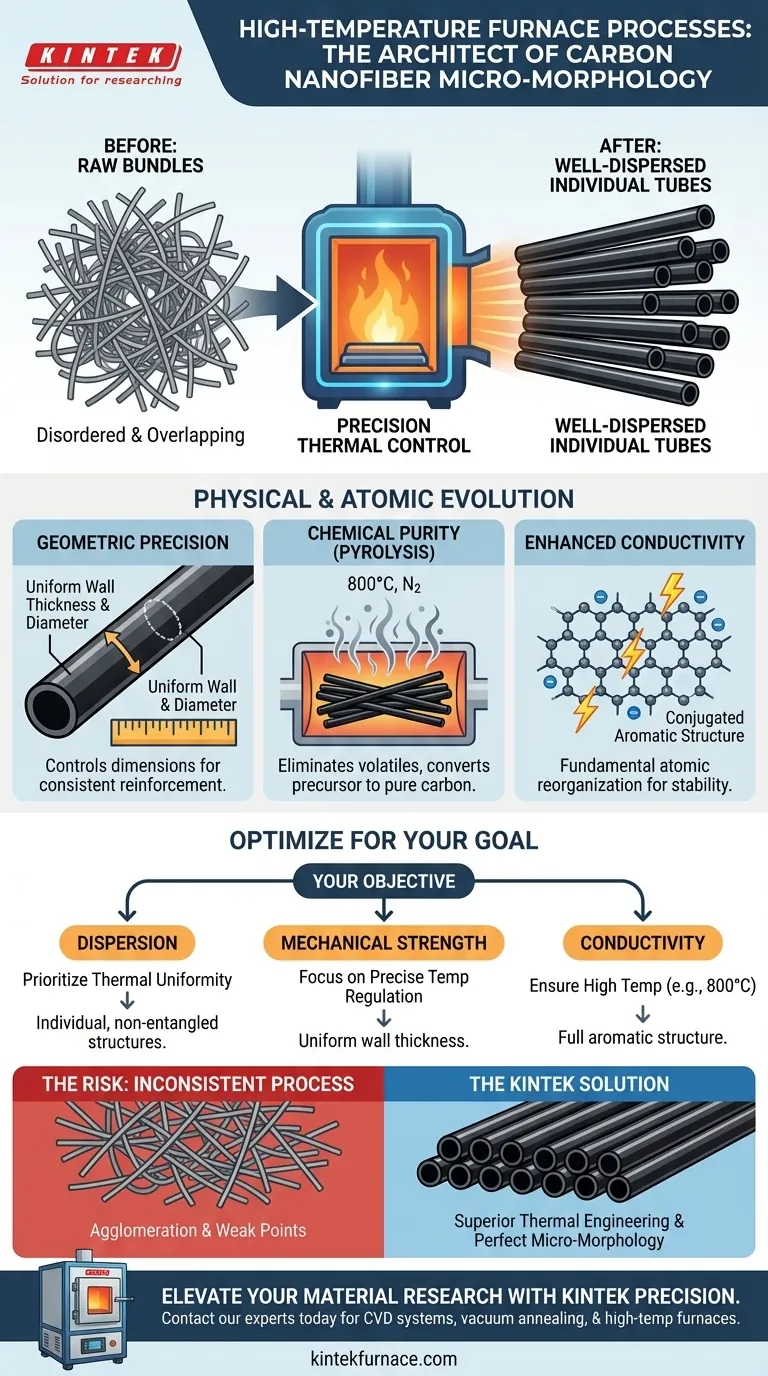
High-temperature furnace processes act as the primary architect of carbon nanofiber (CNF) micro-morphology. They govern the physical transition from disordered, overlapping bundles into well-dispersed, individual tubular structures while defining critical geometric parameters like wall thickness and diameter.
Core Takeaway Precision thermal control in systems like CVD or vacuum annealing is not just about heating; it is about refining the fiber's architecture. It converts raw precursors into stable, conductive fibers with specific dimensions optimized for composite reinforcement.
The Transformation of Physical Structure
Breaking the Bundles
Raw or precursor fibers often exist as overlapping, entangled bundles.
The high-temperature environment is the mechanism that separates these aggregates.
Proper thermal treatment ensures the material transitions into well-dispersed, individual structures, which is a prerequisite for accurate structural analysis and effective material performance.
Defining Geometric Parameters
The furnace environment directly dictates the fiber's physical dimensions.
Specifically, the thermal profile controls the wall thickness and diameter of the resulting nanofibers.
Consistency in these parameters is critical, as they determine how well the fibers function as fillers in composite materials.
Establishing Distinct Features
Beyond size, heat determines shape.
Controlled annealing helps resolve the internal architecture, ensuring the formation of distinct tubular features.
This clarity in structure distinguishes high-quality nanofibers from amorphous carbon deposits.
Chemical and Atomic Evolution
Pyrolysis and Volatile Removal
In specific applications like cellulose-based CNF preparation, the furnace facilitates pyrolysis.
Operating at temperatures such as 800 °C under a protective nitrogen atmosphere, the furnace eliminates volatile components.
This purification process is essential for converting the raw precursor into pure carbon.
Enhancing Stability and Conductivity
The high thermal energy drives a fundamental atomic reorganization.
It transforms the material into a conjugated aromatic structure.
This structural shift significantly enhances the electrical conductivity and overall structural stability of the nanofibers.
Understanding the Trade-offs
The Risk of Thermal Instability
The primary reference emphasizes the need for "proper thermal control."
If the temperature profile fluctuates or is uneven, the transition from bundled to individual fibers may be incomplete.
This results in agglomerations that are difficult to disperse and analyze.
Dimensional Inconsistency
Furnace conditions that are not strictly regulated lead to variable wall thicknesses.
Inconsistent dimensions create weak points in the fiber.
When used as fillers, these irregularities compromise the mechanical integrity of the final composite material.
Making the Right Choice for Your Goal
To optimize your carbon nanofibers, you must align your furnace parameters with your specific performance objectives.
- If your primary focus is Dispersion: Prioritize thermal uniformity to ensure the complete transition from overlapping bundles to discrete, individual fibers.
- If your primary focus is Mechanical Strength: Focus on precise temperature regulation to dictate uniform wall thickness and diameter, ensuring consistent reinforcement capabilities.
- If your primary focus is Conductivity: Ensure high processing temperatures (e.g., 800 °C) to drive the full formation of conjugated aromatic structures.
Ultimately, the furnace is not merely a heat source, but a precision tool that defines the physical identity and utility of the nanofiber.
Summary Table:
| Process Objective | Thermal Impact | Morphological Result |
|---|---|---|
| Dispersion | Bundle Separation | Individual, non-entangled tubular structures |
| Geometric Precision | Controlled Thermal Profile | Uniform wall thickness and fiber diameter |
| Chemical Purity | Pyrolysis (e.g., 800°C in N2) | Removal of volatiles and amorphous carbon |
| Conductivity | Atomic Reorganization | Formation of conjugated aromatic structures |
Elevate Your Material Research with KINTEK Precision
Unlock the full potential of your carbon nanofibers through superior thermal engineering. KINTEK provides industry-leading CVD systems, vacuum annealing furnaces, and high-temp tube furnaces specifically designed to provide the precision thermal control required for perfect micro-morphology and conductivity.
Whether you are scaling production or refining material architecture, our expert R&D and customizable manufacturing solutions ensure your fibers meet exact specifications. Empower your lab with KINTEK—Contact our experts today to discuss your unique project needs!
Visual Guide
References
- Teguh Endah Saraswati, Wijang Wisnu Raharjo. Enhanced Performance of Epoxy Resin-Polyimide Hybrid Composites with Aminated Carbon Nanofibers Filler. DOI: 10.26554/sti.2025.10.1.152-164
This article is also based on technical information from Kintek Furnace Knowledge Base .
Related Products
- 1400℃ High Temperature Laboratory Tube Furnace with Alumina Tube
- 1700℃ High Temperature Laboratory Tube Furnace with Alumina Tube
- 1800℃ High Temperature Muffle Oven Furnace for Laboratory
- 1700℃ High Temperature Muffle Oven Furnace for Laboratory
- 1200℃ Muffle Oven Furnace for Laboratory
People Also Ask
- How does zone-melting in tube furnaces synthesize bismuth micro-wires? Master Single-Crystal Thermoelectric Growth
- How do high-temperature laboratory tube furnaces ensure environmental stability? Precision Thermal Reduction Tips
- How are high-temp tube furnaces used to measure diffusion coefficients per Fick's law? Master Precision Annealing
- How are high-temperature laboratory tube furnaces applied in long-term vacuum homogenization heat treatments for intermetallic samples?
- How are high-temperature tube furnaces applied in testing ceramic-supported alloy membranes? Insights



















