
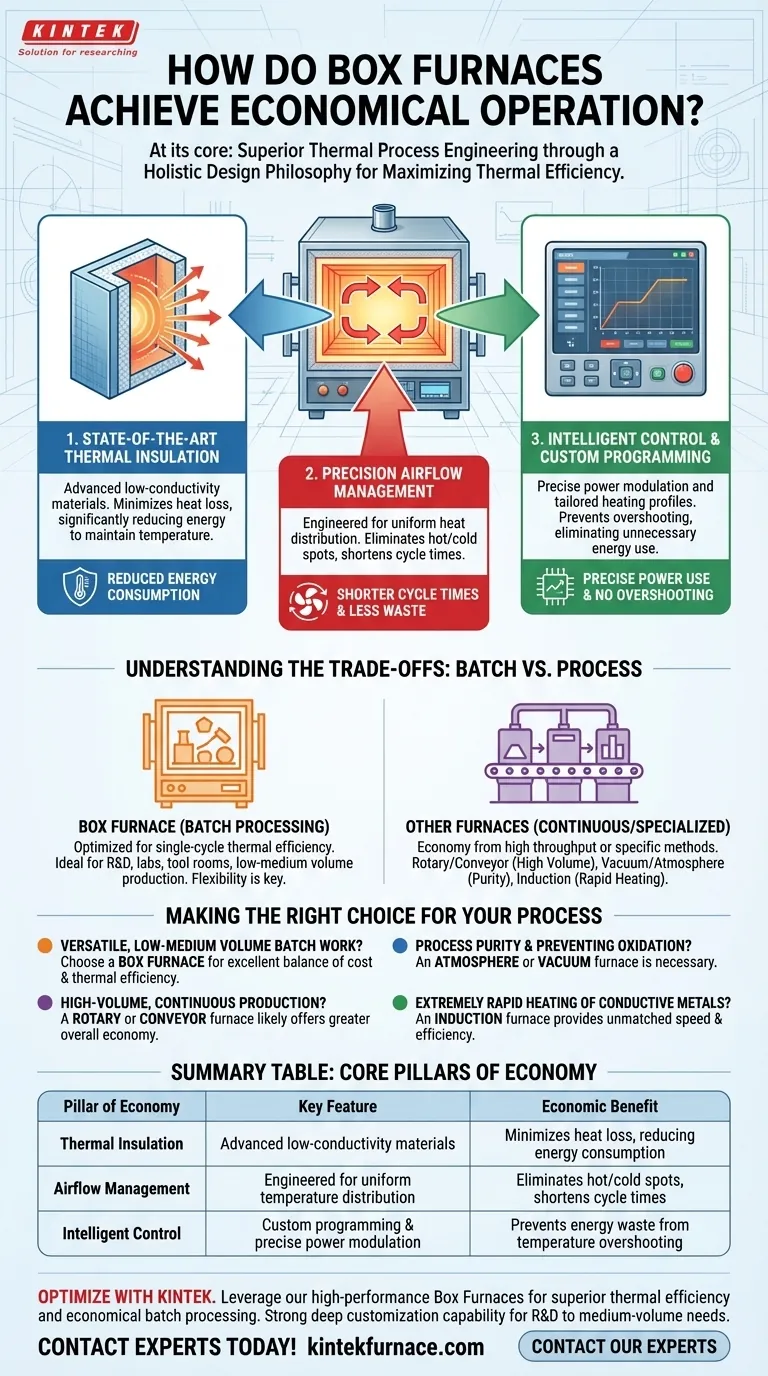
At its core, economical operation in a Box Furnace is achieved through superior thermal process engineering. This involves a focused strategy to minimize energy waste by combining three key elements: state-of-the-art insulation materials to contain heat, effective airflow management for uniform heating, and intelligent custom programming to optimize energy use during a cycle.
The central principle behind a Box Furnace's economy is not a single feature, but a holistic design philosophy focused on maximizing thermal efficiency. While other furnaces gain efficiency from continuous operation or specialized heating methods, the Box Furnace excels by perfecting the fundamentals of retaining and distributing heat within a self-contained batch process.
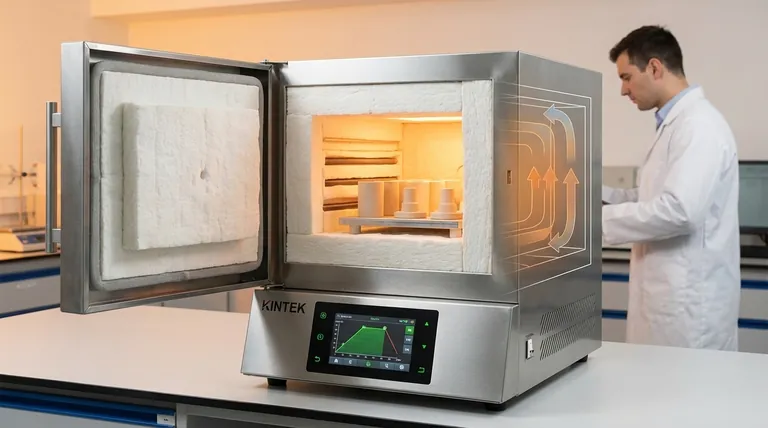
The Core Pillars of Box Furnace Economy
True operational economy is a direct result of minimizing wasted energy. A Box Furnace is engineered from the ground up to combat the primary sources of inefficiency in heat treatment.
State-of-the-Art Thermal Insulation
Heat loss is the single greatest enemy of furnace efficiency. Every unit of thermal energy that escapes the chamber must be replaced by the heating elements, consuming more power.
Modern Box Furnaces utilize advanced insulation materials with extremely low thermal conductivity. This ensures the vast majority of heat generated is kept inside the chamber and directed at the workload, significantly reducing the energy required to reach and maintain temperature.
Precision Airflow Management
Uniform temperature throughout the chamber is critical. Inefficient airflow creates hot and cold spots, forcing longer cycle times or higher temperature setpoints to ensure the entire load is properly treated.
By engineering effective airflow management, a Box Furnace ensures that heat is distributed evenly and efficiently. This guarantees that all parts of the workload reach the target temperature simultaneously, minimizing cycle time and preventing the energy waste associated with overheating certain areas to compensate for others.
Intelligent Control and Custom Programming
Crude on/off heating cycles are notoriously inefficient, often leading to temperature overshooting that wastes significant energy.
Box Furnaces leverage sophisticated control systems and custom programming. These systems precisely modulate power to the heating elements, preventing overshooting and allowing users to create specific heating profiles (heat-up, soak, cool-down) tailored perfectly to the material being processed. This eliminates unnecessary energy expenditure at every stage of the cycle.
Understanding the Trade-offs: Batch vs. Process
The economic model of a Box Furnace is tied to its function as a batch-processing unit. Understanding this context is key to comparing it with other technologies.
The Efficiency of Batch Processing
A Box Furnace is designed to perfect the thermal efficiency within a single, defined cycle. Its strength lies in its versatility for handling different part sizes, geometries, and process requirements from one batch to the next.
This makes it an extremely economical choice for labs, research and development, tool rooms, and low-to-medium volume production where flexibility is as important as energy cost.
When Other Furnaces Are More Economical
For high-volume, continuous production of a uniform product, a rotary or conveyor furnace may offer greater overall economy. Their efficiency comes not from thermal perfection in a static chamber, but from high throughput and uninterrupted operation.
Similarly, specialized furnaces gain efficiency in other ways. Vacuum and atmosphere furnaces create controlled environments that prevent heat loss and material waste from oxidation. Induction furnaces achieve incredible efficiency by transferring energy directly into the metal, bypassing the need to heat a large chamber.
Making the Right Choice for Your Process
Choosing the most economical furnace requires matching the technology's core strengths to your operational goals.
- If your primary focus is versatile, low-to-medium volume batch work: A Box Furnace offers an excellent balance of upfront cost and operational economy through its mastery of fundamental thermal efficiency.
- If your primary focus is high-volume, continuous production: A rotary or conveyor-style furnace will likely provide greater overall economy due to its high throughput and minimal downtime between loads.
- If your primary focus is process purity and preventing material oxidation: An atmosphere or vacuum furnace is necessary, with its economic benefits stemming from both energy conservation and superior product quality.
- If your primary focus is extremely rapid heating of conductive metals: An induction furnace provides unmatched speed and energy efficiency by heating the material directly, minimizing thermal waste.
Ultimately, understanding how each furnace technology achieves its efficiency empowers you to select the right tool for your specific application.
Summary Table:
| Pillar of Economy | Key Feature | Economic Benefit |
|---|---|---|
| Thermal Insulation | Advanced low-conductivity materials | Minimizes heat loss, reducing energy consumption |
| Airflow Management | Engineered for uniform temperature distribution | Eliminates hot/cold spots, shortens cycle times |
| Intelligent Control | Custom programming & precise power modulation | Prevents energy waste from temperature overshooting |
Optimize your lab's energy efficiency and operational costs with a high-performance Box Furnace from KINTEK.
Leveraging exceptional R&D and in-house manufacturing, KINTEK provides diverse laboratories with advanced high-temperature furnace solutions. Our Box Furnaces are engineered for superior thermal efficiency, ensuring economical operation for your batch processing needs. Whether for R&D, tool rooms, or medium-volume production, our strong deep customization capability allows us to precisely meet your unique experimental requirements.
Ready to enhance your heat treatment process with an economical and reliable solution? Contact our experts today to discuss how a KINTEK Box Furnace can benefit your specific application!
Visual Guide
Related Products
- Vacuum Hot Press Furnace Machine Heated Vacuum Press Tube Furnace
- Mesh Belt Controlled Atmosphere Furnace Inert Nitrogen Atmosphere Furnace
- Vacuum Heat Treat Sintering Furnace with Pressure for Vacuum Sintering
- 600T Vacuum Induction Hot Press Vacuum Heat Treat and Sintering Furnace
- Vacuum Hot Press Furnace Machine Heated Vacuum Press
People Also Ask
- Why use Vacuum Hot Press (VHP) for ZnS Ceramics? Achieve Superior IR Transparency and Mechanical Strength
- What are the benefits of the vacuum environment system in a vacuum hot press furnace? Unlock High-Density Sintering
- What safety features are incorporated in vacuum hot press furnaces? Ensure Operator and Equipment Protection
- What is the primary function of the vacuum environment in a vacuum hot press furnace during titanium alloy processing? Prevent Embrittlement for Superior Ductility
- How have vacuum hot press furnaces transformed material processing? Achieve Superior Density and Purity



















