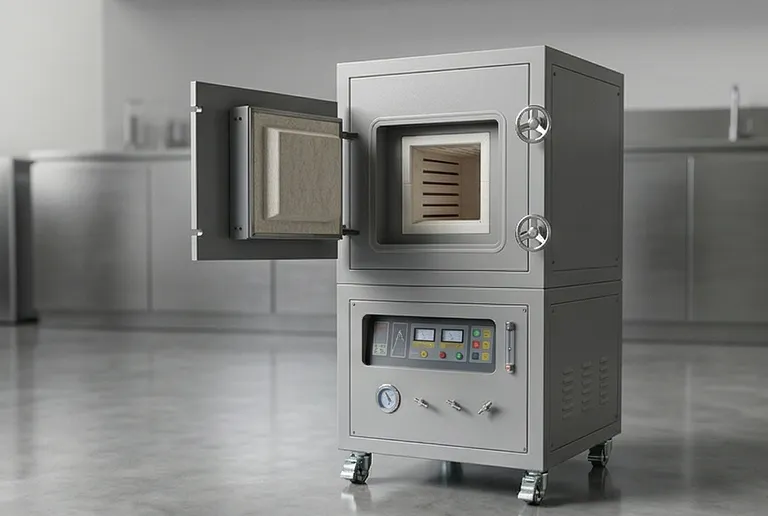
The Mystery of the Peeling Layer: Why "Good" Nitriding Goes Bad
You’ve invested in premium powder metallurgy (PM) high-speed steel for your tools, expecting superior wear resistance and toughness. You put them through a plasma nitriding cycle, the surface looks dark and treated, but then the trouble starts. In the field, the nitrided layer begins to delaminate, or the tool fails prematurely because the "hard" shell wasn't as uniform as promised.
If your laboratory or production floor is seeing inconsistent results—where one batch of tools performs beautifully and the next suffers from poor adhesion—the problem usually isn't the steel, and it isn't the temperature. The culprit is often invisible: a slight imbalance in your gas chemistry.
The Common Struggle: More Nitrogen Isn't Always Better
When a nitriding process fails to deliver the expected hardness, the most common "fix" is to increase the nitrogen flow. It seems logical—if you want to diffuse more nitrogen into the steel, you should provide a richer nitrogen atmosphere.
However, many engineers find that simply "cranking up the N2" leads to a brittle surface or, worse, a layer that fails to bond with the substrate at all. These failed attempts result in more than just scrapped parts; they lead to project delays, increased tooling costs, and a loss of confidence in the heat treatment process. The frustration stems from treating the symptoms of a poor surface finish rather than the barrier preventing a good one.
The Invisible Barrier: Why 95% Hydrogen is the Magic Number
To understand why nitriding fails, we have to look at the tool’s surface at a microscopic level. High-speed steel, especially those made via powder metallurgy, naturally forms a thin, stubborn oxide film when exposed to air. This film acts as a physical shield, blocking nitrogen ions from penetrating the steel.
This is where the gas mixture ratio becomes the "make or break" factor. While nitrogen (N2) provides the atoms necessary for the hard layer, it cannot clean the surface.
The secret lies in the Hydrogen (H2).
In a typical high-performance plasma nitriding setup for PM high-speed steel, the ideal ratio is often as high as 95% Hydrogen to 5% Nitrogen. Here is the science behind that specific balance:
- The Cleaning Phase (Sputtering): Inside the high-voltage electric field of the plasma furnace, hydrogen acts as a powerful reducing agent. It actively "scrubs" the oxide films from the tool surface during the plasma sputtering process.
- The Carrier Role: Hydrogen acts as the carrier gas, ensuring the plasma remains stable and covers every intricate geometry of the tool uniformly.
- The Diffusion Gateway: Only after the hydrogen has cleaned the "gateway" can the nitrogen ions efficiently diffuse into the substrate.
If you have too much nitrogen and not enough hydrogen, the nitrogen ions simply bounce off the oxide layer or create a weak, "patchy" bond. By maintaining a high H2 ratio, you ensure a chemically clean surface that allows for a deep, uniform, and incredibly tenacious nitrided layer.
The Solution: Precision Atmosphere Control
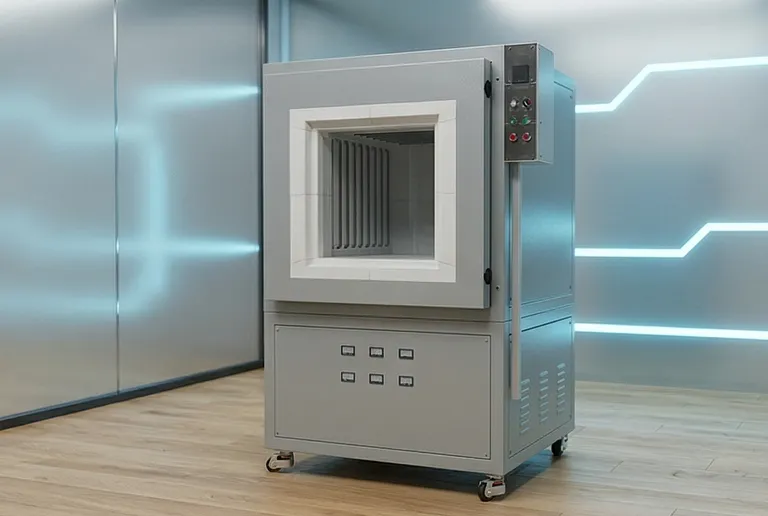
Achieving this delicate 95:5 balance isn't something you can do with guesswork. It requires a furnace designed for absolute atmospheric integrity and precise gas dosing.
At KINTEK, our range of vacuum and atmosphere-controlled furnaces are engineered specifically for these high-stakes applications. We don't just provide "heat"; we provide the environment necessary for complex plasma chemistry.
Our systems feature:
- Mass Flow Control: Ensuring that your 95% H2 / 5% N2 ratio remains constant throughout the entire cycle, preventing the fluctuations that lead to "hit or miss" quality.
- High-Voltage Plasma Stability: Optimized electric fields that facilitate efficient ion diffusion at lower temperatures, preserving the core properties of your high-speed steel.
- Customizable Atmosphere Profiles: Whether you are working with specialized powder metallurgy alloys or standard tool steels, our furnaces allow you to dial in the exact "reduction-to-diffusion" sequence required.
Beyond the Fix: Unlocking Tool Potential
When you master the gas ratio through precision equipment, you stop "fixing" problems and start creating opportunities. A perfectly nitrided PM high-speed steel tool doesn't just last longer; it changes what your machining shop can achieve.
With a uniform, high-adhesion nitrided layer, you can significantly reduce the friction coefficient of your tools, allowing for faster feed rates and reduced adhesive wear. You gain the ability to push your tools harder without fear of the coating "shelling off." This means higher throughput, lower cost-per-part, and a reputation for producing tools that outlast the competition.
The difference between a failing tool and a high-performance one often comes down to a few percentage points of gas. Don't leave your results to chance. Our team of experts can help you configure the ideal furnace environment to ensure your nitriding process is as precise as the tools you create. To discuss your specific project requirements or to explore our range of customizable high-temperature solutions, Contact Our Experts.
Related Products
- Spark Plasma Sintering SPS Furnace
- Slide PECVD Tube Furnace with Liquid Gasifier PECVD Machine
- Inclined Rotary Plasma Enhanced Chemical Deposition PECVD Tube Furnace Machine
- Inclined Rotary Plasma Enhanced Chemical Deposition PECVD Tube Furnace Machine
- 1700℃ Controlled Inert Nitrogen Atmosphere Furnace
Related Articles
- Why Your Titanium-Zirconia Composites Lack Strength—And How SPS Breaks the Mechanical Barrier
- Why Your Sintered Parts Fail: It’s Not Just About Heat, But Pressure and Purity
- Beyond the Program: Why Your Sintering Fails and How to Guarantee Uniformity
- Why Your Superelastic Alloys Fail to Perform—And How Solid-State Precision Fixes It
- Solving the Bonding Dilemma: Why High-Strength Alloys Need More Than Just Pressure



















