The Invisible Flaw in "Perfect" Components
Imagine this: your team has spent weeks perfecting the design of a complex stainless steel fluidic valve. On the surface, the sintered parts look flawless. But during the final quality check—a high-pressure leak test—the "solid" metal fails. Micro-pores buried deep within the matrix allow gas to seep through, and under mechanical stress, the part snaps long before reaching its rated load.
This is the "density gap." In the world of high-performance stainless steel manufacturing, achieving a part that looks right is easy; achieving a part that is truly dense, gas-tight, and metallurgically sound is where most projects stall. If you are struggling with inconsistent mechanical strength or parts that fail in fluidic applications, the problem likely isn't your design—it’s the environment in which your particles are trying to bond.
The Common Struggle: Why Heat Isn't Enough
When manufacturers face low-density issues, the first instinct is often to "crank up the heat" or switch to a standard inert gas atmosphere like nitrogen or argon. While these steps seem logical, they often fail to address the underlying physics of powder metallurgy.
Standard sintering often leaves manufacturers trapped in a cycle of:
- Persistent Porosity: Small pockets of gas remain trapped between particles, preventing the material from reaching its "near-theoretical" density.
- Brittle Interfaces: Even if the part feels solid, the internal bonding between particles is weak, leading to poor compressive strength and premature wear.
- High Scrap Rates: A batch might yield some good parts, but the lack of environmental control leads to unpredictable results, driving up costs and delaying delivery schedules.
These aren't just technical hurdles; they are business risks. Every failed leak test is a wasted production cycle and a potential blow to your reputation for quality.
The Root of the Problem: The Oxygen Barrier
Why do these common fixes fail? The answer lies in the chemistry of stainless steel.
Stainless steel relies on elements like Chromium (Cr) and Molybdenum (Mo) for its strength and corrosion resistance. However, at the high temperatures required for sintering (often around 1250°C), these elements become "oxygen magnets." Even in a "pure" inert gas environment, trace amounts of oxygen can create a microscopic oxide layer around every single powder particle.
This oxide layer acts like a stubborn skin, preventing the metal particles from diffusing and merging into a single, solid mass. Instead of a unified piece of steel, you end up with a collection of particles that are merely "touching" rather than fused. Furthermore, residual gases trapped in the gaps between particles cannot escape, leaving behind the micro-pores that cause leaks in fluidic devices.
The Solution: Precision Vacuum Sintering
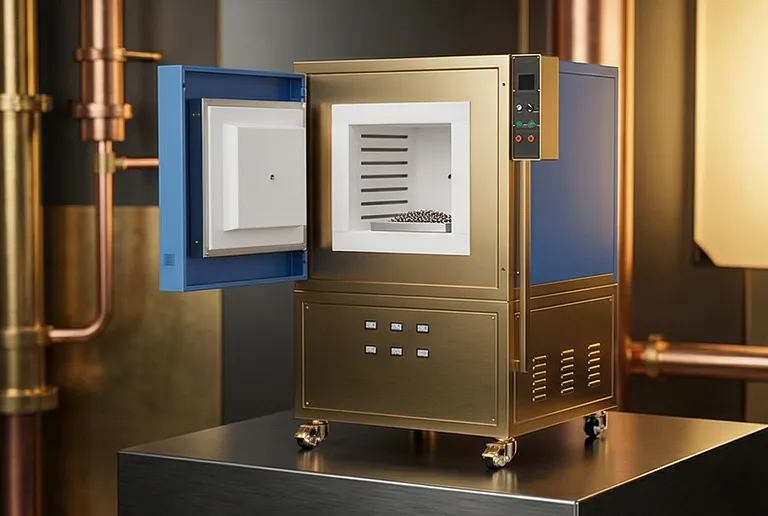
To achieve true high-density stainless steel, you don't just need heat; you need to remove the obstacles to bonding. This is where high-temperature vacuum sintering becomes the decisive factor.
At KINTEK, our vacuum furnaces are engineered to create an environment—typically reaching 1250°C to 1400°C with vacuum pressures as low as 1.33 Pa—that fundamentally changes the sintering physics:
- Eliminating the Oxide Skin: By drastically lowering the oxygen partial pressure, the vacuum prevents oxidative loss. In fact, the extreme environment helps strip away existing surface oxides, allowing for pure metallurgical bonding between particles.
- Facilitating Liquid Phase Sintering: Under vacuum, capillary forces become much more effective. If a liquid phase is present, these forces pull the liquid into the tiny gaps between particles, filling pores and "zipping" the material together into a dense matrix.
- Degassing the Matrix: Unlike atmospheric sintering, a vacuum actively draws out volatile impurities and residual gases from the interstices of the powder. This is what allows the material to reach the gas-tightness required for precision fluidic applications.
By addressing the root cause—oxidation and gas entrapment—rather than just the symptoms, our furnaces ensure that the material achieves its full potential for mechanical strength and wear resistance.
Beyond the Fix: Unlocking Engineering Potential
When you bridge the "density gap," you aren't just solving a manufacturing headache; you are opening the door to new engineering possibilities.
With the ability to consistently produce high-density, gas-tight stainless steel, you can move into more demanding markets. Think of medical implants that require absolute purity and strength, aerospace components that must withstand extreme thermal stress, or high-pressure fluidic systems where a single micro-pore could be catastrophic.
Achieving near-theoretical density means your products will be lighter, stronger, and more reliable. You can reduce the wall thickness of components without sacrificing safety, accelerate your time-to-market by eliminating the "trial and error" of atmospheric sintering, and ultimately deliver a product that exceeds your customers' highest expectations.
Mastering the complexities of material density requires more than just a furnace; it requires a partner who understands the science behind the heat. Whether you are struggling with part failure in fluidic systems or looking to push the limits of powder metallurgy, our team is ready to help you optimize your process. Let’s discuss how KINTEK’s customizable vacuum solutions can turn your most challenging designs into high-performance realities.
Related Products
- Vacuum Heat Treat Sintering Furnace Molybdenum Wire Vacuum Sintering Furnace
- Small Vacuum Heat Treat and Tungsten Wire Sintering Furnace
- 9MPa Air Pressure Vacuum Heat Treat and Sintering Furnace
- Vacuum Heat Treat Sintering Furnace with Pressure for Vacuum Sintering
- 2200 ℃ Tungsten Vacuum Heat Treat and Sintering Furnace
Related Articles
- Why Your Electrochromic Electrodes Fail During Sintering—And How Vacuum Control Restores Transparency
- Why Your Sintered Parts Fail: It’s Not Just About Heat, But Pressure and Purity
- Beyond the Program: Why Your Sintering Fails and How to Guarantee Uniformity
- Why Your 3D-Printed Maraging Steel Parts Aren't Performing—And How to Fix the Structural Weakness
- Why Your Ti-6Al-4V Parts Crack Under Pressure—The Hidden Science of Vacuum Heat Treatment



















