The Silence of a Scrapped Batch
Imagine the scene: a batch of precision aerospace components, hours into a complex heat treatment cycle, emerges from the vacuum furnace. On paper, everything was perfect. The furnace was rated for a blistering temperature, and its vacuum pump was a powerhouse.
Yet, post-process inspection tells a different story. Some parts meet hardness specifications; others don't. Micro-distortions are found in a few. The batch is inconsistent. The result is a quiet, expensive failure—a pile of scrapped material and a schedule in jeopardy.
This scenario isn't a failure of power. It's a failure of trust in the process. It reveals a fundamental truth we often overlook in our search for the "best" equipment: we are psychologically wired to chase big, simple numbers, but the metrics that truly matter are far more nuanced.
The Seduction of Simple Metrics
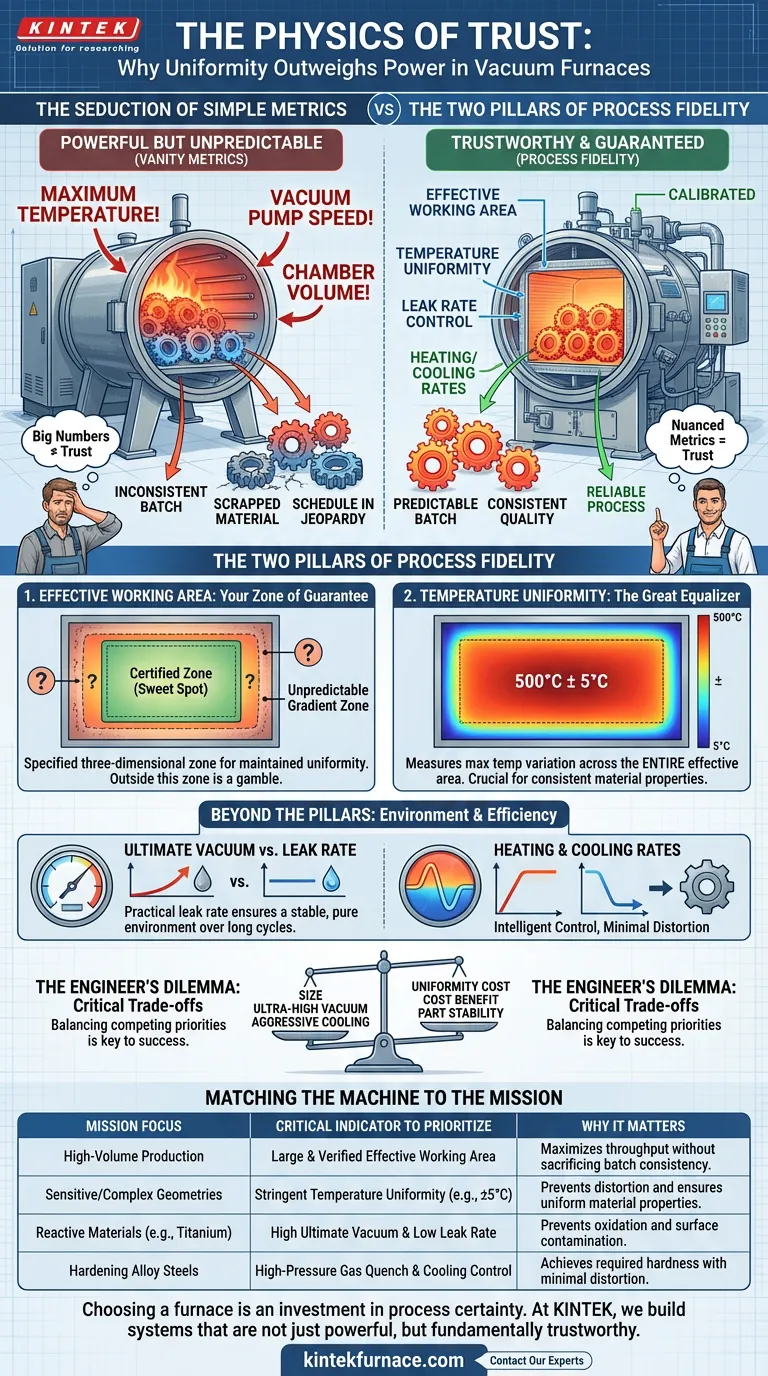
When evaluating complex systems, our brains seek shortcuts. Maximum temperature, vacuum pump-down speed, chamber volume—these are easy to find on a spec sheet and simple to compare. They feel definitive.
But these are often vanity metrics. They describe the furnace's theoretical potential, not its practical, repeatable performance. The real measure of a vacuum furnace is its ability to create a predictable and perfectly uniform thermal environment. Its job isn't to be powerful; its job is to be trustworthy.
This trust is built on two core pillars.
The Two Pillars of Process Fidelity
The quality of any vacuum heat treatment, from annealing to gas quenching, is determined almost entirely by the furnace's command over its internal space and temperature.
1. The Effective Working Area: Your Zone of Guarantee
The effective working area is not the entire internal volume of the furnace. It is the specific, guaranteed three-dimensional zone where the equipment can maintain the specified temperature uniformity.
Think of it as the "sweet spot." It is the physical boundary of your process's reliability. Any part placed outside this certified zone is subject to thermal gradients and unpredictable results. A larger effective area allows for higher throughput, but only if that entire space is governed by the same strict thermal rules.
2. Temperature Uniformity: The Great Equalizer
This is arguably the most critical performance indicator. It measures the maximum temperature variation (e.g., ±5°C) across the entire effective working area once the furnace has stabilized.
Poor uniformity is like trying to bake a cake in an oven that's 50 degrees hotter on one side. No matter how precise your recipe, the result is guaranteed to be inconsistent. For materials, this translates directly to variations in hardness, grain structure, and internal stresses, completely undermining the purpose of the treatment.
Beyond the Pillars: Environment and Efficiency
While the working area and uniformity define the quality of the thermal process, other indicators define the quality of the environment and the efficiency of the operation.
-
Ultimate Vacuum vs. Leak Rate: The ultimate vacuum is the system's theoretical best. The leak rate—the slow rise in pressure over time—is the practical reality. A low leak rate is far more important for day-to-day operations, as it ensures the vacuum environment remains pure and stable throughout a long cycle, preventing contamination.
-
Heating & Cooling Rates: Modern furnace performance is also about control. The ability to ramp temperature up and, critically, cool it down at a precise, programmable rate is essential. For processes like high-pressure gas quenching, the cooling system's ability to extract heat rapidly and evenly is what enables the hardening of advanced alloys without the distortion caused by liquid quenching.
The Engineer's Dilemma: Navigating Critical Trade-offs
Selecting a furnace involves balancing competing priorities. Understanding these trade-offs is key.
-
Size vs. Uniformity: Achieving tight temperature uniformity becomes exponentially more difficult and expensive as the effective working area increases. A massive furnace with poor uniformity is a liability.
-
Vacuum vs. Cost: Pushing for an ultra-high vacuum you don't need adds complexity and cost for no tangible benefit. The goal is to match the vacuum level to the sensitivity of your materials.
-
Cooling Power vs. Part Stability: Aggressive cooling can create immense thermal stress, leading to distortion or cracking. A superior system isn't just about raw quenching power, but the intelligence of its control system to manage it.
Matching the Machine to the Mission
Ultimately, the right furnace is not the one with the highest numbers, but the one whose performance characteristics are precisely aligned with your application's demands.
| Mission Focus | Critical Indicator to Prioritize | Why It Matters |
|---|---|---|
| High-Volume Production | Large & Verified Effective Working Area | Maximizes throughput without sacrificing batch consistency. |
| Sensitive/Complex Geometries | Stringent Temperature Uniformity (e.g., ±5°C) | Prevents distortion and ensures uniform material properties. |
| Reactive Materials (e.g., Titanium) | High Ultimate Vacuum & Low Leak Rate | Prevents oxidation and surface contamination. |
| Hardening Alloy Steels | High-Pressure Gas Quench & Cooling Control | Achieves required hardness with minimal distortion. |
Choosing a furnace is an investment in process certainty. It requires looking beyond the brochure specifications to the physics of uniformity and stability. This is where engineering becomes a craft—a partnership between the user's goal and the equipment's deeply understood capabilities. At KINTEK, our philosophy is built on this partnership, offering customizable Muffle, Tube, and advanced Vacuum Furnace systems designed to deliver guaranteed uniformity within a precisely defined working area. We build systems that are not just powerful, but fundamentally trustworthy.
To ensure your equipment delivers the process fidelity your materials deserve, Contact Our Experts.
Visual Guide
Related Products
- Vacuum Hot Press Furnace Machine Heated Vacuum Press Tube Furnace
- Vacuum Hot Press Furnace Machine Heated Vacuum Press
- 600T Vacuum Induction Hot Press Vacuum Heat Treat and Sintering Furnace
- 2200 ℃ Tungsten Vacuum Heat Treat and Sintering Furnace
- Vacuum Heat Treat Sintering Furnace with Pressure for Vacuum Sintering
Related Articles
- How Vacuum Hot Press Furnaces Transform Advanced Material Engineering
- How to Select the Right Vacuum Hot Pressing Furnace Temperature for Your Materials
- Beyond the Parts List: The Real Reason Your Vacuum Hot Press Fails (And How to Fix It)
- Why Your High-Temperature Materials Fail: The Hidden War Inside Your Furnace
- Is Your Material Data Real? Why Temperature Gradients Are Sabotaging Your Cu2Se Resistivity Measurements