The High-Performance Wall: When Strong Alloys Won’t Join
In the world of advanced materials, (Ni20Cr5.95Al)-Y2O3 alloys—often called Oxide Dispersion Strengthened (ODS) alloys—are the superheroes of extreme environments. Designed to withstand blistering temperatures and corrosive atmospheres, they are the backbone of modern aerospace and energy components.
However, these materials present a frustrating paradox: the very strength that makes them valuable also makes them incredibly difficult to join. Engineers often find themselves in a high-stakes struggle where the traditional "brute force" of diffusion bonding fails. You apply heat and massive amounts of pressure, yet the result is either a joint that fails under stress or a component that has been crushed and deformed beyond its design tolerances.
The Cost of the "Brute Force" Approach
When faced with a bond that won't take, the common instinct is to turn up the dial. More pressure should, in theory, force the two surfaces into an atomic embrace.
But in reality, this leads to a series of costly "common struggles":
- Macroscopic Deformation: To get the stiff ODS alloy to conform, you often exceed its structural limits, resulting in a part that is dimensional "scrap."
- Incomplete Bonding: Because the material is so resistant to change, microscopic gaps remain at the interface, creating "hidden" failure points.
- Project Delays: Failed quality checks and wasted specialty alloys drive up costs and push back critical delivery timelines.
Why does a process that works for standard steel fail so spectacularly here?
The Root Cause: A Microscopic Mountain Range
To understand why these bonds fail, we have to look past the polished surface. Even the most finely machined alloy looks like a rugged mountain range under an electron microscope.
For a successful diffusion bond, these "peaks" must be flattened so that atoms can migrate across the boundary. The problem with (Ni20Cr5.95Al)-Y2O3 alloys is their high yield point. They are simply too stiff to deform easily at the microscopic level. Without that deformation, the atoms never get close enough to bridge the gap.
In standard bonding, you try to flatten these mountains by pressing the entire part. With ODS alloys, the pressure required to flatten the microscopic peaks is often enough to collapse the entire structure.
The Secret "Buffer": Multilayer Metal Foil Interlayers
The solution isn't more pressure; it’s smarter material placement. This is where multilayer metal foils (such as Ni-Al or Cu-Ti) change the game.
By inserting these specialized foils between the alloy surfaces, we introduce an "interlayer" with a much lower yield point than the base metal. Think of it as a scientific "gasket" that works at the atomic level:
- Ease of Flow: Under heat and moderate pressure, the foil deforms easily, flowing into the microscopic "valleys" of the stiff ODS alloy.
- Promoting Diffusion: As the foil conforms to the surface, it creates an intimate contact zone, allowing atoms to move freely between the foil and the alloy.
- Preserving Geometry: Because the foil does the "heavy lifting" of deformation, the base ODS alloy remains stable. You achieve a dense, atomic-level bond at significantly lower bonding pressures.
From Theory to Reality: The Role of the Thermal Environment
Identifying the right foil is only half the battle. To transform these microscopic interactions into a reliable joint, the environment must be flawless. Diffusion is a function of time and temperature, and even a slight fluctuation can ruin the interlayer's effectiveness.
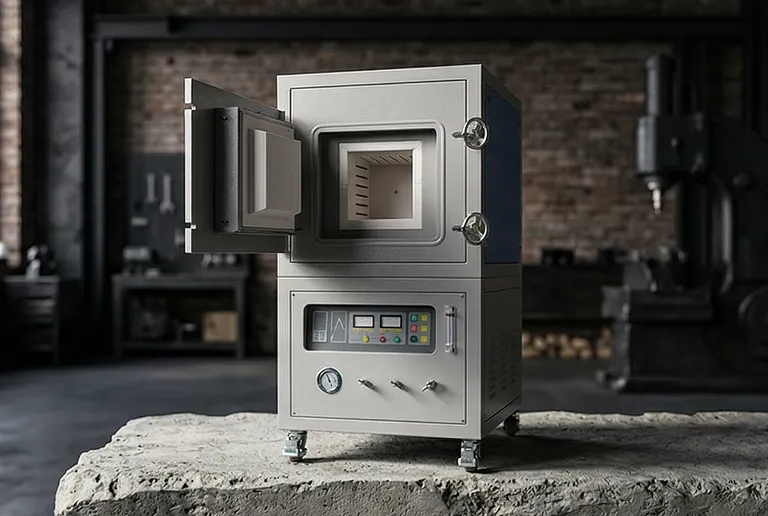
This is where KINTEK’s high-temperature vacuum and atmosphere furnaces become the essential partner in your process. Achieving the "sweet spot" where the foil deforms but the base alloy remains pristine requires:
- Precise Thermal Control: To ensure the foil reaches its ideal plastic state without overheating the ODS structure.
- Controlled Atmospheres: To prevent oxidation that would instantly block the diffusion of atoms across the foil interface.
- Uniform Heat Distribution: Ensuring that large or complex parts bond evenly across every square millimeter of the joint.
Beyond the Fix: Opening New Doors in Engineering
When you master the art of the interlayer, the "impossible" joints become routine. Solving the deformation problem does more than just lower your scrap rate; it unlocks new design possibilities.
With reliable diffusion bonding, you can move toward more complex internal cooling channels in turbine blades, more durable heat exchangers, and lighter assemblies that don't rely on heavy mechanical fasteners. By understanding the physics of the interface and utilizing the right thermal tools, you transition from managing failures to pioneering new technologies.
At KINTEK, we understand that your work isn't just about "heating things up"—it's about the precise control of material science. Our range of customizable vacuum and atmosphere furnaces is designed to meet the rigorous demands of ODS alloy bonding and other complex metallurgical challenges. Whether you are struggling with joint integrity or looking to scale a new joining process, our team of specialists is ready to help you optimize your thermal workflows. Contact Our Experts to discuss your specific project needs and ensure your next bond is as strong as the materials themselves.
Related Products
- Multi Heating Zones CVD Tube Furnace Machine for Chemical Vapor Deposition Equipment
- High Temperature Muffle Oven Furnace for Laboratory Debinding and Pre Sintering
- Vacuum Hot Press Furnace Machine for Lamination and Heating
- Vacuum Heat Treat Sintering and Brazing Furnace
- Spark Plasma Sintering SPS Furnace
Related Articles
- Beyond Heat: Mastering the Controlled Universe Inside a Tube Furnace
- Why Your Crystal Growth Experiments Are Failing: The Hidden Culprit in Your Tube Furnace
- Mastering the Void: How Tube Furnaces Forge the Atoms of Innovation
- Your Furnace Isn't Just a Heater: Why 'Good Enough' Equipment Is Sabotaging Your Advanced Materials Research
- Control is Everything: The Tube Furnace and the Art of Atomic-Scale Engineering