The High Cost of a "Slight" Temperature Shift
Imagine you are developing a next-generation medical stent or a critical aerospace actuator using Ti-Ni (Nickel-Titanium) superelastic alloys. You have the perfect chemical formula on paper, yet when the finished part comes off the line, its "memory" is flawed. The phase transformation temperature—the exact point where the metal should spring back to its original shape—is off by several degrees.
In the world of high-performance materials, a 1% deviation in chemical composition isn't just a minor error; it’s the difference between a life-saving device and a pile of expensive scrap. If your experimental data looks like a "rollercoaster" of inconsistency, you aren't alone. Many labs and manufacturers struggle with this, often spending weeks tweaking furnace settings without realizing that the problem isn't their recipe—it’s the fundamental way they are "cooking" the metal.
The Traditional Melting Trap: Why Casting Often Fails
When most engineers think of making alloys, they think of melting. Traditional vacuum induction melting or casting has been the industry standard for decades. However, for complex Ti-Ni-X (where X might be Cobalt or other dopants), the liquid state is where the trouble begins.
The primary struggle is elemental segregation. Because different elements have different densities and melting points, they don't stay perfectly mixed in a liquid pool. As the metal cools, heavier elements settle, and lighter ones rise. This creates "chemical pockets" within the ingot. Furthermore, traditional casting requires keeping the metal at extreme temperatures for long periods, which encourages grain coarsening—where the internal crystals grow too large, making the material brittle and reducing its fatigue life.
The business consequences are clear: high rejection rates, unpredictable product performance, and an agonizingly slow R&D cycle.
The Root Cause: The Chaos of the Liquid Phase

Why do standard solutions—like stirring the melt longer or using higher temperatures—often make things worse? The answer lies in the physics of solid-state diffusion versus liquid-state convection.
In traditional melting, you are fighting gravity and thermodynamics. In contrast, the secret to a perfect superelastic alloy lies in keeping the atoms exactly where you put them. When you melt these materials, you lose control over the "nano-precipitates"—the tiny structures that give the alloy its superelastic strength. By the time the ingot solidifies, the designed microstructure has been replaced by a coarse, uneven grain structure.
To solve this, we must bypass the liquid phase entirely. We need a way to fuse metal powders into a dense, solid mass without ever letting them become a chaotic, segregated liquid.
The Solution: Spark Plasma Sintering (SPS) as a Precision Tool
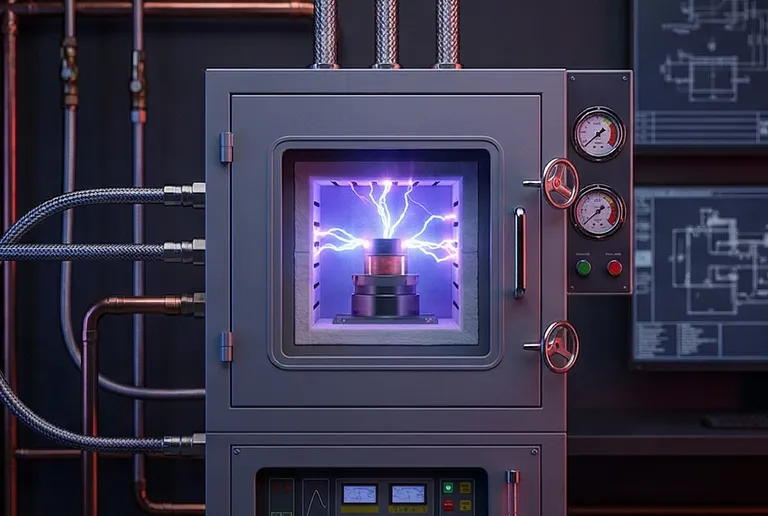
This is where Spark Plasma Sintering (SPS) changes the game. Unlike a traditional furnace that heats a sample from the outside in, an SPS system uses pulsed direct current to generate Joule heat directly within the powder particles.
At KINTEK, we design SPS equipment specifically to turn these physics into a competitive advantage. Here is how it addresses the root causes mentioned above:
- Atomic Precision (Solid-State Diffusion): Because SPS fuses powders using pressure and pulsed electricity rather than total melting, "segregation" is virtually eliminated. The Ti, Ni, and Co atoms stay exactly where they were in the powder mix, ensuring the phase transformation temperature remains stable across the entire part.
- Rapid Densification in Minutes: While traditional methods might take hours, an SPS system can achieve near-theoretical density in as little as 5 to 8 minutes. This "flash" process prevents grains from having the time to grow (coarsen), effectively "freezing" a fine, nanocrystalline microstructure in place.
- Lower Temperatures, Better Results: By applying axial pressure (often up to 60 MPa) alongside the current, SPS achieves full density at significantly lower temperatures than traditional sintering. This inhibits undesirable chemical reactions and preserves the designed properties of the alloy.
Beyond the Fix: Unlocking New Material Potential
When you stop fighting the inconsistencies of melting and start utilizing the precision of KINTEK’s SPS technology, the "impossible" becomes routine.
By mastering the solid-state environment, you can now explore alloys with higher concentrations of dopants that were previously too difficult to stabilize. You can produce materials with significantly higher fatigue resistance, better electrical conductivity, and lower thermal conductivity for thermoelectric applications. For the first time, your production output will finally match your theoretical designs.
Whether you are looking to accelerate your research or stabilize a high-stakes production line, the transition to SPS represents a shift from "guessing" to "engineering."
The challenges of modern material science require more than just high heat; they require surgical precision over how that heat is applied. At KINTEK, we understand that your project's success hinges on the stability of your microstructures and the reliability of your data. Our team is ready to help you transition from the unpredictability of traditional casting to the controlled, high-speed environment of Spark Plasma Sintering. Contact Our Experts today to discuss your specific alloy requirements and see how our customizable SPS solutions can bring your most ambitious material designs to life.
Related Products
- Spark Plasma Sintering SPS Furnace
- Chairside Dental Porcelain Zirconia Sintering Furnace with Transformer for Ceramic Restorations
- Dental Porcelain Zirconia Sintering Ceramic Vacuum Press Furnace
- 600T Vacuum Induction Hot Press Vacuum Heat Treat and Sintering Furnace
- 9MPa Air Pressure Vacuum Heat Treat and Sintering Furnace
Related Articles
- Why Your Titanium-Zirconia Composites Lack Strength—And How SPS Breaks the Mechanical Barrier
- Why Your Sintered Parts Fail: It’s Not Just About Heat, But Pressure and Purity
- Beyond the Program: Why Your Sintering Fails and How to Guarantee Uniformity
- Solving the Bonding Dilemma: Why High-Strength Alloys Need More Than Just Pressure
- Why Your Electrochromic Electrodes Fail During Sintering—And How Vacuum Control Restores Transparency