The Tyranny of the Tube
Imagine a delicate, instrumented substrate. Your entire experiment hinges on placing it perfectly within the narrow, blistering-hot core of a furnace. You slide it in, inch by inch, effectively blind. Did it shift? Is a probe touching the wall? The process feels less like science and more like threading a needle in the dark.
This small, recurring moment of friction is a classic case of a tool dictating the workflow. But great engineering doesn't just solve the big problems; it eliminates the small frustrations that drain a researcher's focus and energy.
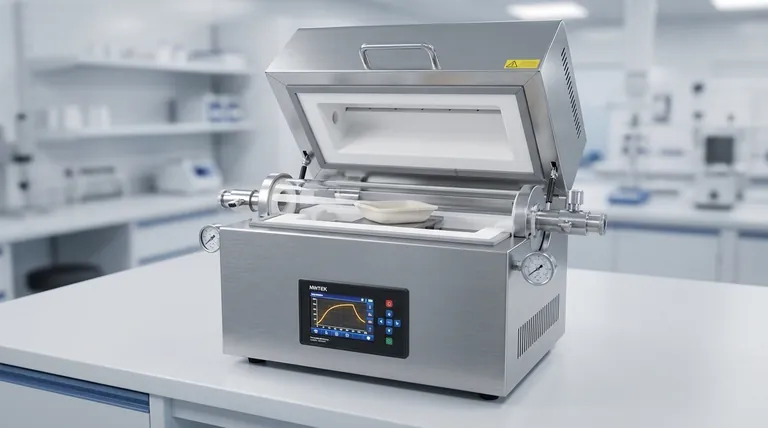
This is the quiet genius of the single-zone split tube furnace. Its design is a direct response to this very human challenge.
A Philosophy of Access and Simplicity
At its heart, a single-zone split tube furnace is defined by two deliberate design choices that prioritize user experience over all else.
The Split-Hinge: An Ode to Ergonomics
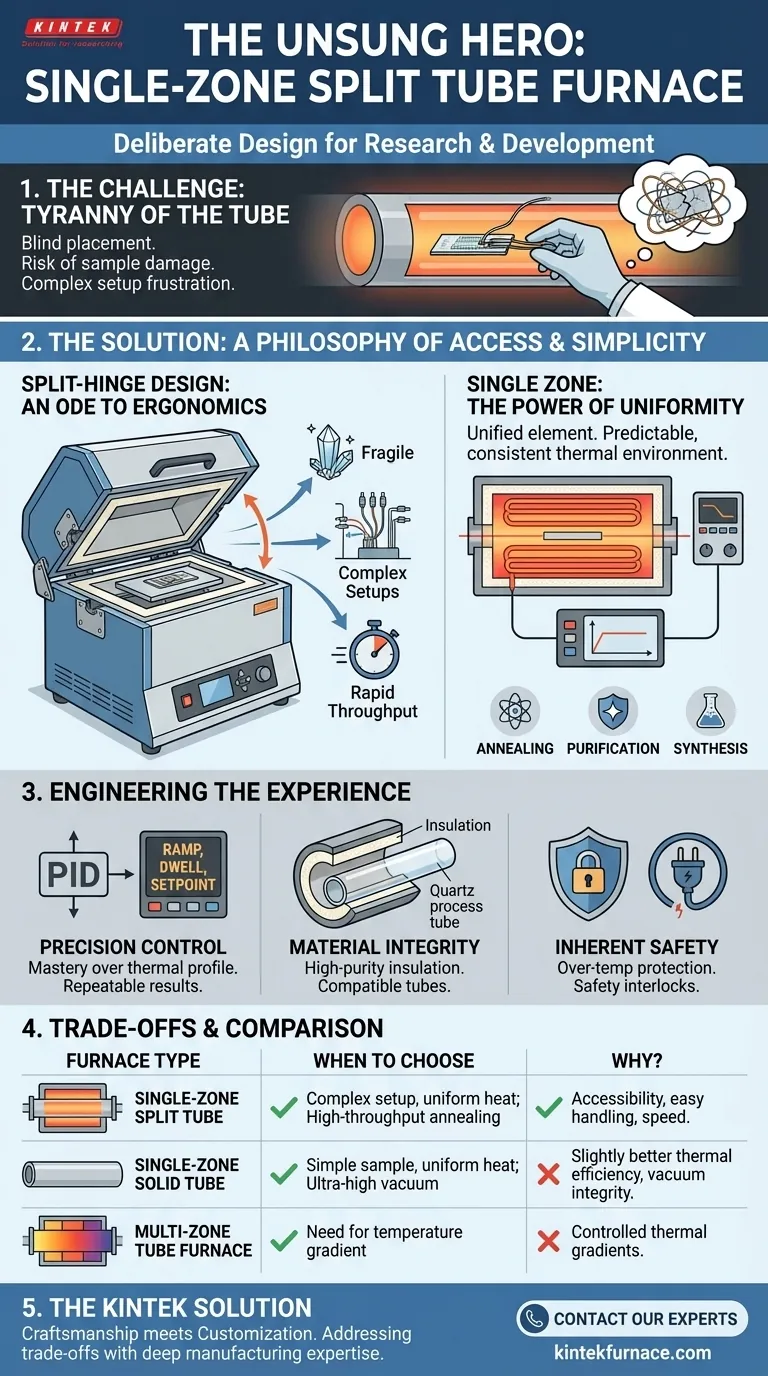
The most visible innovation is its clamshell body. The furnace opens along its length, transforming the heating chamber from a restrictive tunnel into an open stage.
This isn't merely a convenience; it's a psychological shift. The anxiety of blind placement is replaced by the confidence of direct manipulation.
- For Delicate Samples: Fragile crystals, thin films, or complex assemblies can be placed with precision, not just slid into place.
- For Complex Setups: Experiments with multiple thermocouples, gas lines, or probes can be arranged perfectly before closing the chamber.
- For Rapid Throughput: Sample changes are measured in seconds, not minutes, dramatically improving workflow efficiency.
The split-hinge design acknowledges that the moments before and after the heating process are just as critical as the process itself.
The Single Zone: The Power of Uniformity
The "single zone" designation refers to a single, unified heating element governed by one controller. This creates a predictable and consistent thermal environment across the entire sample.
It is an intentional choice for simplicity and reliability. For countless core material science applications, a uniform temperature is not just a feature; it is the entire point.
This is the workhorse for foundational processes:
- Annealing: Relieving internal stresses in materials.
- Purification: Driving off volatile impurities.
- Synthesis: Growing uniform crystals or compounds.
In these cases, complexity is the enemy. The single zone delivers exactly what is needed: a stable, homogenous field of heat.
Engineering the Experience: Beyond the Basics
A well-designed furnace is more than its core structure. It's a system of components working in concert to create a reliable and safe tool.
- Precision Control: Modern PID (Proportional-Integral-Derivative) controllers provide mastery over the thermal profile. You dictate the exact ramp rates, dwell times, and setpoints, ensuring your process is repeatable down to the degree.
- Material Integrity: High-purity ceramic fiber insulation minimizes heat loss, while process tubes made from quartz, alumina, or advanced alloys ensure compatibility with your specific temperatures and chemical atmospheres. The furnace is built to endure the rigors of discovery.
- Inherent Safety: Features like over-temperature protection and safety interlocks that cut power when the furnace is open are not afterthoughts. They are foundational, providing the peace of mind needed to focus on the science, not the equipment.
The Honest Trade-Offs: When to Choose Differently
No tool is perfect for every job. The brilliance of the single-zone split tube furnace lies in its specialization, which comes with inherent trade-offs. Understanding them is key.
The Gradient Imperative
The primary limitation is clear: if your process requires a temperature gradient—where different parts of a sample are at different, controlled temperatures—you need a multi-zone furnace. This isn't a flaw, but a different tool for a different task, like chemical vapor transport.
The Pursuit of Perfect Atmosphere
The seam where the two halves meet, while expertly engineered, presents more potential leak points than a solid tube furnace. For most inert atmosphere or moderate vacuum applications, this is a non-issue. But for ultra-high vacuum (UHV) systems, a solid tube design may offer superior integrity.
| Scenario | Recommended Furnace Type | Why? |
|---|---|---|
| Complex setup, uniform heat | Single-Zone Split Tube | Prioritizes accessibility and easy sample handling. |
| Simple sample, uniform heat | Single-Zone Solid Tube | Offers slightly better thermal efficiency and vacuum integrity. |
| Need for a temperature gradient | Multi-Zone Tube Furnace | The only design capable of creating controlled thermal gradients. |
| High-throughput annealing | Single-Zone Split Tube | The split design radically speeds up sample exchange. |
The KINTEK Solution: Where Craftsmanship Meets Customization
Choosing the right furnace is about aligning the tool's design philosophy with your experimental goals. The single-zone split tube furnace is the definitive choice for uniform heating combined with unparalleled access.
However, the line between "standard" and "specialized" is often blurred in cutting-edge research. This is where deep manufacturing expertise becomes critical. At KINTEK, our foundation in both R&D and in-house manufacturing allows us to address the honest trade-offs of furnace design head-on. If your process demands the accessibility of a split tube but requires enhanced atmospheric control, we can engineer a solution.
Our portfolio, from Tube and Muffle furnaces to complex CVD systems, is built on the principle of providing the right tool for the job. We believe a furnace shouldn't just meet spec; it should accelerate your research. By offering deep customization, we ensure your equipment is a perfect extension of your scientific vision.
To discuss the specific thermal challenges of your application, Contact Our Experts.
Visual Guide
Related Products
- Split Multi Heating Zone Rotary Tube Furnace Rotating Tube Furnace
- Split Chamber CVD Tube Furnace with Vacuum Station CVD Machine
- 1200℃ Split Tube Furnace Laboratory Quartz Tube Furnace with Quartz Tube
- Multi Heating Zones CVD Tube Furnace Machine for Chemical Vapor Deposition Equipment
- Multi Zone Laboratory Quartz Tube Furnace Tubular Furnace
Related Articles
- More Than a Hot Box: The Art and Science of Configuring a Split Tube Furnace
- The Bottleneck is the Cooldown: How Split Tube Furnaces Redefine Lab Efficiency
- Beyond Heat: Mastering the Controlled Universe Inside a Tube Furnace
- Why Your Crystal Growth Experiments Are Failing: The Hidden Culprit in Your Tube Furnace
- Mastering the Void: How Tube Furnaces Forge the Atoms of Innovation



















