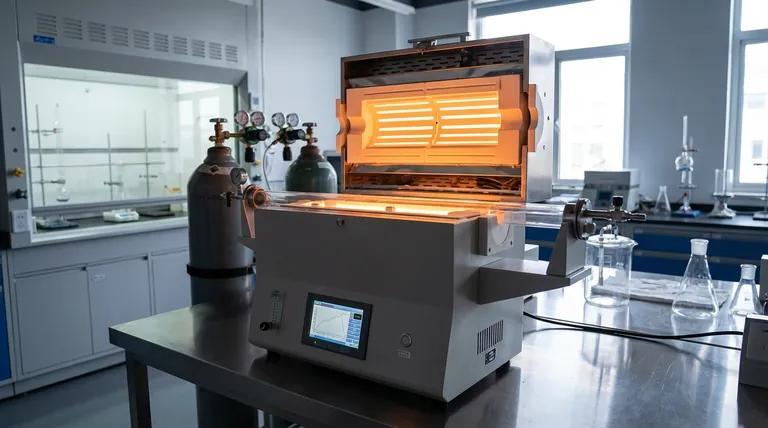
The Illusion of Simplicity
At first glance, a tube furnace seems simple: a heated chamber. An oven for scientists.
But this perspective misses the profound challenge at the heart of materials science. The goal isn't just to make things hot. The goal is to create a perfect, isolated universe—a pocket of absolute control where new forms of matter can be willed into existence, reliably and repeatedly.
The real workhorse of advanced research is not heat, but control. The psychological burden on any researcher is eliminating variables. A tube furnace is, at its core, an instrument for mastering the void.
The Tyranny of Unseen Variables
Creating the materials that define our future—from semiconductors to next-generation alloys—is a battle against environmental chaos. Every stray oxygen molecule or micro-degree fluctuation is a potential point of failure.
This is where the tube furnace’s true value emerges: its ability to impose order on two fundamental fronts.
The Pursuit of Thermal Equilibrium
A material doesn't care about the average temperature; it responds to the specific temperature it experiences at every point in its structure. Inconsistency breeds defects.
A tube furnace is engineered to create a "hot zone," a region of such uniform temperature that the material can be processed as a whole. This isn't just a technical feature; it's a prerequisite for trust.
- For annealing, it ensures stresses are relieved evenly, preventing weak points.
- For crystal growth, it provides the stability needed for atoms to arrange themselves into a flawless lattice.
Without this uniformity, every result is suspect, and repeatability—the cornerstone of science—is lost.
Sculpting the Atmosphere
Many of the most promising materials are incredibly reactive at high temperatures. Exposed to open air, they would instantly oxidize, becoming something other than what was intended.
The sealed chamber of a tube furnace allows researchers to dictate the exact atmospheric conditions. This is like giving a sculptor perfect marble instead of a crumbling block of sandstone.
- A vacuum removes the "noise" of atmospheric contaminants.
- An inert gas like argon provides a neutral, protective blanket.
- A flow of reactive gases becomes a precise tool, driving specific chemical reactions on a material's surface.
This is how we move from crude heating to sophisticated, molecular-level engineering.
From Control to Creation: The Alchemist's Modern Toolkit
With this precise control over temperature and atmosphere, a tube furnace becomes a versatile platform for fundamental material transformations.
Building from the Atom Up: Synthesis & Nanomaterials
The furnace is where we construct materials that cannot exist naturally. In Chemical Vapor Deposition (CVD), precursor gases flow through the controlled hot zone, reacting and depositing onto a substrate as an impossibly thin, perfect film. This is the magic behind semiconductors and advanced coatings.
Similarly, processes like pyrolysis use this oxygen-free environment to thermally decompose materials, forming the building blocks of carbon nanotubes and graphene.
Forging Strength from Within: Heat Treatment
Heat treatment is the art of changing a material's inner character.
- Sintering takes fine powders and fuses them into a dense, solid object—essential for high-performance ceramics and metal parts.
- Annealing softens metals and glasses, increasing their ductility and relieving internal stresses that could lead to catastrophic failure.
These are not brute-force processes; they are carefully choreographed thermal cycles designed to optimize a material's microstructure.
The Pragmatist's Compromise: Understanding Boundaries
No tool is universal. The genius of an engineer or scientist is in knowing the limits of their instruments.
| Limitation | Technical Consideration | Strategic Implication |
|---|---|---|
| Sample Size | The diameter of the process tube limits the physical size of the sample. | Ideal for R&D and pilot batches, not mass production. |
| Temp. Gradients | Temperature is perfectly uniform only in the central hot zone, dropping off at the ends. | Requires careful sample placement for uniformity or can be leveraged for gradient studies. |
| Material Compatibility | The process tube itself is a variable. Quartz is common but has a ~1200°C limit. Alumina goes higher but can be brittle. | The tube material must be inert to your process chemistry and stable at your target temperature. |
Aligning the Tool with the Vision
Choosing the right instrument begins with a clear understanding of the scientific question. The furnace is not just a piece of hardware; it is an extension of your research objective.
- For Novel Synthesis (CVD, Nanotubes): Your primary need is impeccable atmospheric control. Airtight seals and precision mass-flow controllers are non-negotiable.
- For Material Improvement (Alloys, Ceramics): You require programmable, repeatable temperature cycles. The focus is on the precision of the thermal journey for processes like sintering and annealing.
- For High-Temperature Analysis (>1200°C): The system's own material limits become critical. You need high-purity alumina tubes and robust heating elements that won't become a source of contamination.
This deep alignment between the research goal and the instrument's capability is where breakthroughs happen. Standard, off-the-shelf equipment can force compromises, but the most ambitious research demands a solution tailored to the problem. That's why KINTEK's foundation in R&D and manufacturing focuses on delivering customizable high-temperature systems—from Tube and Muffle Furnaces to complete CVD setups—that are built to serve a specific vision.
We provide the controlled environment so you can focus on discovering what's possible within it. If your research demands a universe built to your exact specifications, Contact Our Experts.
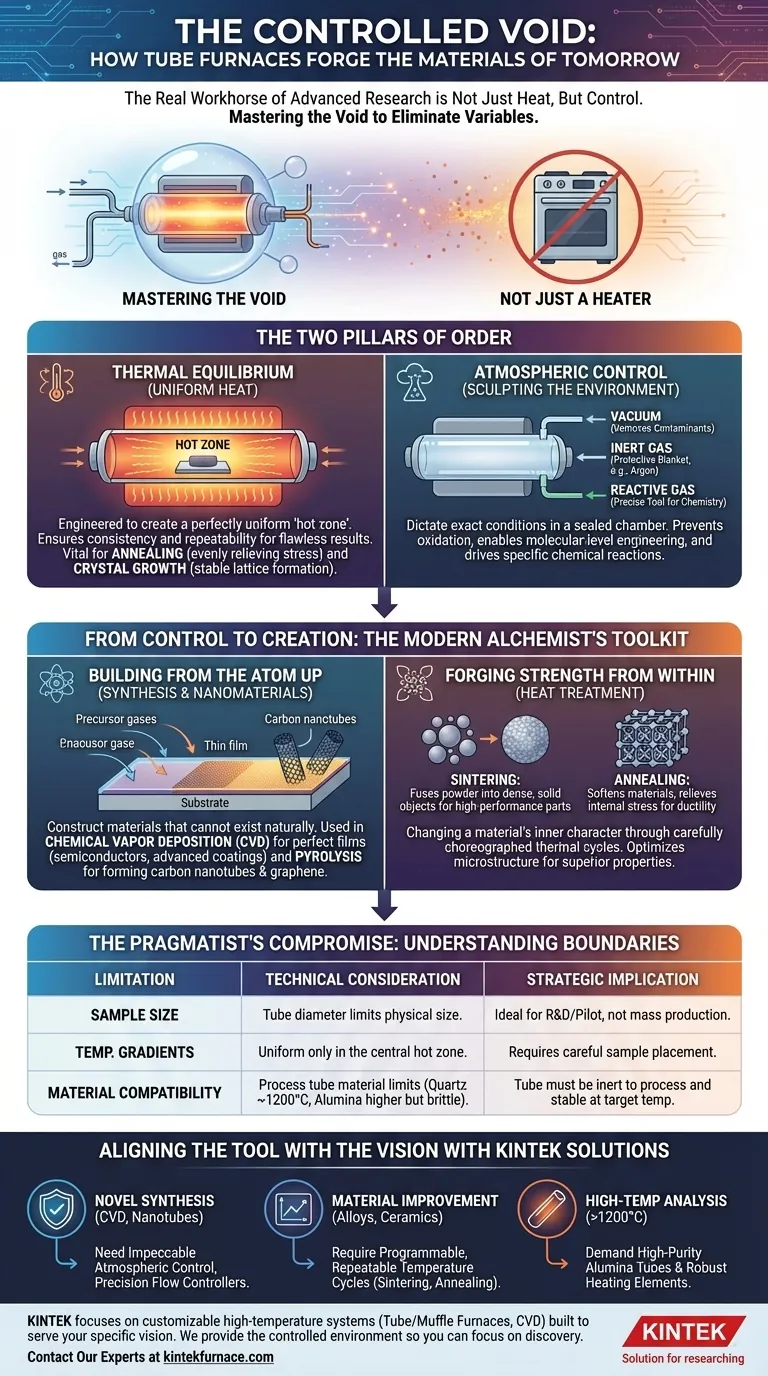
Visual Guide
Related Products
- Vacuum Sealed Continuous Working Rotary Tube Furnace Rotating Tube Furnace
- 1400℃ High Temperature Laboratory Tube Furnace with Alumina Tube
- 1700℃ High Temperature Laboratory Tube Furnace with Alumina Tube
- Magnesium Extraction and Purification Condensing Tube Furnace
- High Pressure Laboratory Vacuum Tube Furnace
Related Articles
- Beyond Heat: Mastering the Controlled Universe Inside a Tube Furnace
- Mastering the Void: How Tube Furnaces Forge the Atoms of Innovation
- Why Your Crystal Growth Experiments Are Failing: The Hidden Culprit in Your Tube Furnace
- The Art of Isolation: Mastering Material Properties with Tube Furnaces
- Beyond Heat: The Art of Control in a Tube Furnace



















