
The Experiment Was Perfect. The Results Were Not.
It’s a familiar scene in labs across the world. A researcher has spent weeks preparing a sample. The synthesis protocol is followed flawlessly. The high-temperature furnace runs its cycle, hitting the precise target temperature for the exact duration required.
Yet, the results are useless. An unknown element has contaminated the sample, invalidating the entire run. Or worse, a sharp crack is heard during cooldown—the sound of an expensive alumina tube fracturing, bringing research to a sudden halt.
The cause is rarely a flaw in the experiment itself. It’s a failure in what happens between experiments. It’s a failure of maintenance, driven not by negligence, but by human psychology.
The Paradox of Alumina
To understand why these tubes fail, we have to understand the material. Alumina is chosen for its remarkable properties: it is chemically inert and can withstand incredibly high temperatures. It is the silent, stable environment where new materials are born.
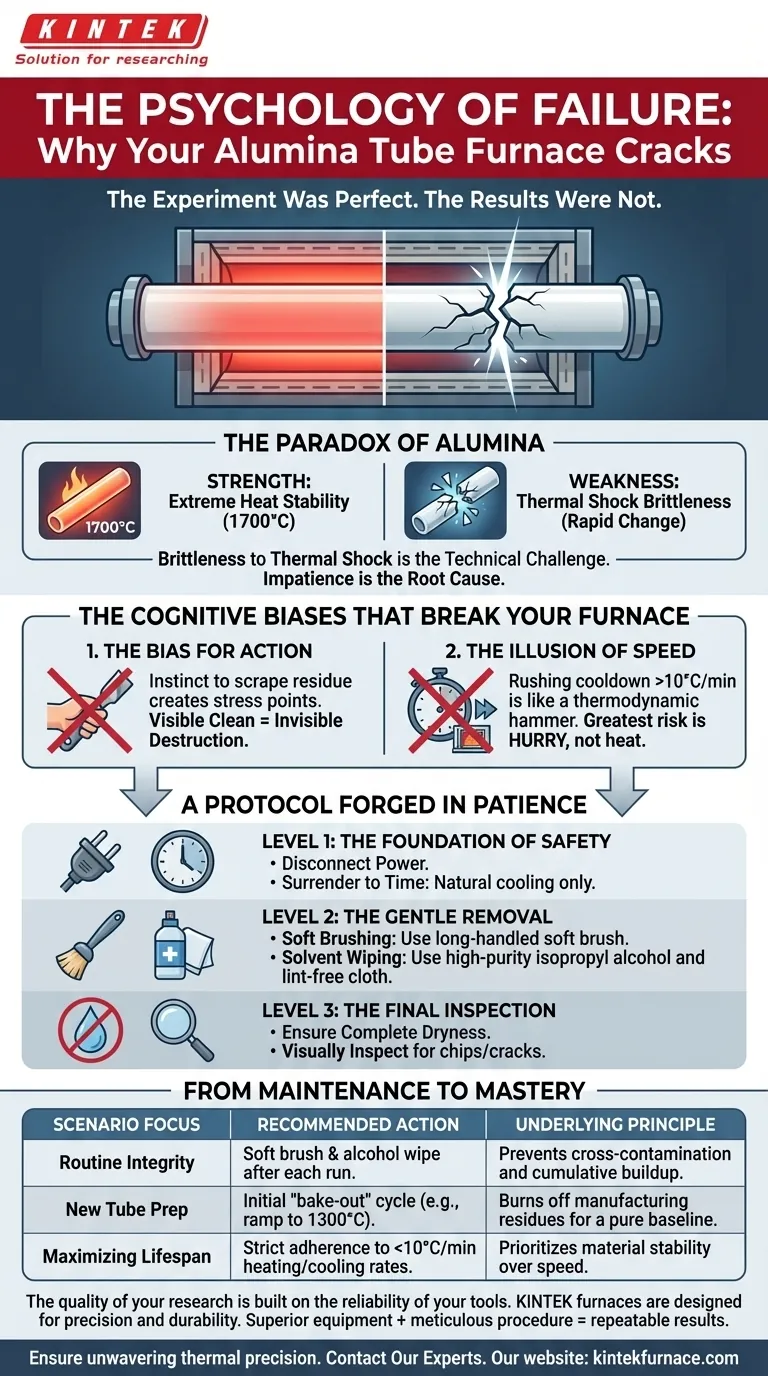
But alumina is a paradox. It scoffs at 1700°C but shatters from a rapid 100°C change. Its strength is in stability; its weakness is in transition.
This brittleness in the face of thermal shock is the central technical challenge. But the root cause of that shock is almost always a psychological one: impatience.
The Cognitive Biases That Break Your Furnace
Our brains are wired for efficiency and action, instincts that serve us well in many areas but become liabilities when dealing with high-temperature ceramics.
1. The Bias for Action
When we see a stubborn residue baked onto the tube wall, our instinct is to attack it. We reach for a metal tool to scrape it away because scrubbing feels productive.
This is a critical error. Gouging the alumina surface, even microscopically, creates stress concentration points. These tiny scratches become the epicenters of fractures during the next thermal cycle. The desire for a visibly clean tube leads to its invisible destruction.
2. The Illusion of Speed
The most common cause of tube failure is rushing the cooldown. An experiment is finished, and the pressure is on to get the next one started. Waiting hours for a furnace to cool from 1200°C to room temperature feels like wasted time.
But for the alumina tube, this slow, patient process is essential. A controlled cooling rate, typically no more than 10°C per minute, allows internal stresses to dissipate evenly. Forcing it to cool faster is like hitting it with a thermodynamic hammer. The greatest risk to your furnace isn't the heat; it's the hurry.
A Protocol Forged in Patience
Proper cleaning is not an act of force but a discipline of procedure. It is a ritual designed to counteract our worst instincts and preserve the integrity of both the equipment and the research.
Level 1: The Foundation of Safety
- Disconnect Power: Before anything else, ensure the furnace is completely disconnected from its power source.
- Surrender to Time: Allow the furnace to cool naturally to ambient temperature. This is the single most important step for preventing thermal shock. Do not open the furnace door to "help" it cool faster.
Level 2: The Gentle Removal
- Soft Brushing: Use a long-handled, soft-bristled polymer or natural brush to gently sweep out loose powders and debris. The goal is persuasion, not force.
- Solvent Wiping: For any remaining film, dampen a lint-free cloth with high-purity isopropyl alcohol and gently wipe the interior. The alcohol acts as a solvent, lifting contaminants without leaving its own residue.
Level 3: The Final Inspection
- Ensure Complete Dryness: Before the next run, verify the tube is bone-dry. Any trapped moisture will vaporize upon heating, creating a pressure shock that can crack the tube.
- Visually Inspect: Check for new chips or hairline cracks. Early detection prevents catastrophic failure.
From Maintenance to Mastery
Your cleaning strategy should be a conscious choice based on your application, not an afterthought.
| Scenario Focus | Recommended Action | The Underlying Principle |
|---|---|---|
| Routine Integrity | Soft brush & alcohol wipe after each run. | Prevents cross-contamination and cumulative buildup. |
| New Tube Prep | Initial "bake-out" cycle (e.g., ramp to 1300°C). | Burns off manufacturing residues for a pure baseline. |
| Maximizing Lifespan | Strict adherence to <10°C/min heating/cooling rates. | Prioritizes material stability over speed. |
The quality of your research is built on the reliability of your tools. A furnace is more than a box that gets hot; it is a controlled universe. Protecting its integrity is fundamental to the scientific process.
While this discipline rests with the operator, the foundation of reliability begins with well-engineered equipment. Furnaces from KINTEK, from Muffle and Tube furnaces to advanced CVD systems, are designed for precision and durability. Our deep customization capabilities ensure your equipment is perfectly matched to your research demands, providing a robust platform for discovery. It is the combination of superior equipment and meticulous procedure that yields truly repeatable results.
If your work demands unwavering thermal precision and reliability, let's ensure your equipment is a source of strength, not a variable. Contact Our Experts
Visual Guide
Related Products
- 1400℃ High Temperature Laboratory Tube Furnace with Alumina Tube
- 1700℃ High Temperature Laboratory Tube Furnace with Alumina Tube
- Magnesium Extraction and Purification Condensing Tube Furnace
- Vertical Laboratory Quartz Tube Furnace Tubular Furnace
- High Pressure Laboratory Vacuum Tube Furnace
Related Articles
- The Alchemy of Control: Mastering Material Properties with High-Temperature Tube Furnaces
- Beyond Max Temp: The Systems Thinking Approach to Selecting a High-Temperature Tube Furnace
- Why Your High-Temperature Experiments Fail: The Hidden Flaw in Your Furnace
- The Hidden Saboteur in Your HT-LiCoO2 Synthesis: Why Precise Ramp Rates Can Make or Break Your Battery Materials
- Why High-Purity Gas Fails Your High-Temp Brazing—And How Mono-Silane Doping Fixes It



















