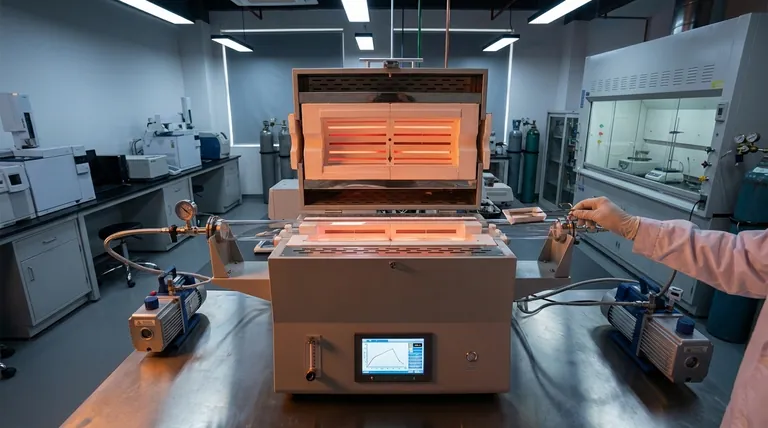
The Scientist's Dilemma: Taming Chaos
At the frontier of materials science, progress is a battle against variables. A single, stray oxygen molecule can poison a semiconductor wafer. A one-degree temperature fluctuation can ruin the growth of a perfect crystal.
The goal is not just to heat a sample, but to create a pocket of absolute certainty in a world of physical chaos. It's a psychological challenge as much as a technical one: how do you build an environment so pure and stable that your process, and only your process, dictates the outcome?
The answer, surprisingly, lies in one of engineering's most fundamental shapes: the cylinder.
The Core Principle: A Universe in a Tube
The profound versatility of the tube furnace comes from its elegant design. By enclosing the sample within a sealed tube, it achieves two critical objectives with remarkable efficiency: perfect atmospheric isolation and exceptional thermal uniformity.
This geometry is not an accident; it's the optimal solution for exerting control.
Mastering the Atmosphere
The defining feature of a tube furnace is its ability to hermetically seal an experiment from the outside world. This transforms the chamber from a simple oven into a controllable micro-environment.
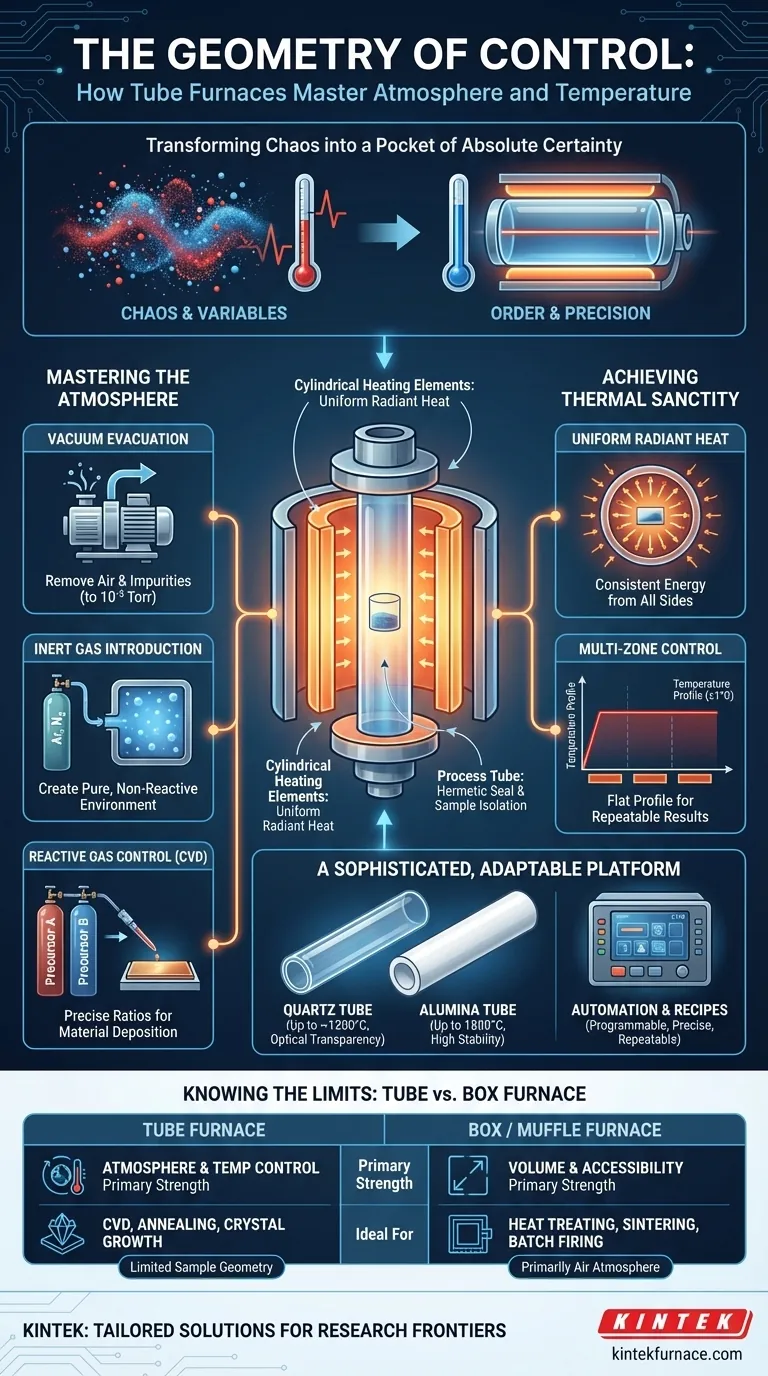
- Creating a Vacuum: You can evacuate the ambient air, removing reactive elements like oxygen and water vapor down to vacuum levels of 10⁻⁵ Torr or lower. This is non-negotiable for processes sensitive to oxidation.
- Introducing Purity: You can backfill the chamber with a specific, high-purity gas like argon or nitrogen to create an inert environment.
- Driving Reactions: You can introduce reactive gases in precise, controlled ratios, which is the entire basis for processes like Chemical Vapor Deposition (CVD), where precursor gases react to deposit a solid thin film onto a substrate.
For the researcher, this means the atmosphere is no longer a variable to worry about; it's a parameter to be set.
Achieving Thermal Sanctity
The cylindrical heating elements that surround the process tube naturally promote an even distribution of radiant heat. The sample, sitting in the center, receives energy uniformly from all sides.
Modern multi-zone furnaces elevate this control to an art form. By dividing the furnace into several independently controlled heating sections, they can create a temperature profile that is flat to within ±1°C. This level of thermal stability ensures that every part of a sample experiences the exact same conditions, leading to consistent, repeatable material properties.
From a Simple Tube to a Sophisticated Platform
While the core principles are simple, the modern tube furnace is a highly adaptable processing platform. This is where a deep understanding of materials and manufacturing becomes critical.
The Power of Interchangeability
The process tube itself is a modular component. The choice of material is a deliberate decision based on the experiment's demands:
- Quartz Tubes: Used for their high purity and optical transparency at temperatures up to ~1200°C, allowing for visual monitoring of a process.
- Alumina Tubes: Chosen for high-temperature applications (up to 1800°C) where excellent thermal stability and chemical resistance are paramount.
This ability to swap the core component means a single furnace can be reconfigured for wildly different chemical processes and temperature ranges.
Evolving for Automation and Precision
Today's systems are far more than just heaters. Integrated programmable controllers can execute complex, multi-step recipes of heating, cooling, and dwelling. Advanced gas mixing systems can deliver precise gas compositions automatically, removing the risk of human error.
This automation isn't just about convenience; it's about guaranteeing repeatability—a cornerstone of scientific and industrial progress.
Knowing the Limits: A Question of Geometry
No tool is perfect for every job. The tube furnace's greatest strength—its enclosed, cylindrical geometry—is also its primary constraint.
The tube inherently limits the size and shape of the sample. For processing large, bulky components or firing trays of many small parts in an air atmosphere, the geometry is impractical.
In these cases, a box (or muffle) furnace is the superior choice. Its large, accessible chamber prioritizes volume and ease of loading over atmospheric control. Understanding this trade-off is key to selecting the right instrument.
| Feature | Tube Furnace | Box/Muffle Furnace |
|---|---|---|
| Primary Strength | Atmosphere & Temperature Control | Volume & Accessibility |
| Ideal For | CVD, Annealing, Crystal Growth, Nanomaterials | Heat Treating, Sintering large parts, Batch Firing |
| Atmosphere | High Vacuum, Inert/Reactive Gas | Primarily Air (can be modified) |
| Sample Geometry | Limited by tube diameter | Large, irregular shapes, or multiple items |
The Right Tool for the Right Kind of Control
Ultimately, choosing a furnace is an act of identifying the most critical variable you need to control.
If your work depends on creating a pristine, tightly regulated atmosphere and a perfectly uniform thermal environment, the tube furnace is the unequivocal choice. It provides the most precise control over the conditions your material requires.
At KINTEK, we specialize in engineering that control. Backed by expert R&D and in-house manufacturing, we build Muffle, Tube, Rotary, and CVD furnace systems designed for the frontiers of research. Because we understand that every process is unique, we offer deep customization to create a furnace that is not just a tool, but a tailored solution to your specific challenge.
To build the ideal environment for your next discovery, Contact Our Experts.
Visual Guide
Related Products
- Vacuum Sealed Continuous Working Rotary Tube Furnace Rotating Tube Furnace
- 1400℃ High Temperature Laboratory Tube Furnace with Alumina Tube
- 1700℃ High Temperature Laboratory Tube Furnace with Alumina Tube
- Magnesium Extraction and Purification Condensing Tube Furnace
- High Pressure Laboratory Vacuum Tube Furnace
Related Articles
- Beyond Heat: Mastering the Controlled Universe Inside a Tube Furnace
- Mastering the Void: How Tube Furnaces Forge the Atoms of Innovation
- Why Your Crystal Growth Experiments Are Failing: The Hidden Culprit in Your Tube Furnace
- The Art of Isolation: Mastering Material Properties with Tube Furnaces
- Beyond Heat: The Art of Control in a Tube Furnace



















