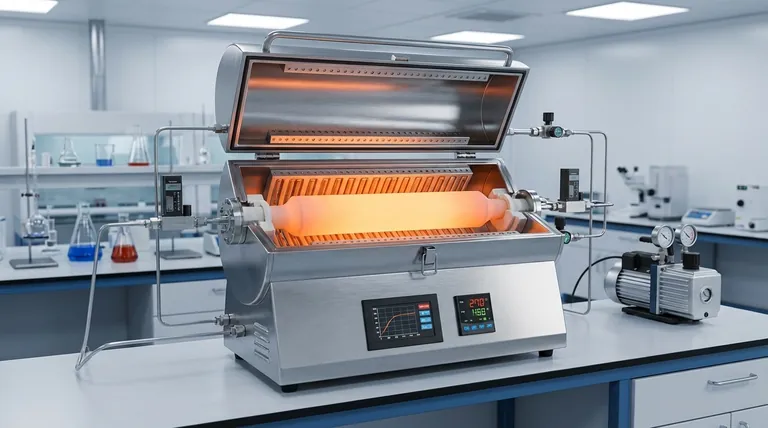
The Illusion of Simplicity
At first glance, a tube furnace seems deceptively simple: a heated ceramic tube. It evokes images of basic chemistry labs and high school experiments.
But this simplicity is an illusion.
In reality, a modern tube furnace is a miniature, controlled universe. It’s a precision instrument designed not just to generate heat, but to give scientists and engineers absolute dominion over the fundamental variables that govern matter: temperature, atmosphere, and pressure. Its power lies in its ability to create an environment that cannot exist in nature, allowing us to forge the materials of the future.
The Triad of Control
The story of material innovation is a story of control. To create something new—a stronger alloy, a more efficient semiconductor, a better catalyst—you must first master the conditions of its creation. The tube furnace is the arena where this mastery is practiced.
Absolute Temperature Authority
Heat is more than just energy; it's a tool for rearranging atoms. A tube furnace offers programmable controllers that can execute intricate thermal recipes—ramping up, soaking for hours, and cooling down with surgical precision.
Multi-zone configurations extend this control, creating a perfectly uniform temperature landscape along the tube. This isn't just about getting hot; it's about ensuring every part of a sample experiences the exact same thermal journey, a critical factor for repeatable, reliable results at temperatures soaring up to 1800°C.
Total Atmospheric Command
The sealed tube is the furnace's most defining feature. It allows an operator to do something profound: eliminate the Earth's atmosphere and replace it with a custom one.
By evacuating the chamber to a near-perfect vacuum (down to 10⁻⁵ torr) or flooding it with a specific gas—be it inert argon to prevent oxidation or reactive gases for deposition—we can dictate the chemical interactions that occur. This capability is the gateway to processes like Chemical Vapor Deposition (CVD), where new materials are built one atomic layer at a time.
A Universe on the Benchtop: The 70mm Standard
The 70mm inner diameter isn't arbitrary. It’s a carefully considered compromise, a "Goldilocks" dimension for the world of research and development.
It's large enough to process samples of a meaningful size or to run multiple experiments in parallel, providing valuable throughput for a lab setting. Yet, it remains compact enough to fit on a standard laboratory benchtop. This balance makes it the ideal platform for turning theoretical concepts into tangible prototypes, bridging the gap between an idea and a pilot-scale process.
Forging the Future: Applications in Focus
When you command the environment, you can command the outcome. This is why the tube furnace is a cornerstone instrument across a spectrum of advanced fields.
Material Science: Teaching Metals New Tricks
In the hands of a materials scientist, the furnace is a crucible for heat treatment. Processes like annealing relieve internal stresses in metals, making them less brittle. Sintering takes fine ceramic powders and fuses them into a dense, solid object. The inert atmosphere is the silent guardian, preventing unwanted oxidation that could ruin the final product.
Chemical Engineering: The Catalyst's Birthplace
For a chemical engineer, the furnace is where catalysts are born and activated. Calcination, a process of controlled heating in a specific gas flow, purges impurities and prepares the catalyst's structure for its reactive mission. It's a fundamental step in creating the agents that drive a vast portion of our industrial economy.
Nanotechnology: Building Atom by Atom
This is where the furnace becomes truly futuristic. It is the chamber for synthesizing nanomaterials like graphene and carbon nanotubes via CVD. Precursor gases flow into the glowing tube, decompose on a substrate, and deposit a film of material with atomic-level perfection. This process is the foundation of the entire semiconductor industry.
The Operator’s Dilemma: Navigating Physical Limits
This power comes with responsibility and an understanding of the instrument's inherent trade-offs. The scientist’s mindset is as crucial as the hardware itself.
The Vessel's Soul: Choosing the Right Tube
The process tube itself defines the boundaries of your experimental universe. Each material offers a different set of rules:
- Quartz: The choice for purity and high vacuum, but it bows to heat above ~1100°C.
- Alumina: The high-temperature champion, capable of enduring 1700°C or more, but it demands respect, being sensitive to rapid temperature changes (thermal shock).
- Stainless Steel: The rugged workhorse, but it has lower temperature limits and can be a source of contamination for hyper-sensitive experiments.
The Burden of Purity
Achieving a controlled outcome requires obsessive process integrity. A fingerprint, a trace of moisture, or a microscopic dust particle can become a catastrophic contaminant at 1000°C under vacuum. The discipline of cleaning, preparation, and following procedure is not bureaucracy; it is the bedrock of valid science.
From Controlled Environment to Predictable Outcome
Ultimately, the goal of research isn't just to heat a sample; it's to create a specific, predictable, and repeatable result. This requires a tool that is not merely powerful, but perfectly tailored to the scientific question being asked.
Achieving this level of granular control requires deep expertise in thermal systems and materials. KINTEK's foundation in R&D and in-house manufacturing provides just that—a range of Muffle, Rotary, Vacuum, and CVD furnaces designed for precision. More importantly, their deep customization capabilities mean you are not just buying a furnace; you are commissioning the exact controlled environment your research demands.
Whether you are exploring new alloys, synthesizing next-generation catalysts, or depositing novel thin films, having the right instrument is the first step toward discovery. To configure the perfect thermal solution for your specific goals, Contact Our Experts.
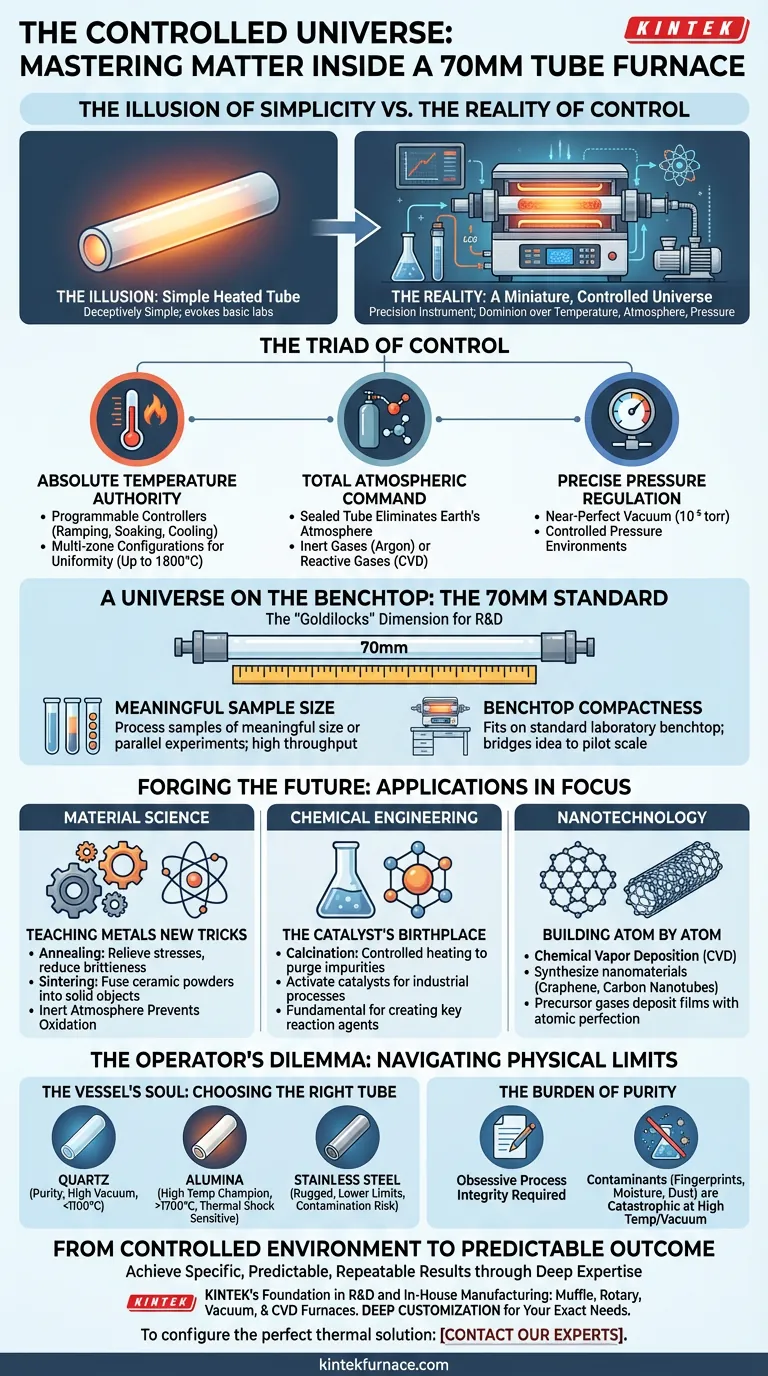
Visual Guide
Related Products
- Vacuum Sealed Continuous Working Rotary Tube Furnace Rotating Tube Furnace
- 1400℃ High Temperature Laboratory Tube Furnace with Alumina Tube
- 1700℃ High Temperature Laboratory Tube Furnace with Alumina Tube
- Magnesium Extraction and Purification Condensing Tube Furnace
- High Pressure Laboratory Vacuum Tube Furnace
Related Articles
- Beyond Heat: Mastering the Controlled Universe Inside a Tube Furnace
- Mastering the Void: How Tube Furnaces Forge the Atoms of Innovation
- Why Your Crystal Growth Experiments Are Failing: The Hidden Culprit in Your Tube Furnace
- The Art of Isolation: Mastering Material Properties with Tube Furnaces
- Beyond Heat: The Art of Control in a Tube Furnace



















