Imagine a materials scientist spending weeks developing a novel ceramic powder. The final step is sintering—a precise heating process to fuse the particles into a solid, high-strength component. They place the sample in a furnace, set the temperature, and wait.
Hours later, they pull it out. It’s warped, with micro-cracks spiderwebbing across the surface. The experiment is a failure.
The cause wasn't a mistake in the formula or a flaw in the process. It was an invisible enemy: a few degrees of temperature variation across the furnace chamber. A "hot spot."
This scenario highlights a fundamental truth in materials science and chemistry: precision heating isn't about reaching a target temperature. It's about creating an environment of absolute thermal uniformity. This is the core challenge tube furnaces are engineered to solve.
It's a system built on trust, where digital intelligence and physical design work in concert.
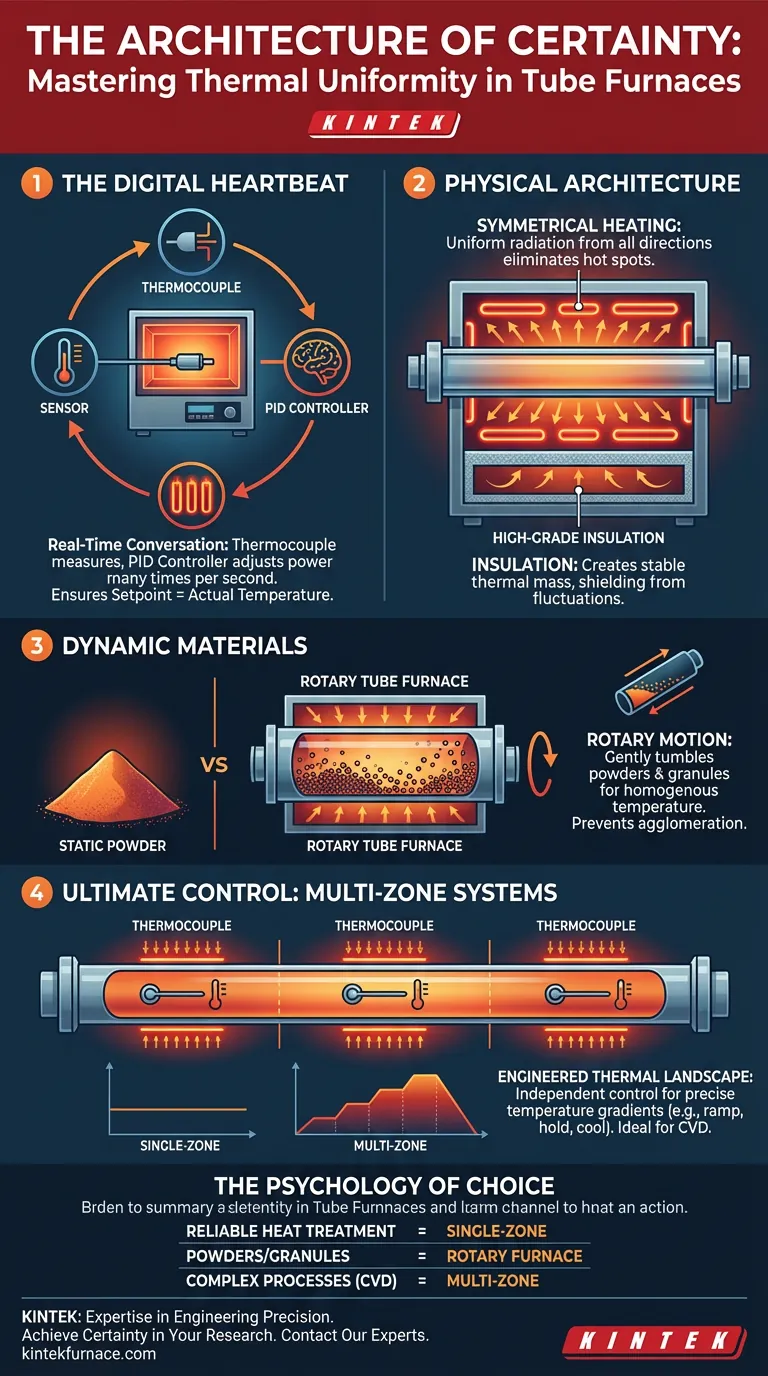
The Digital Heartbeat: A Conversation in Real-Time
A furnace’s ability to maintain a set temperature feels simple, but it relies on a constant, high-speed feedback loop—a digital nervous system.
The Sensor and The Brain
- The Thermocouple: This is the nerve ending. A highly sensitive temperature sensor placed within the heating chamber, it constantly measures the thermal reality of the environment.
- The PID Controller: This is the brain. It receives data from the thermocouple and compares it to the desired setpoint.
This isn't a simple on/off switch. The controller is constantly making micro-adjustments, increasing or decreasing power to the heating elements. This perpetual conversation, happening many times a second, is the first line of defense against temperature drift. It ensures the temperature you set is the temperature you get.
The Physical Architecture of Trust
An intelligent controller is useless if the furnace's body is poorly designed. Uniformity is ultimately a physical property, an architecture designed to eliminate thermal chaos.
Symmetrical Heating
Heating elements are not placed arbitrarily. They are strategically positioned around the entire circumference of the process tube.
This ensures thermal energy radiates inward from all directions simultaneously, enveloping the sample in a perfectly balanced field of heat. It removes the possibility of one side being hotter than another.
Containing The Energy
High-grade ceramic fiber insulation is arguably the unsung hero of thermal stability.
Its primary job is obvious: prevent heat from escaping. But its more critical role is to create a stable, predictable thermal mass. By trapping heat, the insulation ensures that the internal environment is shielded from outside fluctuations and that the radiant energy remains consistent. It turns the chamber into its own self-contained, stable universe.
When Static Isn't Enough: Mastering Dynamic Materials
For solid, stationary samples, the combination of digital control and physical design is often sufficient. But what about powders, granules, or materials that can clump together?
This is where the problem becomes one of physics, not just heat. A static powder pile will always have particles on the inside that are insulated by their neighbors, creating inevitable cold spots.
The Power of Motion
This is why Rotary Tube Furnaces exist. By continuously rotating the process tube, the furnace gently tumbles the material inside.
- Every particle is systematically exposed to the radiant heat source.
- Agglomeration is prevented.
- The entire batch achieves a homogenous temperature.
For processes requiring a continuous flow, some rotary furnaces also tilt, using gravity to ensure a consistent residence time as material moves through the heating zone.
The Ultimate Control: Engineering a Thermal Landscape
The most demanding applications, like chemical vapor deposition (CVD), require more than just a uniform temperature. They may need a perfectly controlled temperature gradient—a thermal journey for the material.
Multi-Zone Heating Systems
Advanced furnaces divide the tube into multiple, independently controlled heating zones.
| Zone Type | Control Capability | Ideal Application |
|---|---|---|
| Single-Zone | A single, uniform temperature across the furnace length. | General heat treatment, annealing, sintering simple samples. |
| Multi-Zone | A series of independent temperatures along the furnace length. | CVD, crystal growth, complex processes requiring a precise thermal profile. |
Each zone has its own thermocouple and heating elements. This allows a researcher to either maintain an incredibly precise and uniform temperature over a long area or deliberately engineer a profile—for example, a ramp-up zone, a stable reaction zone, and a cool-down zone, all within the same process tube.
The Psychology of Choice: Matching Precision to Purpose
The temptation in science is to seek the most advanced tool available. But true efficiency comes from matching the tool to the specific task. The choice of a furnace is a psychological balance between the need for certainty and the constraints of complexity and budget.
- For reliable heat treatment of solid parts, a standard single-zone furnace is a trusted workhorse.
- For powders, granules, or anything prone to uneven heating, the mechanical motion of a rotary furnace is non-negotiable.
- For complex, multi-stage processes like CVD, a multi-zone furnace provides the only path to success.
At KINTEK, we specialize in manufacturing this full spectrum of solutions—from Muffle and Tube Furnaces to advanced Rotary, Vacuum, and CVD systems. Our expertise lies in understanding these trade-offs and engineering a furnace that provides the precise level of uniformity your work demands. True precision is born from a system where every component works in harmony.
To achieve the certainty your research deserves, you need a furnace built on this principle. Contact Our Experts
Visual Guide
Related Products
- Vacuum Sealed Continuous Working Rotary Tube Furnace Rotating Tube Furnace
- 1400℃ High Temperature Laboratory Tube Furnace with Alumina Tube
- 1700℃ High Temperature Laboratory Tube Furnace with Alumina Tube
- Magnesium Extraction and Purification Condensing Tube Furnace
- High Pressure Laboratory Vacuum Tube Furnace
Related Articles
- Beyond Heat: Mastering the Controlled Universe Inside a Tube Furnace
- Mastering the Void: How Tube Furnaces Forge the Atoms of Innovation
- Why Your Crystal Growth Experiments Are Failing: The Hidden Culprit in Your Tube Furnace
- The Art of Isolation: Mastering Material Properties with Tube Furnaces
- Beyond Heat: The Art of Control in a Tube Furnace



















