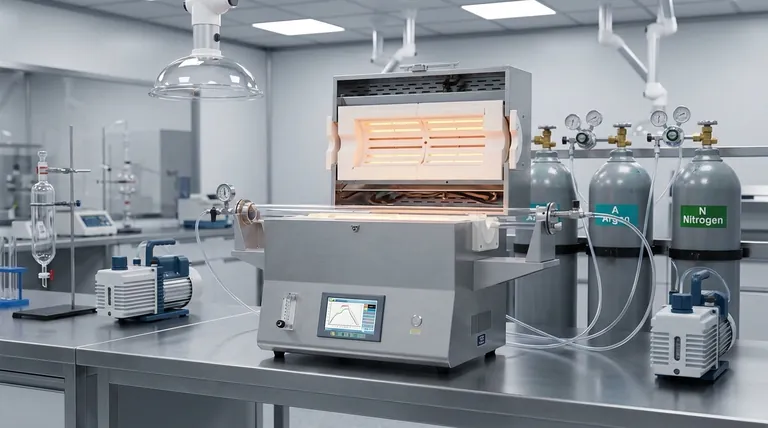
The Illusion of Simple Heat
In the pursuit of scientific discovery, control is not a luxury; it is the entire game. We think of heating a material as a simple act of raising its temperature. But for a materials scientist synthesizing a new alloy or a researcher growing a perfect crystal, "heat" is a clumsy, chaotic force.
The real challenge isn't just generating high temperatures. It's creating an environment of absolute predictability. It's isolating a sample from the world so that the only variable at play is the one you are testing. This psychological need for order in the face of molecular chaos is the very reason the tube furnace exists. It's not just an oven; it's an instrument of control.
Creating an Island of Thermal Uniformity
The genius of the tube furnace lies in its elegant simplicity. Heating elements encircle a ceramic or quartz tube, bathing the sample inside with radiant energy from all directions simultaneously.
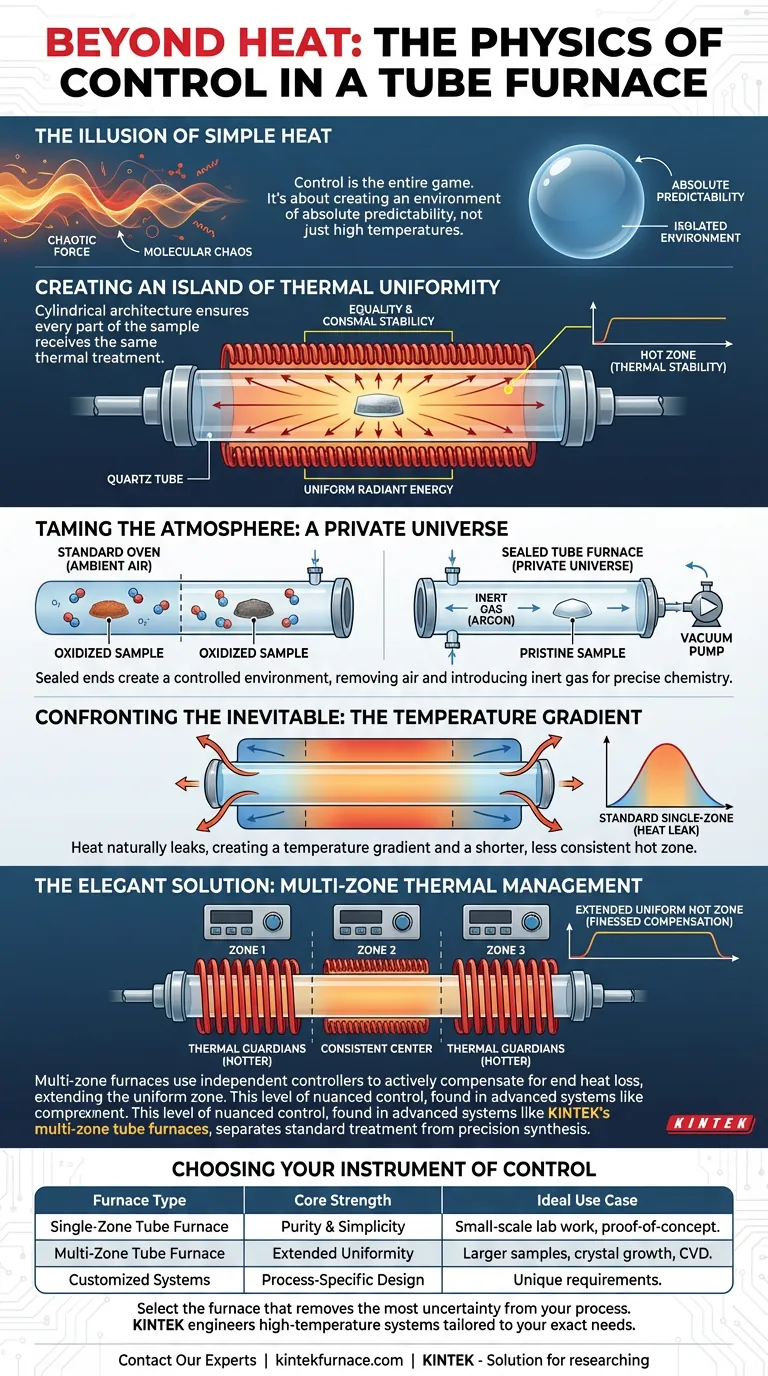
This cylindrical architecture ensures that the central portion of the tube—the "hot zone"—becomes a realm of exceptional thermal stability. It's an architecture of equality, ensuring every part of the sample within this zone receives the same thermal treatment. For a researcher, this uniformity isn't just a technical specification; it's peace of mind. It eliminates the doubt that one part of the sample was processed differently from another.
Taming the Atmosphere: A Private Universe
The true power of a tube furnace is revealed when its ends are sealed. Suddenly, the interior is no longer a part of our world. It becomes a private universe where the laws of chemistry can be dictated by the researcher, not by the random composition of ambient air.
Imagine trying to anneal a sensitive metal that instantly oxidizes in the presence of oxygen. In a standard oven, the task is impossible. In a sealed tube furnace, you can pull a vacuum to remove the air entirely, then introduce a pure, inert gas like argon. This atmospheric control is the key that unlocks processes from creating advanced semiconductors to purifying materials to a level once thought impossible.
Confronting the Inevitable Imperfection: The Temperature Gradient
Physics, however, is a stubborn partner. Heat, like any form of energy, seeks to escape. In a standard single-zone tube furnace, the ends of the tube will always be slightly cooler than the dead center. Heat leaks out into the cooler surrounding environment.
For some experiments, this gradient is irrelevant. But for processes requiring a longer, perfectly consistent hot zone—perhaps for treating a larger sample or for a continuous process—this natural phenomenon becomes a critical limitation. It introduces an unwelcome variable, the very thing the furnace was designed to eliminate.
The Elegant Solution: Multi-Zone Thermal Management
How do you fight a fundamental law of physics? With smarter engineering. This is the purpose of the multi-zone furnace.
Instead of one set of heating elements, a three-zone furnace has three, each with its own independent controller. The two outer zones are programmed to run slightly hotter than the center zone. They act as thermal "guardians," actively pumping in extra energy to compensate for the heat that is naturally lost at the ends.
The result is a dramatically longer and more uniform hot zone. This isn't brute force; it's finessed compensation. This level of nuanced control, found in advanced systems like KINTEK's multi-zone tube furnaces, is what separates standard heat treatment from precision material synthesis.
Choosing Your Instrument of Control
Selecting the right furnace is not about finding the highest temperature or the biggest chamber. It's about matching the instrument's control capabilities to the specific uncertainties of your process.
| Furnace Type | Core Strength | Ideal Use Case |
|---|---|---|
| Single-Zone Tube Furnace | Purity & Simplicity | Small-scale lab work, proof-of-concept synthesis. |
| Multi-Zone Tube Furnace | Extended Uniformity | Processing larger samples, crystal growth, CVD. |
| Customized Systems | Process-Specific Design | Unique requirements where standard models fail. |
Ultimately, the right furnace is the one that removes the most uncertainty between your hypothesis and your result. For some, a simple, reliable single-zone furnace is perfect. For those pushing the boundaries, the extended control of a multi-zone system is essential. And for true pioneers, off-the-shelf solutions are just the starting point.
At KINTEK, our deep expertise in R&D and in-house manufacturing allows us to engineer high-temperature systems tailored to your exact needs. Contact Our Experts to build the precise environment your research deserves.
Visual Guide
Related Products
- Vacuum Sealed Continuous Working Rotary Tube Furnace Rotating Tube Furnace
- 1400℃ High Temperature Laboratory Tube Furnace with Alumina Tube
- 1700℃ High Temperature Laboratory Tube Furnace with Alumina Tube
- Magnesium Extraction and Purification Condensing Tube Furnace
- High Pressure Laboratory Vacuum Tube Furnace
Related Articles
- Beyond Heat: Mastering the Controlled Universe Inside a Tube Furnace
- Mastering the Void: How Tube Furnaces Forge the Atoms of Innovation
- Why Your Crystal Growth Experiments Are Failing: The Hidden Culprit in Your Tube Furnace
- The Art of Isolation: Mastering Material Properties with Tube Furnaces
- Beyond Heat: The Art of Control in a Tube Furnace



















