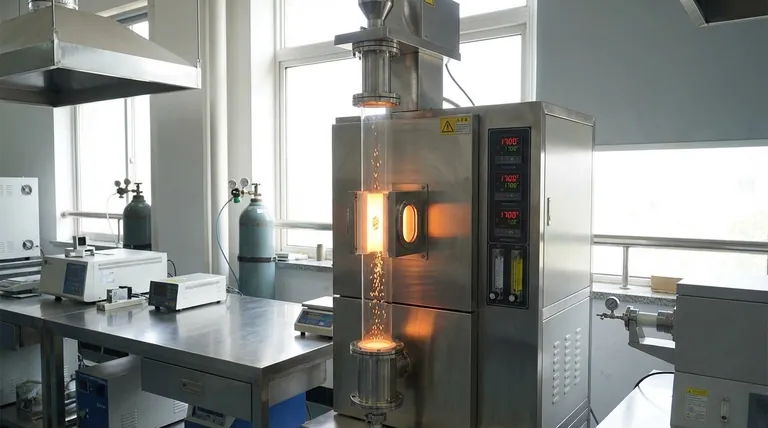
The Scientist's Dilemma: Time vs. Temperature
Imagine trying to replicate an industrial combustion process that happens in milliseconds, inside a massive power plant boiler, but on your lab bench.
The core problem isn't just reaching 1500°C. The real challenge is controlling how a single particle experiences that heat. Does it sit and bake for an hour? Or does it flash through the hot zone in the blink of an eye?
This isn't a question of temperature. It's a question of time and trajectory. And for this, a conventional oven is the wrong tool for the job. We often fall into the cognitive trap of using the tool we have, not the one the problem demands.
Gravity as a Precision Instrument
A drop tube furnace is engineered around a simple, powerful, and often overlooked force: gravity.
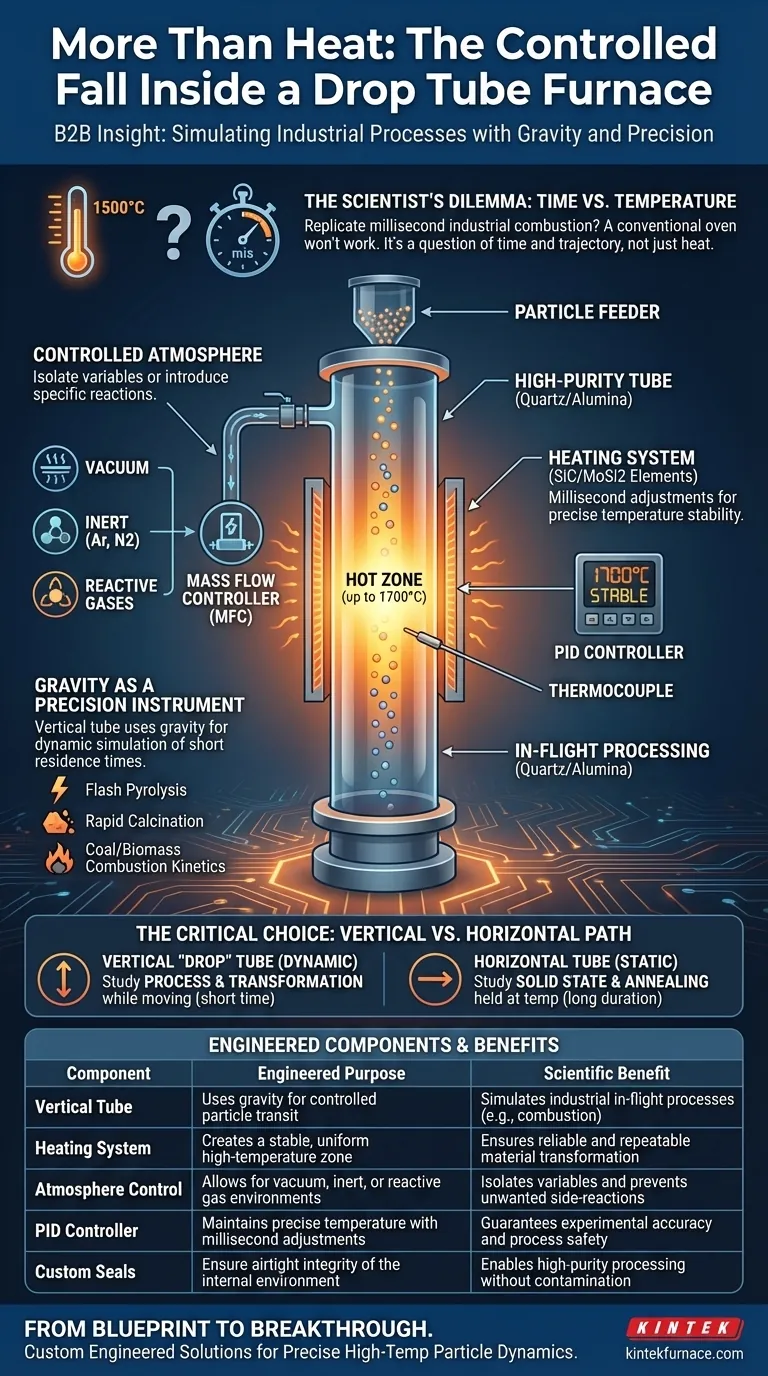
Its defining feature—the vertical furnace tube—isn't an arbitrary design choice. It's a deliberate act of using gravity as a transport mechanism. It transforms the furnace from a static heating chamber into a dynamic process simulator.
By introducing powdered or particulate samples at the top, they fall freely and consistently through a precisely engineered thermal profile. This "in-flight" processing is the only way to accurately study phenomena with short residence times, such as:
- Flash pyrolysis
- Rapid calcination
- Coal or biomass combustion kinetics
The furnace becomes a miniature, controlled version of the massive industrial reactors it's designed to simulate.
The Unseen Guardian: Material Purity
The heart of this system is the furnace tube itself. At temperatures where steel would sag and melt, we rely on high-purity ceramics.
- Quartz: The clear choice for processes up to ~1200°C, offering excellent thermal shock resistance.
- Alumina (Corundum): The workhorse for extreme temperatures, often exceeding 1700°C, ensuring minimal sample contamination when purity is paramount.
The choice of material is an act of foresight—a defense against the unseen variable of contamination that can invalidate an entire experimental campaign.
Engineering an Alternate Reality
The true power of a drop tube furnace is revealed when you control what’s inside the tube. Heat is just one ingredient; atmosphere is the other.
A World Without (or With) Air
A robust sealing system, often using water-cooled flanges, allows you to create a perfect blank canvas. By first pulling a vacuum, you remove the unpredictable influence of ambient air.
From there, you can write the rules of the environment:
- Inert Atmosphere: Backfill with Argon or Nitrogen to create a shield, preventing oxidation and isolating the effects of pure thermal decomposition.
- Reactive Atmosphere: Introduce specific oxidizing or reducing gases to directly study their chemical interaction with the falling particles.
This control is managed with the precision of a digital Mass Flow Controller (MFC), ensuring that every experiment is identical and repeatable.
The Discipline of a Perfect Climate
Maintaining a stable 1700°C hot zone requires relentless discipline. This is the job of the PID (Proportional-Integral-Derivative) controller.
Think of it not as a simple thermostat, but as a vigilant guardian. It receives constant feedback from a thermocouple and makes micro-adjustments to the power flowing to the heating elements (like SiC or MoSi2) thousands of times per minute. It’s this digital vigilance that holds the temperature steady, preventing the ruinous fluctuations that could corrupt your data.
The Critical Choice: A Vertical Drop or a Horizontal Path?
The orientation of the furnace tube dictates its purpose. This choice is fundamental and non-negotiable.
-
Vertical "Drop" Tube: Choose this when your research question is about a process. You are studying how particles transform while moving through a thermal gradient for a short, defined time.
-
Horizontal Tube: Choose this for a static state. You are studying what a solid sample becomes after being held at a specific temperature for a longer, controlled duration, such as in annealing or certain CVD processes.
Confusing the two is like using a stopwatch to measure a mile. You're using the wrong instrument for the variable you care about.
From Blueprint to Breakthrough
The specifications we've discussed—tube material, atmosphere control, temperature stability—are not just features on a datasheet. They are the variables you must control to get reliable answers to your research questions.
An off-the-shelf furnace forces you to adapt your experiment to the tool's limitations. But groundbreaking research often requires a tool built for the experiment.
This is where design and manufacturing expertise become critical. Building a system that integrates a specific feeder, a high-purity alumina tube, and a water-cooled collection vessel isn't just assembly; it's the creation of a unique scientific instrument. At KINTEK, we specialize in this process. Our deep R&D and in-house manufacturing capabilities allow us to build custom Muffle, Tube, and Vacuum furnaces precisely engineered for unique applications like these.
The right tool doesn't just make the work easier; it makes new questions possible.
| Component | Engineered Purpose | Scientific Benefit |
|---|---|---|
| Vertical Tube | Uses gravity for controlled particle transit | Simulates industrial in-flight processes (e.g., combustion) |
| Heating System | Creates a stable, uniform high-temperature zone | Ensures reliable and repeatable material transformation |
| Atmosphere Control | Allows for vacuum, inert, or reactive gas environments | Isolates variables and prevents unwanted side-reactions |
| PID Controller | Maintains precise temperature with millisecond adjustments | Guarantees experimental accuracy and process safety |
| Custom Seals | Ensure airtight integrity of the internal environment | Enables high-purity processing without contamination |
Building the perfect experimental setup requires a partner who understands the physics behind the blueprint. If your work demands precise control over high-temperature particle dynamics, we can help you engineer the exact solution you need. Contact Our Experts
Visual Guide
Related Products
- Vacuum Sealed Continuous Working Rotary Tube Furnace Rotating Tube Furnace
- Slide PECVD Tube Furnace with Liquid Gasifier PECVD Machine
- Custom Made Versatile CVD Tube Furnace Chemical Vapor Deposition CVD Equipment Machine
- 1200℃ Split Tube Furnace Laboratory Quartz Tube Furnace with Quartz Tube
- Laboratory Vacuum Tilt Rotary Tube Furnace Rotating Tube Furnace
Related Articles
- Beyond Heat: Mastering the Controlled Universe Inside a Tube Furnace
- Mastering the Void: How Tube Furnaces Forge the Atoms of Innovation
- Why Your Crystal Growth Experiments Are Failing: The Hidden Culprit in Your Tube Furnace
- The Art of Isolation: Mastering Material Properties with Tube Furnaces
- Beyond Heat: The Art of Control in a Tube Furnace



















