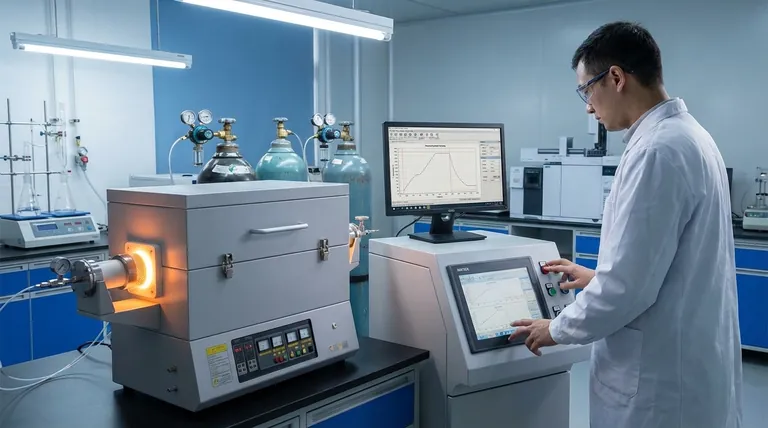
The Instrument and the Operator
An experiment fails. The results are inconsistent. The material's properties drift from batch to batch. We instinctively blame the precursors, the sample preparation, or a flaw in the hypothesis.
We rarely blame the dial.
But the control system of a tube furnace isn't just a dial or a set of buttons. It's the central nervous system of your thermal process. The choice of controller is a strategic decision that reflects a deeper operational philosophy—a choice that defines the boundary between frustration and breakthrough.
It’s a decision about trust, repeatability, and the integrity of your work.
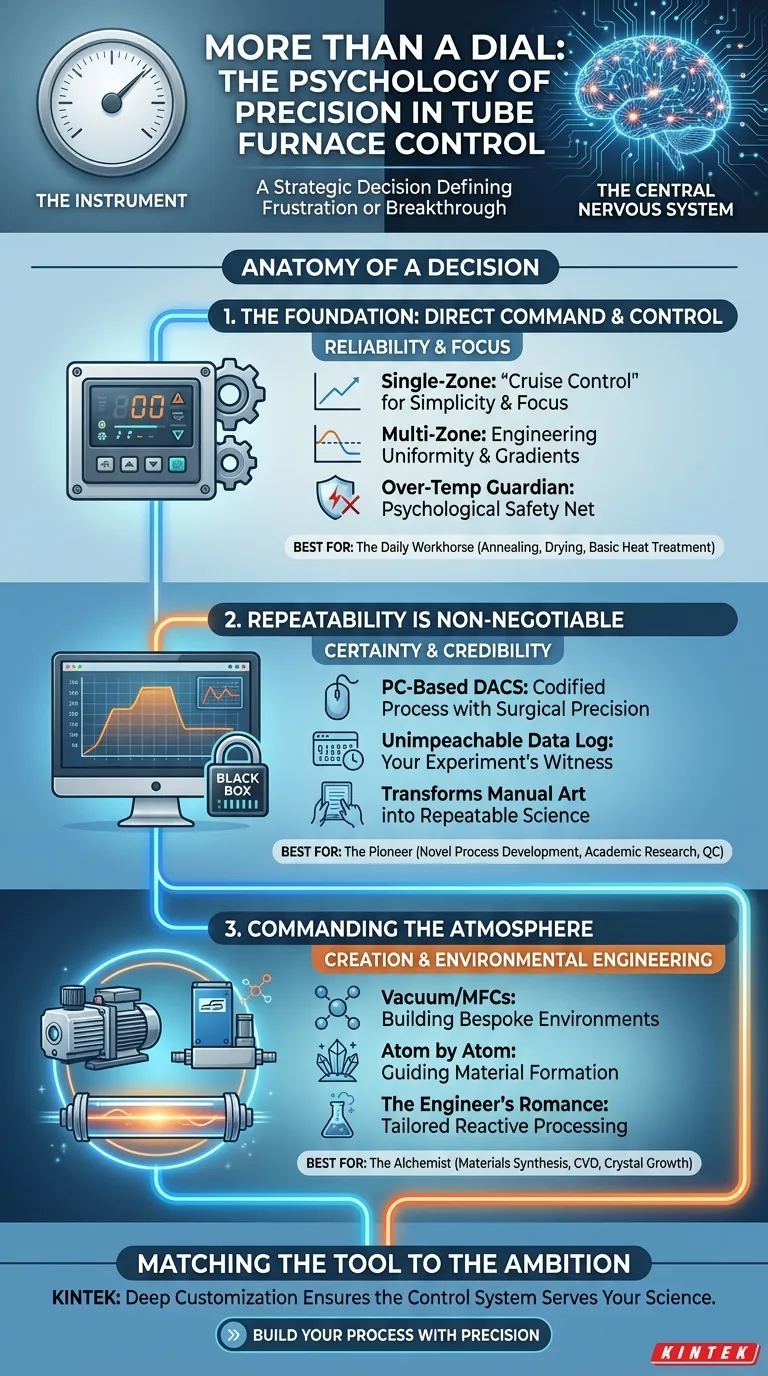
The Foundation: Direct Command and Control
At its most basic, a furnace must reliably reach and hold a temperature. The standard panel-mounted electronic controller is the time-tested tool for this job.
The Virtue of Simplicity
Think of a single-zone controller as the cruise control of your thermal process. You set a target, and it maintains that state with high fidelity. It is built for one purpose and executes it flawlessly. For routine tasks like annealing, drying, or simple heat treatments, this simplicity is not a limitation; it is a strength. It minimizes cognitive load and reduces the potential for operator error.
Engineering Uniformity and Gradients
When a process requires more nuance, multi-zone control comes into play. Instead of one controller managing the entire heated length, multiple independent controllers and sensors work in concert. This allows for two distinct possibilities:
- Exceptional Uniformity: Forcing a perfectly flat temperature profile across a long sample.
- Deliberate Gradients: Creating a controlled, sloping temperature profile, essential for processes like chemical vapor transport.
This is the first step away from "making something hot" and toward "engineering a precise thermal environment."
The Unseen Guardian
Every standard system is shadowed by an independent over-temperature controller. This isn't just a feature; it's a psychological safety net. It stands guard, ready to cut power if the primary system fails, protecting your sample, your furnace, and your lab. This silent guardian allows the researcher to focus on the science, confident that the instrument is protecting itself.
When Repeatability Becomes Non-Negotiable
For many, simple heating is not enough. The process itself is the experiment. This is where advanced control systems transform the furnace from a simple tool into a true research partner.
Your Process, Codified
Imagine defending your research. A reviewer questions the exact ramp rates and soak times of your thermal cycling. A manual logbook has a forgotten entry or a scribbled, ambiguous number. Your credibility hangs in the balance.
PC-based Data Acquisition and Control Software (DACS) solves this problem. It allows you to design complex, multi-step thermal profiles with surgical precision and execute them automatically. More importantly, it creates an unimpeachable, time-stamped digital record of every variable.
The Data as Your Witness
This automated log is the experiment's black box. It is objective proof that you did what you said you did. For quality control in manufacturing, for academic publication, or for GMP compliance, this level of data integrity is not a luxury—it is the foundation of trust. It turns a manual art into a repeatable science.
Commanding the Atmosphere
Many modern materials are born in environments devoid of oxygen, or within a carefully curated cocktail of reactive gases. Advanced systems integrate control over this atmosphere.
- Vacuum Systems: From simple rotary vane pumps to multi-stage turbo pumps, the controller can manage the evacuation of the process tube to create a clean, non-reactive environment.
- Mass Flow Controllers (MFCs): These devices are the heart of atmosphere control. They allow a computer to precisely mix multiple gases, creating specific reducing or inert atmospheres for processes like CVD or sintering.
This is where the engineer's romance truly lies—in the ability to build a bespoke environment, atom by atom, to guide a material's formation.
The Anatomy of a Decision
Choosing the right control system is a matter of matching the tool to the ambition of the task. It's a balance of capability, complexity, and cost.
| Control Level | Core Function | Psychological Driver | Best For |
|---|---|---|---|
| Integrated Controller | Set, ramp, soak, and hold temperature. | Reliability and Focus | The daily workhorse: annealing, drying, tempering, basic heat treatment. |
| PC-Based Software (DACS) | Program complex profiles, log all data. | Certainty and Credibility | The pioneer: novel process development, academic research, quality control. |
| Atmosphere/Vacuum Control | Manage gas flows and vacuum levels precisely. | Creation and Environmental Engineering | The alchemist: materials synthesis, CVD, crystal growth, reactive processing. |
A mismatch between your goal and your control system leads to friction. Too simple a system for a complex task creates unreliable data. Too complex a system for a simple task creates unnecessary overhead.
This philosophy—matching the tool precisely to the task—is central to how we approach furnace design at KINTEK. Our expertise in R&D and manufacturing allows us to craft solutions tailored to your real-world needs. Whether you require a robust tube furnace for daily heat treatment or a fully automated, multi-zone CVD system with integrated gas management, our deep customization capability ensures the control system serves your science, not the other way around.
To build a thermal process with the precision your work demands, Contact Our Experts.
Visual Guide
Related Products
- Vacuum Sealed Continuous Working Rotary Tube Furnace Rotating Tube Furnace
- 1400℃ High Temperature Laboratory Tube Furnace with Alumina Tube
- 1700℃ High Temperature Laboratory Tube Furnace with Alumina Tube
- Magnesium Extraction and Purification Condensing Tube Furnace
- High Pressure Laboratory Vacuum Tube Furnace
Related Articles
- Beyond Heat: Mastering the Controlled Universe Inside a Tube Furnace
- Mastering the Void: How Tube Furnaces Forge the Atoms of Innovation
- Why Your Crystal Growth Experiments Are Failing: The Hidden Culprit in Your Tube Furnace
- The Art of Isolation: Mastering Material Properties with Tube Furnaces
- Beyond Heat: The Art of Control in a Tube Furnace



















