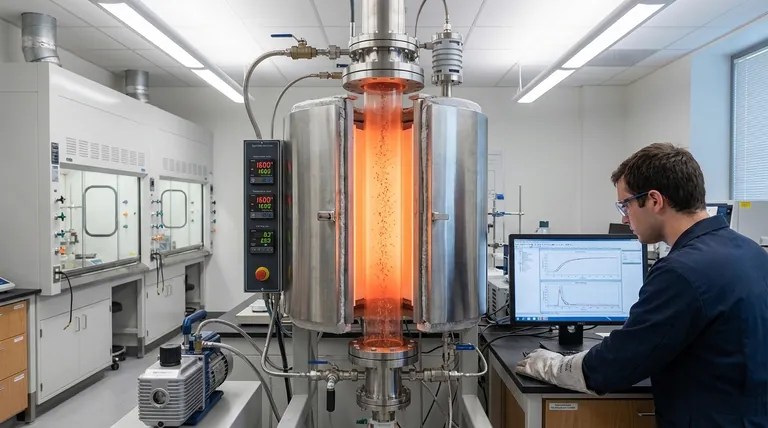
The Challenge of a Single Particle
Imagine you're a materials scientist. Your goal isn't to process a large batch of material, but to understand the fundamental behavior of a single, tiny particle as it encounters extreme heat.
How does a microscopic grain of coal combust? How does a novel ceramic powder sinter as it falls through a 1600°C inert atmosphere?
To answer these questions, you can't simply place the sample in a conventional oven. You need to observe it in motion, isolated, and in a perfectly controlled environment. This is not a problem of brute force heating; it is a problem of exquisite control.
This is the problem the drop tube furnace was engineered to solve.
The Principle of Controlled Falling
At its heart, a drop tube furnace is a deceptively simple concept. It orients a high-temperature furnace vertically. Instead of placing a sample inside, you drop it from the top.
This vertical orientation is a deliberate design choice that leverages a fundamental force of nature: gravity. It allows researchers to study the thermal processing of powders, particulates, and droplets as they pass through a precisely calibrated hot zone.
The Vertical Passage: A Stage for Transformation
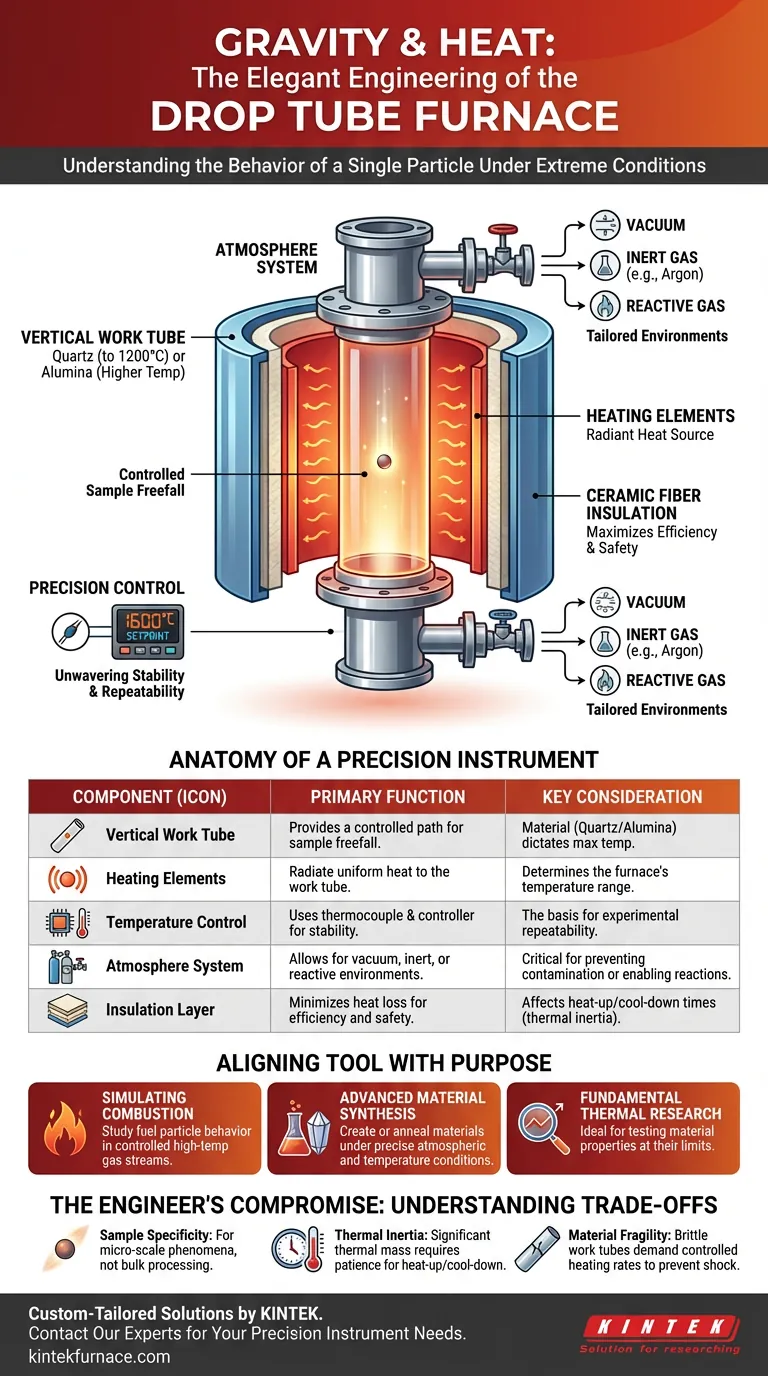
The core of the system is the work tube, a vertical column typically crafted from high-purity quartz (for temperatures up to 1200°C) or a robust ceramic like alumina (for higher temperatures). This tube acts as the stage where the material's transformation occurs.
Samples are introduced at the top and fall, a process that can last from a fraction of a second to several seconds, depending on the tube's length and the atmosphere inside.
The Source of Uniformity: Radiant Heat
Surrounding the work tube are powerful heating elements (like SiC or MoSi2 rods). These elements don't heat the sample directly. Instead, they radiate energy, turning the furnace chamber into an incredibly uniform, high-temperature environment.
This radiant heat is absorbed by the work tube, which then heats the sample as it passes through. The result is a consistent thermal exposure, free from the hot and cold spots that could plague other methods.
The Brains of the Operation: Precision Control
For research to be valid, it must be repeatable. A thermocouple acts as the furnace's nervous system, constantly measuring the temperature near the work tube.
This data is fed to a digital controller, which makes micro-adjustments to the power supplied to the heating elements. This feedback loop ensures the temperature you set is the temperature you get, with unwavering stability. For a researcher, this isn't just a feature; it's the foundation of trust in their data.
Anatomy of a Precision Instrument
Each component of a drop tube furnace is chosen for a specific purpose, contributing to a whole that is far greater than the sum of its parts.
-
The Work Tube: Its material is critical. It must withstand extreme thermal shock while remaining chemically inert, ensuring that the only thing reacting with your sample is the environment you've created.
-
The Atmospheric Gatekeeper: The tube is sealed at both ends with flanges. These aren't just caps; they are ports to another level of control. They allow for the introduction of a vacuum, an inert gas like argon to prevent oxidation, or a reactive gas for specific chemical processes. This level of atmospheric control is where bespoke systems become essential. Manufacturers like KINTEK specialize in tailoring these systems to precise research protocols, ensuring the gas environment is perfectly matched to the experimental goals.
-
The Guardian of Energy: A thick layer of ceramic fiber insulation surrounds the heating chamber. This layer is crucial for two reasons: it maximizes energy efficiency by preventing heat from escaping, and it keeps the external casing cool, ensuring the safety of the lab environment.
The Engineer's Compromise: Understanding the Trade-offs
No single tool is perfect for every job. The drop tube furnace is a specialized instrument, and its strengths are defined by its limitations.
-
Sample Specificity: It is designed for powders, particulates, and small samples. It is a scalpel for studying micro-scale phenomena, not a hammer for bulk processing.
-
Thermal Inertia: The robust materials and insulation required for high-temperature stability also mean the furnace has significant thermal mass. It takes time to heat up and cool down. This isn't a flaw; it's a physical reality that demands patience and planning from the operator.
-
Material Fragility: The ceramic or quartz work tubes are brittle. They are the heart of the furnace but also its most delicate component. Adhering to controlled heating and cooling rates is essential to prevent thermal shock and failure.
Aligning Tool with Purpose
Is a drop tube furnace the right instrument for you? The answer lies in your primary objective.
- For simulating combustion or gasification? Absolutely. There is no better way to study how individual fuel particles behave in a controlled, high-temperature gas stream.
- For advanced material synthesis? Yes. The precise atmospheric and temperature control allows you to create or anneal materials under conditions that are impossible to achieve in a standard furnace.
- For fundamental thermal research? It is ideal. The clean, tightly controlled environment provides the perfect platform for testing the properties of materials at their limits.
Once the need is clear, the next step is finding a partner who can build the exact tool for the job. While an off-the-shelf solution may work, cutting-edge research often requires custom-tailored equipment. KINTEK, with its deep expertise in R&D and in-house manufacturing, excels at providing customizable high-temperature furnace solutions—from drop tube and rotary furnaces to complex CVD systems—ensuring your instrument is perfectly aligned with the unique demands of your work.
| Component | Primary Function | Key Consideration |
|---|---|---|
| Vertical Work Tube | Provides a controlled path for sample freefall. | Material (Quartz/Alumina) dictates max temp. |
| Heating Elements | Radiate uniform heat to the work tube. | Determines the furnace's temperature range. |
| Temperature Control | Uses a thermocouple and controller for thermal stability. | The basis for experimental repeatability. |
| Atmosphere System | Allows for vacuum, inert, or reactive gas environments. | Critical for preventing contamination or enabling reactions. |
| Insulation Layer | Minimizes heat loss for efficiency and safety. | Affects heat-up/cool-down times (thermal inertia). |
Ultimately, the drop tube furnace is a beautiful piece of engineering that transforms a simple fall into a sophisticated scientific experiment.
Whether you are simulating industrial processes or synthesizing next-generation materials, having the right instrument is paramount. Contact Our Experts
Visual Guide
Related Products
- Vacuum Sealed Continuous Working Rotary Tube Furnace Rotating Tube Furnace
- Slide PECVD Tube Furnace with Liquid Gasifier PECVD Machine
- Custom Made Versatile CVD Tube Furnace Chemical Vapor Deposition CVD Equipment Machine
- 1200℃ Split Tube Furnace Laboratory Quartz Tube Furnace with Quartz Tube
- Laboratory Vacuum Tilt Rotary Tube Furnace Rotating Tube Furnace
Related Articles
- Beyond Heat: Mastering the Controlled Universe Inside a Tube Furnace
- Mastering the Void: How Tube Furnaces Forge the Atoms of Innovation
- Why Your Crystal Growth Experiments Are Failing: The Hidden Culprit in Your Tube Furnace
- The Art of Isolation: Mastering Material Properties with Tube Furnaces
- Beyond Heat: The Art of Control in a Tube Furnace



















