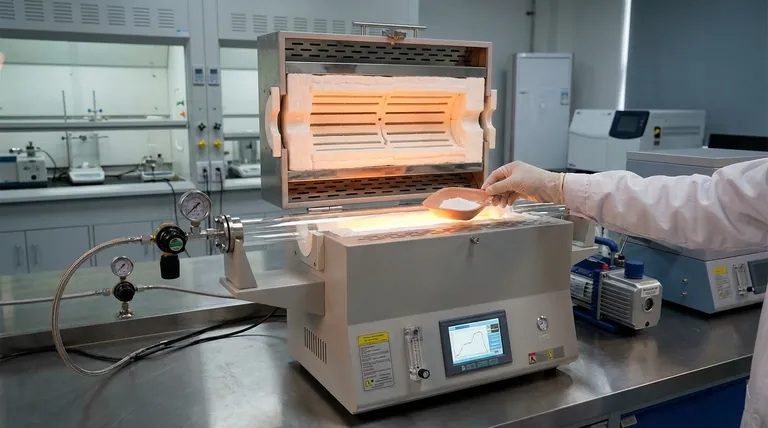
The Paradox of Strength from Dust
It’s a modern form of alchemy. An engineer begins with a container of fine, unassuming powder and, through a carefully controlled process, transforms it into a solid component strong enough for a jet engine or a dental crown.
This transformation is called sintering. It’s not about melting the material into a liquid; it’s a more delicate act of persuasion. By applying heat just below the material’s melting point, individual particles are encouraged to fuse, reducing porosity and dramatically increasing density and strength.
But this process is incredibly fragile. The success of this transformation from loose dust to a dense, high-performance part hinges entirely on the absolute control of its environment. Any deviation can lead to failure.
The Twin Pillars of Sintering: Temperature and Atmosphere
At its core, sintering is a battle against chaos. To win, an engineer must master two invisible yet powerful variables: temperature and atmosphere. The tube furnace is the arena designed for this very purpose.
The Temperature Tightrope
Every material has a specific "sintering window"—a narrow temperature range where particles bond effectively.
Go too low, and the fusion is incomplete, leaving a weak, porous part. Go too high, and the material begins to melt, losing its shape and structural integrity. For advanced ceramics like zirconia, reaching and holding a precise temperature, often as high as 1600°C, is the only way to achieve the hardness required for medical implants. It's a walk on a thermal tightrope.
The Unseen Enemy: Oxidation
At high temperatures, the air we breathe becomes a corrosive agent. Oxygen molecules eagerly react with many materials, especially metals, forming brittle oxides that compromise the final part's strength and purity.
This is where atmosphere control becomes non-negotiable. The enclosed chamber of a tube furnace allows engineers to remove the air entirely, creating a vacuum, or to replace it with a neutral (like argon) or reducing (like hydrogen) gas. For refractory metals like tungsten and molybdenum, this is essential. Their legendary high-temperature strength is only possible if they are sintered in an oxygen-free environment, preventing them from becoming hopelessly brittle.
Why the Tube is the Ideal Crucible
The design of a tube furnace is not arbitrary. Its simple, cylindrical geometry is a direct and elegant solution to the core challenges of sintering.
A Sealed Universe for Your Material
The enclosed tube makes creating a pristine environment straightforward. It's relatively easy to purge and seal, providing a self-contained universe where the atmosphere can be precisely dictated. This design is fundamental to achieving the high-purity results required in aerospace, electronics, and research.
The Logic of Uniform Heat
A cylinder is a naturally efficient shape for distributing heat. Heating elements surrounding the tube deliver thermal energy evenly from all sides, ensuring the entire sample heats and cools at the same rate. This uniformity prevents the development of internal stresses, weak spots, or warping, which are common issues with uneven heating.
Material Dictates Machine: A Practical Guide
The ideal furnace is not a one-size-fits-all solution. The material you are working with defines the engineering requirements of your equipment.
-
For High-Purity Refractory Metals: If your goal is to sinter tungsten or molybdenum, your primary concern is preventing oxidation. The priority is a furnace with exceptional vacuum capabilities and precise gas handling for inert or reducing atmospheres.
-
For High-Hardness Advanced Ceramics: To process materials like zirconia, your focus is on thermal energy. You need a furnace engineered to safely and stably achieve very high temperatures (1600°C or more) to ensure complete densification.
-
For Exploratory R&D: If your work involves testing various materials, versatility is key. An ideal system would offer flexible temperature programming and the adaptability to handle multiple types of controlled atmospheres.
| Material Type | Key Requirement | Why It Matters | KINTEK's Solution Focus |
|---|---|---|---|
| Refractory Metals | Atmosphere Control | Prevents oxidation and embrittlement. | High-Vacuum & Atmosphere Systems |
| Advanced Ceramics | High Temperature | Ensures full densification and hardness. | High-Temperature Tube Furnaces |
| R&D / Diverse Use | Versatility | Allows for experimentation across materials. | Customizable Furnace Platforms |
The Necessary Trade-offs
A tube furnace is a tool of precision, not brute force. Its strengths come with inherent limitations. The diameter of the tube restricts the size of the component, making it ideal for rods, samples, and smaller parts. Sintering is also a methodical, time-consuming batch process, requiring careful heating and cooling ramps; it is not designed for high-throughput manufacturing.
Understanding this is key. You choose a tube furnace when control is more important than volume, and when precision is the difference between success and failure.
Achieving this level of control requires equipment engineered for the task. Whether your work demands an impeccable vacuum for refractory metals or stable, ultra-high temperatures for advanced ceramics, having a system tailored to your material is critical. At KINTEK, our expertise in R&D and manufacturing allows us to deliver customizable furnace solutions—from Tube and Vacuum systems to CVD—that provide the precise environmental control your work demands.
If mastering the transformation of materials is your goal, let's ensure you have the right tools. Contact Our Experts
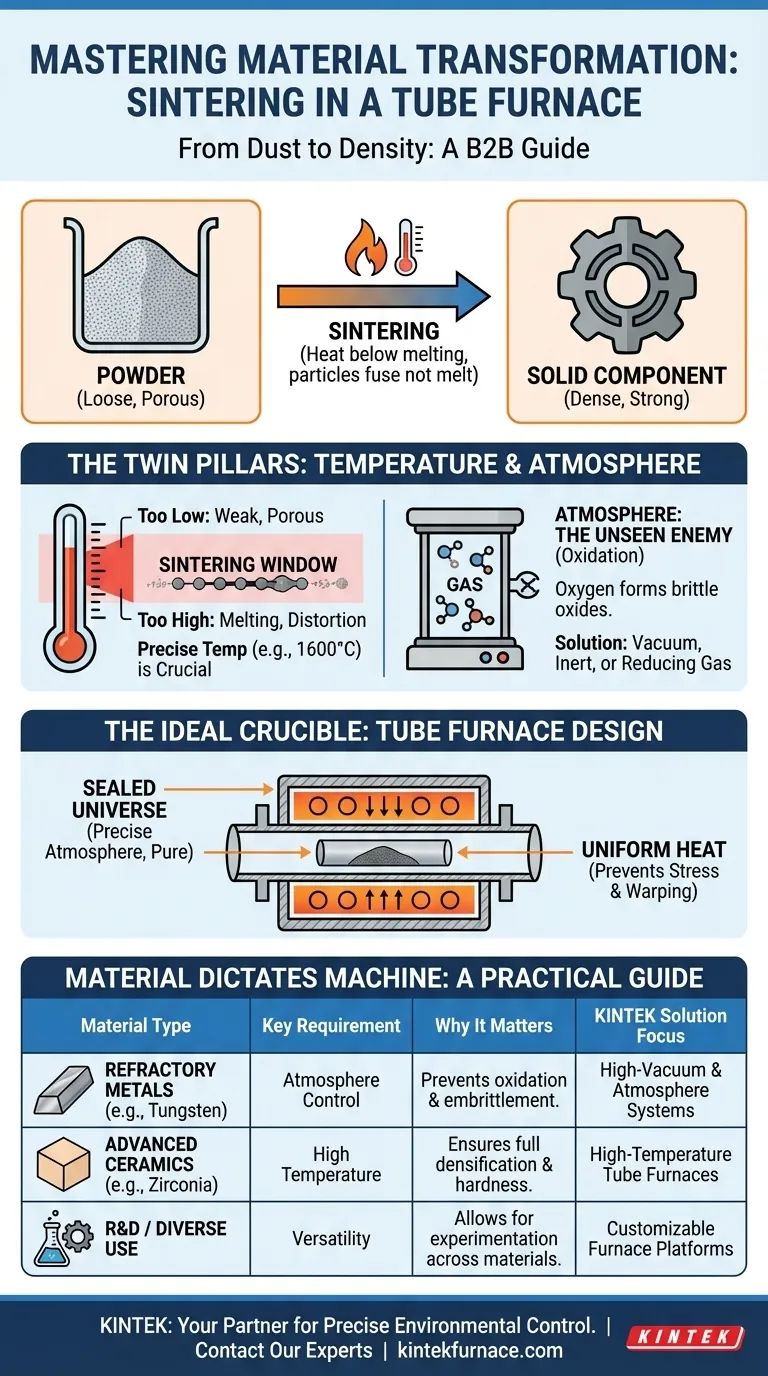
Visual Guide
Related Products
- Vacuum Sealed Continuous Working Rotary Tube Furnace Rotating Tube Furnace
- 1400℃ High Temperature Laboratory Tube Furnace with Alumina Tube
- 1700℃ High Temperature Laboratory Tube Furnace with Alumina Tube
- Magnesium Extraction and Purification Condensing Tube Furnace
- High Pressure Laboratory Vacuum Tube Furnace
Related Articles
- Beyond Heat: Mastering the Controlled Universe Inside a Tube Furnace
- Mastering the Void: How Tube Furnaces Forge the Atoms of Innovation
- Why Your Crystal Growth Experiments Are Failing: The Hidden Culprit in Your Tube Furnace
- The Art of Isolation: Mastering Material Properties with Tube Furnaces
- Beyond Heat: The Art of Control in a Tube Furnace



















