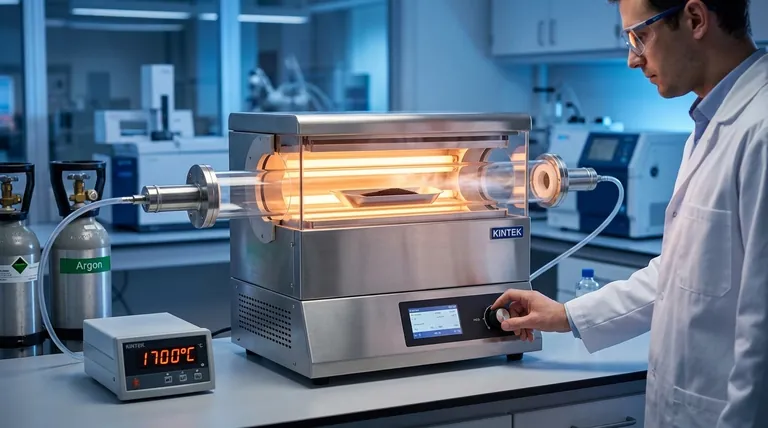
The Scientist's Dilemma: Control vs. Chaos
At the heart of every scientific breakthrough lies a battle against chaos. Researchers spend their lives trying to isolate a single variable, to create an environment so pure that cause and effect can be observed without interference.
But heat is a chaotic force. When you heat a material in open air, you aren't just raising its temperature; you're inviting a mob of reactive oxygen molecules to the party. This unwanted interaction can corrupt results, compromise material integrity, and turn a promising experiment into a frustrating dead end.
This is where the psychological need for control becomes a technical requirement. It’s not enough to simply make something hot. You must create a pocket universe where you, the researcher, set all the rules. The tube furnace is the architecture for that universe.
The Anatomy of Precision: What Defines a Tube Furnace?
While many furnaces can reach high temperatures, the tube furnace is engineered for a higher purpose: absolute environmental mastery. Its design philosophy is built on two unwavering principles.
1. Unmatched Atmospheric Control
The defining feature is the process tube—a sealed chamber of quartz, alumina, or metal. This simple enclosure is a powerful tool. It allows you to evacuate the air, creating a near-perfect vacuum, or to introduce a precisely managed flow of inert or reactive gas.
Imagine synthesizing a novel 2D material like graphene. A single stray oxygen atom can introduce a defect, ruining its perfect hexagonal lattice and rendering the sample useless. In a tube furnace, you can flood the chamber with argon, creating an inert shield that protects your creation. It transforms the process from a gamble into a repeatable procedure.
2. Exceptional Temperature Uniformity
The heating elements in a tube furnace are arranged cylindrically, wrapping around the process tube. This isn't just for aesthetics; it's a geometric solution to a thermal problem. This design creates an incredibly stable and consistent temperature zone along the length of the tube.
For processes like growing a single, flawless crystal or annealing a metal to relieve internal stresses, this uniformity is non-negotiable. Any hot or cold spots would be like inconsistent brushstrokes on a masterpiece, introducing imperfections that compromise the final structure.
From Blueprint to Breakthrough: Where Control Creates Value
The precision of a tube furnace unlocks capabilities across a vast spectrum of scientific and industrial applications. Its value is measured in the purity of the materials it creates and the reliability of the data it helps generate.
Material Synthesis and Purification
This is the furnace's native territory. It provides the pristine environment needed to build materials from the atoms up or to cleanse them of impurities.
- Synthesis: Crafting nanomaterials, advanced ceramics, and polymer composites where atmospheric purity is paramount.
- Purification: Removing volatile contaminants from a sample under vacuum or an inert gas flow.
- Crystal Growth: Nurturing single, high-purity crystals from a melt or vapor phase, a process demanding absolute thermal stability.
- Calcination: Decomposing compounds to create pure oxides, a fundamental step in ceramics and catalyst production.
Heat Treatment and Material Modification
Here, the furnace acts as a tool to unlock a material's hidden potential, altering its internal microstructure to enhance its physical properties.
- Annealing: Gently heating and cooling metals or glass to erase internal stresses, increasing ductility and reducing hardness.
- Sintering: Fusing fine powders together below their melting point to form a solid, dense object—the core of powder metallurgy and advanced ceramics manufacturing.
- Brazing: Joining components with a filler metal in a vacuum or inert atmosphere to create a bond that is strong, clean, and free of oxidation.
Advanced Research and Testing
For researchers, the greatest sin is an experiment that cannot be repeated. The tube furnace provides the stable, controlled conditions necessary for generating reliable and reproducible data.
- Catalyst Research: Testing the efficiency and lifespan of catalysts by passing reactive gases over them at precisely controlled temperatures.
- Fuel Cell Components: Simulating the extreme operating conditions of solid oxide fuel cells to test material durability and performance.
- Thermocouple Calibration: Using the stable thermal zone as a benchmark to verify the accuracy of temperature sensors.
This level of repeatable precision isn't a given; it's the outcome of expert engineering. High-performance systems from specialists like KINTEK are designed with deep customization in mind, ensuring the furnace's capabilities align perfectly with the unique demands of your research.
Choosing Your Arena: The Strategic Limits of a Tube Furnace
No tool is perfect for every job. The tube furnace's greatest strength—its contained, precise geometry—is also its primary limitation.
It is a scalpel, not an axe.
Its tubular chamber is ideal for powders, wafers, wires, and small components. It is poorly suited for large, bulky, or irregularly shaped objects. For those applications, a box or muffle furnace provides a more practical arena. Similarly, most lab-scale tube furnaces are designed for batch processing, prioritizing quality over quantity.
The choice isn't about which furnace is "better," but which one aligns with your strategic goal. If your work hinges on creating a perfect atmosphere and a uniform thermal field, the tube furnace is the undisputed champion.
Application Spectrum at a Glance
| Application Category | Key Uses | Core Requirement Met |
|---|---|---|
| Material Synthesis & Purification | Nanomaterials, crystal growth, calcination | Atmospheric Control |
| Heat Treatment & Modification | Annealing, sintering, brazing | Temperature Uniformity |
| Advanced Research & Testing | Catalyst testing, fuel cell simulation | Control & Repeatability |
Ultimately, harnessing high temperatures for advanced applications is an art of control. It requires a tool built not just to generate heat, but to tame it. By providing an environment of unparalleled atmospheric purity and thermal stability, the tube furnace empowers researchers and engineers to move beyond guesswork and achieve truly predictable, groundbreaking results.
If your work demands this level of precision, we can help you configure the ideal thermal processing solution, from standard models to fully customized systems. Contact Our Experts
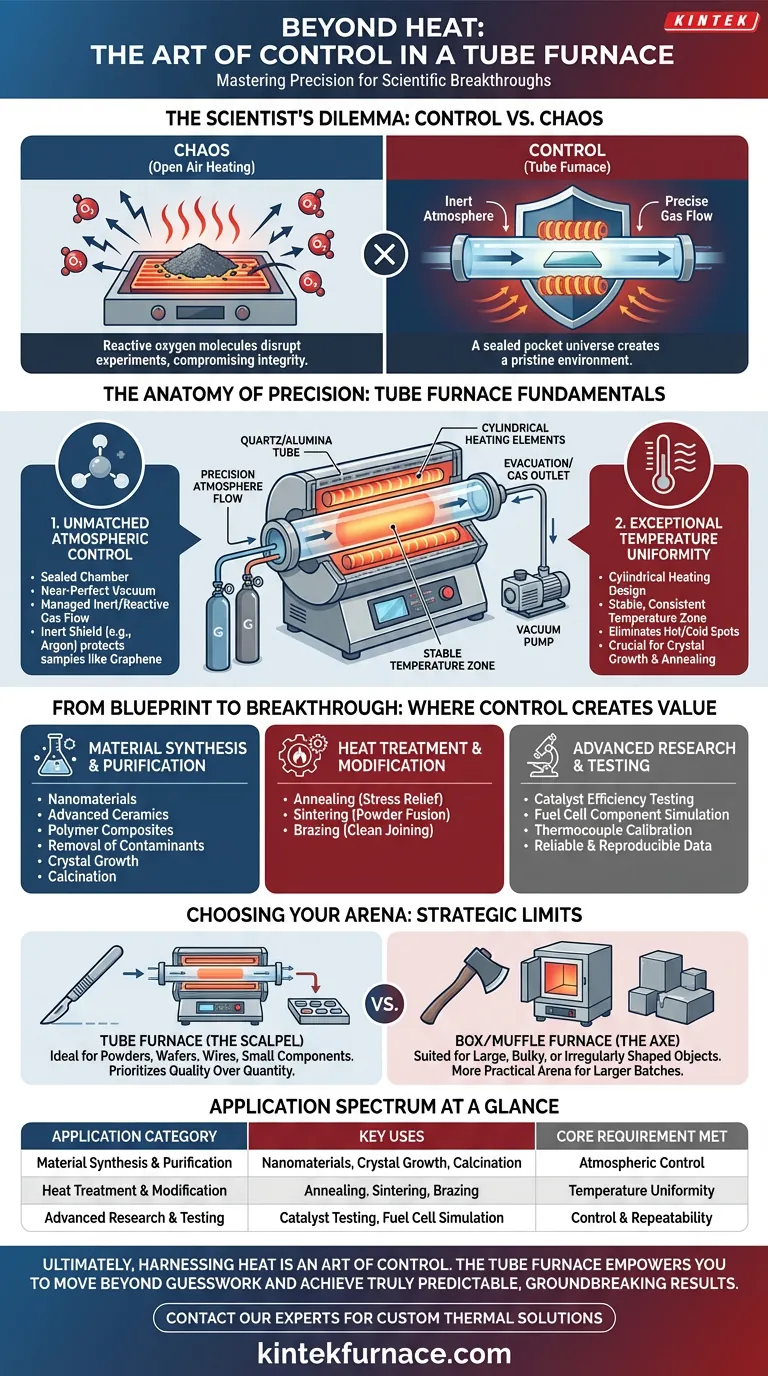
Visual Guide
Related Products
- Vacuum Sealed Continuous Working Rotary Tube Furnace Rotating Tube Furnace
- 1400℃ High Temperature Laboratory Tube Furnace with Alumina Tube
- 1700℃ High Temperature Laboratory Tube Furnace with Alumina Tube
- Magnesium Extraction and Purification Condensing Tube Furnace
- High Pressure Laboratory Vacuum Tube Furnace
Related Articles
- Beyond Heat: Mastering the Controlled Universe Inside a Tube Furnace
- Mastering the Void: How Tube Furnaces Forge the Atoms of Innovation
- Why Your Crystal Growth Experiments Are Failing: The Hidden Culprit in Your Tube Furnace
- The Art of Isolation: Mastering Material Properties with Tube Furnaces
- Beyond Heat: The Unseen Power of Environmental Control in Tube Furnaces



















