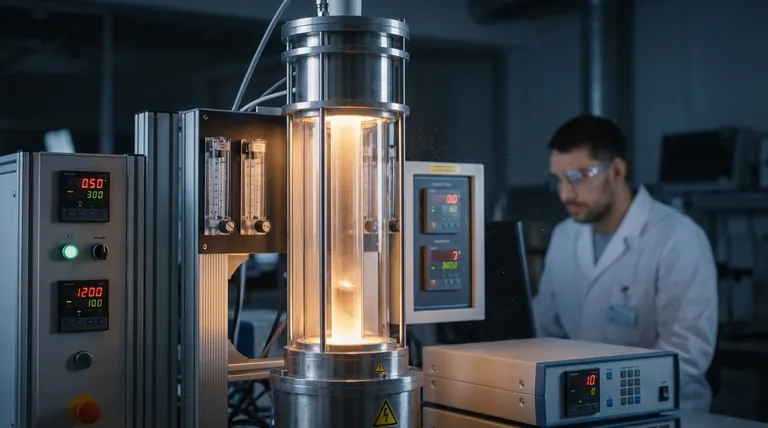
The Illusion of Uniformity
Our mental model for a furnace is simple: a hot box. We place an object inside, it reaches a uniform temperature, and we take it out. This model works perfectly for annealing steel or firing pottery.
But this model fails completely when the process of heating is more important than the final temperature.
What if you need to understand how a single coal particle ignites in a power plant? Or how a droplet of biomass slurry behaves in a gasifier? In these scenarios, the sample isn't a static block; it's a dynamic particle cloud experiencing a violent thermal shock.
Studying this requires a different kind of tool—one that masters not just heat, but time and gravity.
Engineering a Controlled Free-Fall
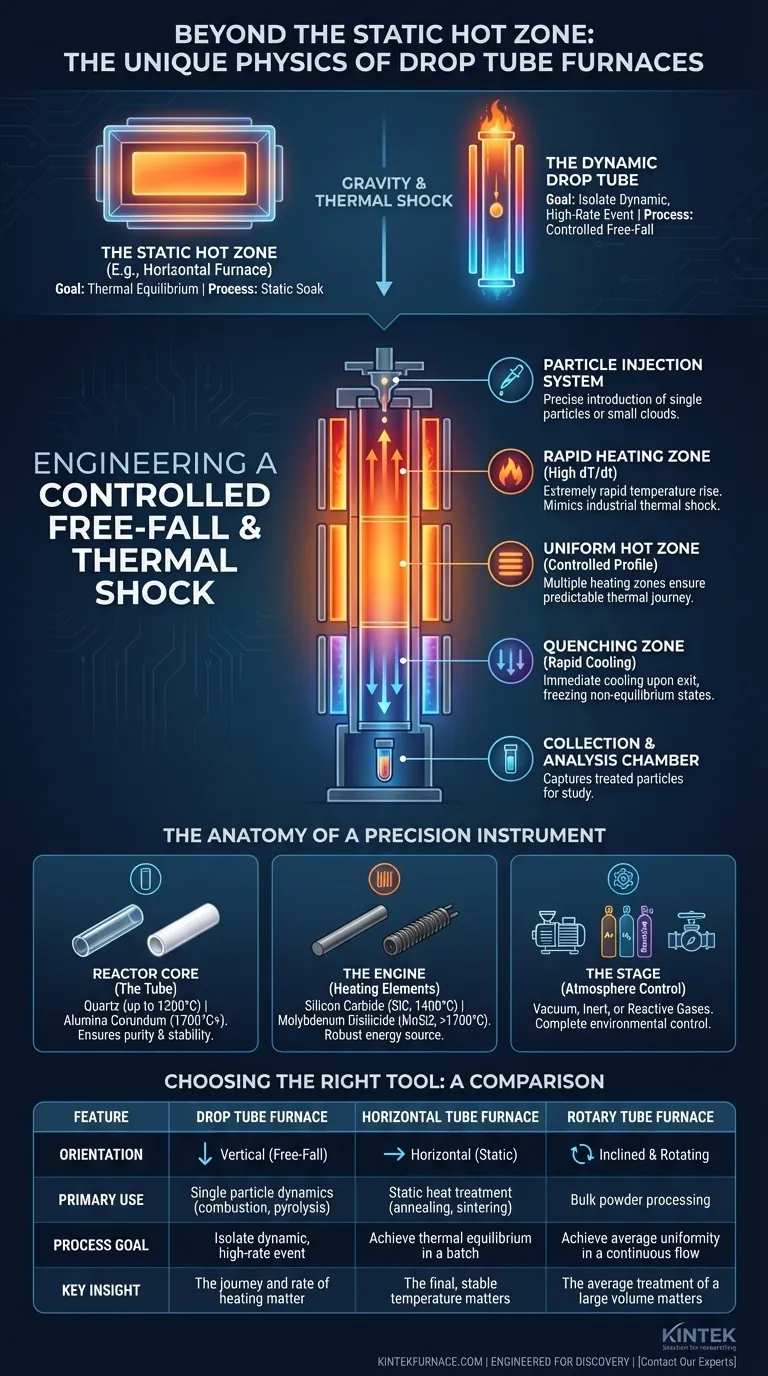
A drop tube furnace is not merely a vertical tube that gets hot. Its entire design philosophy is built around using gravity as a precise, repeatable transport mechanism. Materials are introduced at the top and fall through a tightly controlled thermal environment, allowing us to observe phenomena that are invisible in a static "hot box."
This vertical journey unlocks three critical research capabilities.
1. Mimicking Real-World Dynamics
Industrial processes like pulverized coal combustion, spray drying, and biomass pyrolysis involve injecting particles into a hot gas stream. A drop tube furnace is a laboratory-scale replica of this environment. It allows researchers to isolate and study the behavior of individual particles, answering fundamental questions about reaction kinetics and efficiency.
2. The Power of a Thermal Shock
As a particle falls through the heated tube, it experiences an extremely rapid temperature rise (a high dT/dt). Upon exiting the hot zone, it cools just as quickly. This rapid heating and quenching is impossible to replicate in a batch furnace but is essential for studying high-rate reactions and creating unique material microstructures that only form under non-equilibrium conditions.
3. A Predictable Thermal Journey
The long, vertical tube, often engineered with multiple, independently controlled heating zones, ensures every falling particle experiences a highly uniform and predictable temperature profile. This isn't just about even heating; it’s about creating a known, repeatable experimental timeline for every single particle.
The Anatomy of a Precision Instrument
Achieving this level of control requires a synthesis of advanced materials and engineering. Each component is a deliberate choice designed to manage extreme conditions.
-
The Tube as the Reactor Core: The process tube must withstand immense heat and prevent sample contamination. High-purity Quartz is excellent for temperatures up to 1200°C, while Alumina Corundum tubes are specified for extreme applications reaching 1700°C or more, ensuring thermal stability and chemical inertness.
-
Heating Elements as the Engine: Robust resistive elements provide the energy. Silicon Carbide (SiC) elements are the workhorses for temperatures up to 1400°C. For the most demanding research simulating advanced combustion or materials synthesis, Molybdenum Disilicide (MoSi2) elements are employed to reliably reach temperatures exceeding 1700°C.
-
Atmosphere Control as the Stage: A drop tube furnace is a sealed system. This allows for complete control over the chemical environment. Researchers can operate under a vacuum to study materials in its purest state, an inert gas like Argon to prevent oxidation, or a complex reactive gas mixture to simulate specific industrial processes.
A Tool is Defined by What It Is Not
The profound value of a drop tube furnace is best understood by comparing it to its alternatives. The choice of furnace is fundamentally a choice of which physical model you wish to test.
| Feature | Drop Tube Furnace | Horizontal Tube Furnace | Rotary Tube Furnace |
|---|---|---|---|
| Orientation | Vertical | Horizontal | Inclined & Rotating |
| Primary Use | Single particle dynamics (combustion, pyrolysis) | Static heat treatment (annealing, sintering) | Bulk powder processing |
| Process Goal | Isolate a dynamic, high-rate event | Achieve thermal equilibrium in a batch | Achieve average uniformity in a continuous flow |
| Key Insight | The journey and rate of heating matter | The final, stable temperature matters | The average treatment of a large volume matters |
You choose a horizontal furnace when your goal is patience and stability—to "soak" a sample at equilibrium. You choose a rotary furnace when your goal is industrial throughput—to process large volumes uniformly.
You choose a drop tube furnace when you need to understand a single, violent, fleeting event.
Specialization Demands Expertise
This specialization comes with trade-offs. By design, drop tube furnaces have low throughput. They are complex to operate, requiring precise particle injection and collection systems. They are the scalpel, not the sledgehammer, of thermal analysis.
Such a specialized instrument cannot be an off-the-shelf solution. The research dictates the design. The required temperature ramp rates, the residence time needed for the reaction, the corrosive nature of the process gases—all these factors influence the choice of materials, heating elements, and control systems.
This is where deep customization becomes critical. KINTEK's foundation in both R&D and in-house manufacturing allows us to engineer and build drop tube furnace systems precisely tailored to these unique experimental needs. Our expertise across the full spectrum of thermal equipment—from static tube furnaces to rotary and CVD systems—provides a holistic understanding of the challenge. We don't just provide a furnace; we provide the right thermal processing model for your specific question.
Choosing the right tool is the first step toward discovery. For systems designed to answer the most specific and demanding research questions, precision and customization are everything. Contact Our Experts
Visual Guide
Related Products
- Vacuum Sealed Continuous Working Rotary Tube Furnace Rotating Tube Furnace
- Slide PECVD Tube Furnace with Liquid Gasifier PECVD Machine
- Custom Made Versatile CVD Tube Furnace Chemical Vapor Deposition CVD Equipment Machine
- 1200℃ Split Tube Furnace Laboratory Quartz Tube Furnace with Quartz Tube
- Laboratory Vacuum Tilt Rotary Tube Furnace Rotating Tube Furnace
Related Articles
- Beyond Heat: Mastering the Controlled Universe Inside a Tube Furnace
- Mastering the Void: How Tube Furnaces Forge the Atoms of Innovation
- Why Your Crystal Growth Experiments Are Failing: The Hidden Culprit in Your Tube Furnace
- The Art of Isolation: Mastering Material Properties with Tube Furnaces
- Beyond Heat: The Art of Control in a Tube Furnace



















