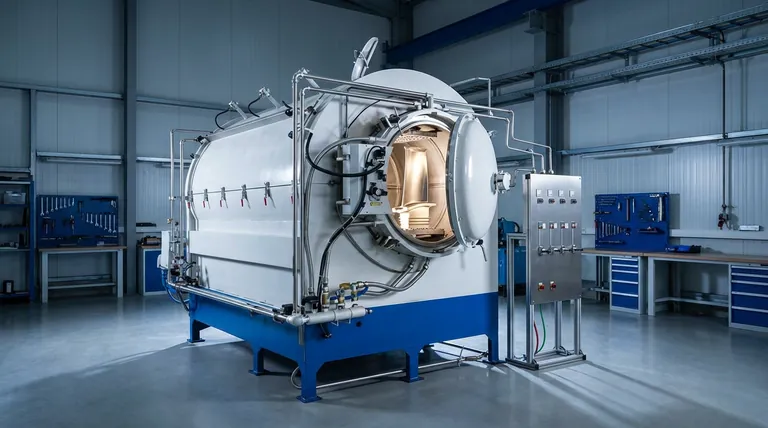
The Unseen Enemy in Every Workshop
Imagine a team of engineers has spent weeks designing and machining a critical component for an aerospace application. Every tolerance is perfect, every surface flawless. Now, it must be heat-treated to achieve the required hardness and strength.
The component is placed in a furnace, heated to over a thousand degrees, and then cooled. But when it emerges, the once-gleaming surface is covered in a dark, rough scale. The precise dimensions are now compromised. The material's surface chemistry has been altered in unpredictable ways.
The culprit wasn't a flaw in the metal or a mistake in the process. The enemy was the air itself.
The Tyranny of the Atmosphere
From a materials science perspective, a standard atmosphere is a chaotic and hostile environment for heat treatment. It introduces variables that undermine the very control we seek.
Oxidation: The Inevitable Cost of Oxygen
When you heat metal in the presence of oxygen, a chemical reaction—oxidation—is unavoidable. It's the same process that causes rust, but accelerated a thousandfold by heat.
This creates a layer of scale that is not just cosmetic. It must be removed through secondary processes like sandblasting or acid pickling. These aggressive steps add time and cost, and they risk altering the part's final dimensions, undoing the precision of the initial machining.
Contamination: The Hidden Variables
Air is not just oxygen. It's a mix of nitrogen, water vapor, dust, and other trace elements. At high temperatures, these contaminants eagerly react with a material's surface.
This isn't just a surface issue; it can lead to unforeseen changes in the material's chemical and mechanical properties. For an engineer, this is the ultimate problem: a loss of predictability. You can't guarantee performance if you can't control all the inputs.
Creating Order from Chaos: The Vacuum Solution
The psychological drive for vacuum heat treatment is the desire to eliminate uncertainty. It's about creating a chemically pure stage where the material can perform its transformation without interference.
By removing the air, we remove the variables.
The Principle: Total Environmental Control
A vacuum furnace operates on a simple, powerful principle: if the atmosphere is the problem, get rid of it. A vacuum pump evacuates the sealed chamber, reducing the pressure and removing the reactive elements—oxygen, water vapor, and others.
What remains is a near-perfect, inert environment where the heat treatment can proceed as intended, governed only by the laws of physics, not the whims of atmospheric chemistry.
The Process: A Controlled Ballet
- Evacuation: The component is loaded, the chamber is sealed, and pumps remove the atmosphere to a specified vacuum level. This step is a methodical purification of the environment.
- Heating: With the environment now under control, thermal energy is applied with extreme uniformity. There are no hot spots or convection currents caused by turbulent air.
- Soaking: The material is held at a precise temperature for a precise duration, allowing its internal structure to transform uniformly.
- Quenching: Cooling is managed with equal precision, often using a high-pressure backfill of inert gas like nitrogen or argon. This ensures the desired properties are locked in consistently across the entire part.
The Payoff: Perfection and Predictability
The results are a direct solution to the problems caused by air.
- Pristine Surfaces: Components emerge from a vacuum furnace bright, clean, and scale-free. They look exactly as they did when they went in, often eliminating the need for any post-processing.
- Uniform Properties: The exceptional thermal uniformity results in a consistent grain structure and, therefore, highly reliable and repeatable mechanical properties like hardness and toughness.
This level of control is not just a feature; it's the foundation for high-performance engineering. It's what allows for lighter, stronger, and more reliable components in demanding fields.
The Engineer's Dilemma: Investment vs. Outcome
While powerful, vacuum technology represents a focused investment in quality. The decision to use it is a strategic trade-off.
| Consideration | Vacuum Heat Treatment | Traditional Atmosphere Treatment |
|---|---|---|
| Initial Cost | Higher, due to complex furnace and vacuum pump systems. | Lower, with simpler furnace designs. |
| Cycle Time | Longer, as it includes the pump-down phase to create the vacuum. | Shorter, as heating can begin almost immediately. |
| Process Control | Exceptional. Precise control over temperature, environment, and quenching. | Good, but susceptible to atmospheric variables and non-uniformity. |
| Surface Finish | Superior. Bright, clean, and scale-free, often eliminating secondary cleaning. | Prone to oxidation and scaling, requiring post-treatment processing. |
| Best Application | Critical components where performance, repeatability, and finish are non-negotiable. | General-purpose parts where minor surface imperfections are acceptable. |
Choosing a vacuum furnace is a conscious decision to prioritize certainty and perfection over upfront cost and speed.
Making the Right Call
The choice hinges on a single question: What level of risk are you willing to accept?
- If a pristine surface and dimensional accuracy are critical, the choice is clear.
- If achieving the absolute maximum and most repeatable mechanical properties is the goal, there is no substitute.
- If you are engineering for the highest levels of performance and reliability, you must control the environment.
Achieving this mastery requires more than just a furnace; it requires a system meticulously engineered for control. That's where purpose-built equipment, designed with deep customization capabilities, becomes essential. At KINTEK, we provide the tools—from advanced Vacuum Furnaces and CVD systems to fully customized high-temperature solutions—that allow engineers and scientists to move beyond simply heating materials and start truly mastering them.
If you're ready to eliminate the variables and unlock the full potential of your components, we can help build the perfect environment for your work. Contact Our Experts
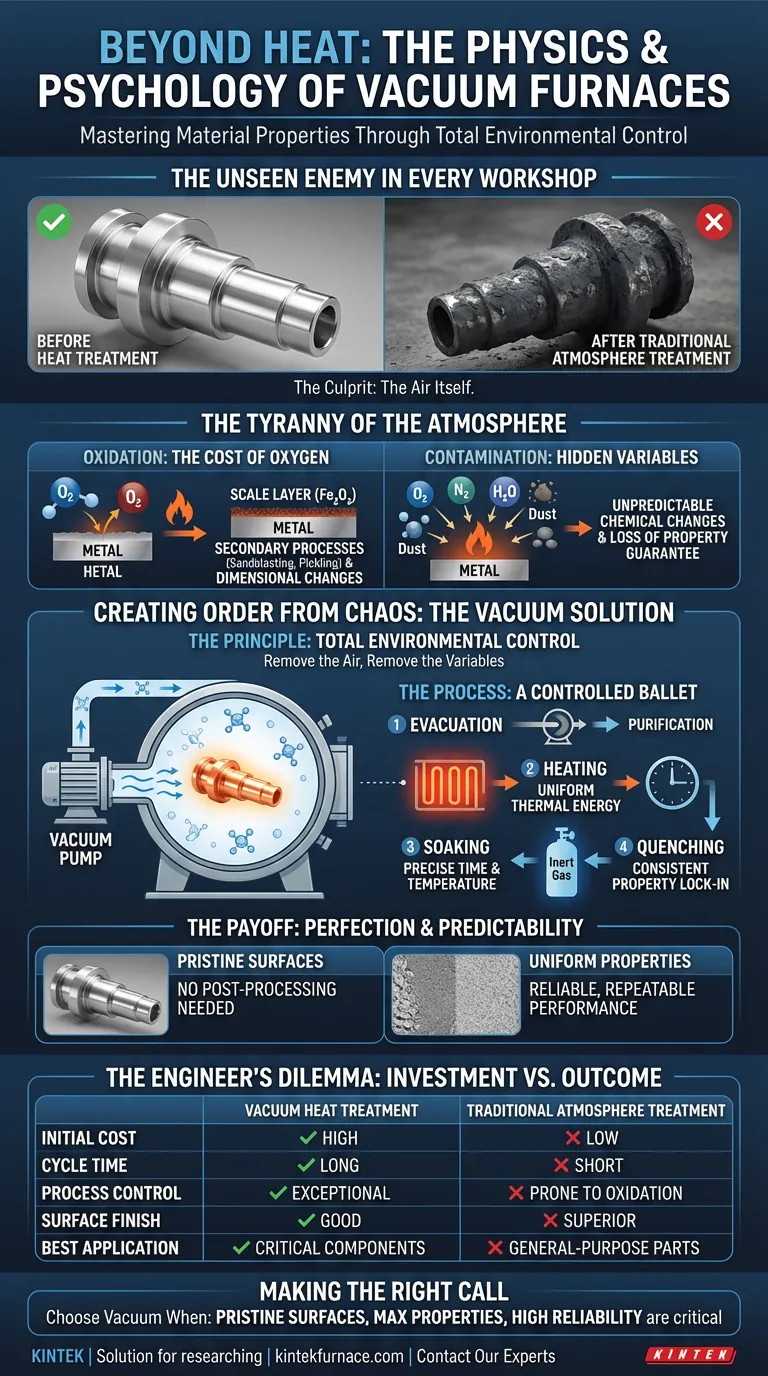
Visual Guide
Related Products
- Vacuum Hot Press Furnace Machine Heated Vacuum Press Tube Furnace
- Vacuum Hot Press Furnace Machine Heated Vacuum Press
- 600T Vacuum Induction Hot Press Vacuum Heat Treat and Sintering Furnace
- 2200 ℃ Tungsten Vacuum Heat Treat and Sintering Furnace
- Vacuum Heat Treat Sintering Furnace with Pressure for Vacuum Sintering
Related Articles
- How Vacuum Hot Press Furnaces Transform Advanced Material Engineering
- How to Select the Right Vacuum Hot Pressing Furnace Temperature for Your Materials
- Beyond the Parts List: The Real Reason Your Vacuum Hot Press Fails (And How to Fix It)
- Why Your High-Temperature Materials Fail: The Hidden War Inside Your Furnace
- Is Your Material Data Real? Why Temperature Gradients Are Sabotaging Your Cu2Se Resistivity Measurements



















