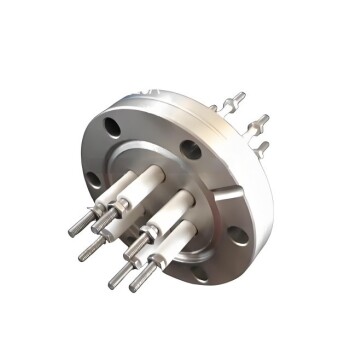
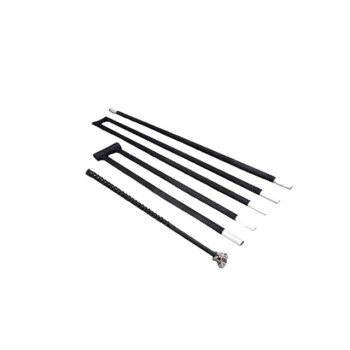
The use of Carbon-Carbon Composite Material (CCCM) for current leads is mandatory because standard metallic conductors cannot survive the 2500 °C threshold. At these extreme temperatures, CCCM provides the unique combination of structural integrity, chemical compatibility, and matched thermal expansion necessary to maintain a stable electrical signal within a vacuum furnace.
Core Takeaway: CCCM is the only viable material for 2500 °C current leads because it prevents mechanical failure and signal drift by matching the thermal and chemical properties of the sensor’s sensitive elements while remaining solid where metals would melt.
Thermal Stability at Ultra-High Temperatures
Survival Beyond Metallic Melting Points
Most conventional metals and alloys melt or lose all structural rigidity long before reaching 2500 °C.
Even refractory metals like tungsten can become brittle or interact poorly with other furnace components at these limits.
CCCM maintains its mechanical strength and electrical properties at temperatures where other materials would liquefy or vaporize.
Maintaining Physical Structure
In a vacuum furnace, materials are subject to intense thermal stress that can lead to warping or sagging.
CCCM exhibits exceptional dimensional stability, ensuring that the leads do not deform and cause short circuits or mechanical interference.
This stability is critical for the reliable transmission of electrical signals from the high-temperature zone to the external measurement systems.
Material Compatibility and Thermal Expansion
Matching Expansion Coefficients
A primary cause of sensor failure is the mechanical stress caused by different materials expanding at different rates.
By using CCCM, the leads match the thermal expansion coefficients of the thermoresistive sensitive elements.
This synchronization prevents the leads from pulling away or crushing the sensor interface during the heating and cooling cycles.
Ensuring Chemical Homogeneity
In high-temperature vacuum environments, dissimilar materials can undergo unwanted chemical reactions or "alloying" at contact points.
Using carbon-based leads for what are typically carbon-based sensitive elements ensures material compatibility.
This homogeneity prevents the formation of brittle intermetallic layers that would otherwise degrade electrical performance over time.
Understanding the Trade-offs
Susceptibility to Oxidation
While CCCM is nearly unrivaled in a vacuum, it is highly sensitive to oxygen at high temperatures.
Any leak in the vacuum seal will result in the rapid oxidation and "burn-off" of the carbon material.
This makes rigorous vacuum integrity a prerequisite for using CCCM leads effectively.
Brittleness and Handling
Unlike copper or nickel leads, CCCM is a ceramic-like composite and lacks ductility.
It is inherently brittle, meaning the leads can crack if subjected to sudden mechanical impacts or improper installation torque.
Engineers must design the furnace assembly to minimize mechanical vibration and shock to protect the lead structure.
Applying CCCM to Your High-Temperature System
Making the Right Choice for Your Goal
To ensure the longevity of your thermoresistive converter, your implementation strategy must align with your specific operational environment.
- If your primary focus is Measurement Accuracy: Use CCCM leads to ensure the electrical resistance remains stable and free from the "noise" caused by metallic degradation.
- If your primary focus is System Longevity: Ensure your vacuum levels are strictly maintained below $10^{-3}$ mbar to prevent the leads from thinning due to oxidation.
- If your primary focus is Structural Reliability: Utilize floating mounts or bellows to allow for any residual thermal movement without putting stress on the brittle CCCM connections.
By prioritizing material compatibility through CCCM, you ensure that your current leads become a reliable bridge rather than a point of failure in extreme thermal environments.
Summary Table:
| Feature | CCCM Capability at 2500 °C | Impact on System Performance |
|---|---|---|
| Melting Point | Remains solid; exceeds metal limits | Prevents lead failure and structural collapse |
| Thermal Expansion | Low and matched expansion | Eliminates mechanical stress and sensor drift |
| Chemical Stability | High homogeneity with sensors | Prevents alloying and electrical degradation |
| Structural Rigidity | Maintains strength at peak heat | Ensures stable signal transmission without warping |
| Environment Need | Requires strict vacuum ($10^{-3}$ mbar) | Protects material from rapid oxidation |
Optimize Your Ultra-High Temperature Processes with KINTEK
Precision at 2500 °C requires more than just standard equipment—it requires specialized material expertise. KINTEK specializes in advanced laboratory equipment and consumables, offering a comprehensive range of high-performance furnaces, including:
- Vacuum & Atmosphere Furnaces (Optimized for CCCM applications)
- CVD & Rotary Furnaces for advanced material synthesis
- Muffle, Tube, Dental, and Induction Melting Furnaces
- Fully Customizable Solutions tailored to your unique research requirements
Don't let material failure compromise your data. Partner with KINTEK for reliable, high-integrity thermal solutions.
Contact Our Experts Today to Discuss Your Custom Furnace Needs
References
- I.V. Gurin, О. Токарєва. USING OF CARBON-CARBON COMPOSITE MATERIALS FOR CREATION OF THERMAL-RESISTIVE CONVERTER OF THERMAL RADIATION. DOI: 10.46813/2024-149-125
This article is also based on technical information from Kintek Furnace Knowledge Base .
Related Products
- Split Chamber CVD Tube Furnace with Vacuum Station CVD Machine
- 2200 ℃ Tungsten Vacuum Heat Treat and Sintering Furnace
- Multi Heating Zones CVD Tube Furnace Machine for Chemical Vapor Deposition Equipment
- CF KF Flange Vacuum Electrode Feedthrough Lead Sealing Assembly for Vacuum Systems
- 2200 ℃ Graphite Vacuum Heat Treat Furnace
People Also Ask
- What role does a Tube Furnace play in the CVD growth of carbon nanotubes? Achieve High-Purity CNT Synthesis
- What are the advantages of using a CVD tube furnace for preparing gate dielectrics? Achieve High-Quality Thin Films for Transistors
- How does a CVD tube furnace achieve high purity in gate media preparation? Master Precision Control for Flawless Films
- What are the operational and maintenance requirements for a CVD tube furnace? Ensure Precision for Thin Film Deposition
- What temperature range do standard CVD tube furnaces operate at? Unlock Precision for Your Material Deposition