Pressure-assisted reactive hot pressing directly dismantles the problematic particle networks formed during chemical reactions, a critical flaw in conventional pressureless reaction sintering. In unassisted methods, newly formed phases bridge between particles early in the process, locking in porosity that cannot be removed by capillary forces alone. By applying simultaneous heat and uniaxial mechanical pressure, reactive hot pressing continuously disrupts these rigid networks. This allows particle rearrangement, plastic flow, and enhanced diffusion to eliminate voids, enabling the composite to reach near-theoretical density at significantly lower temperatures and shorter hold times.
Conventional reaction sintering is undermined by the formation of rigid particle-particle bridges that “freeze” porosity into the structure. Reactive hot pressing uses mechanical pressure to shatter these bridges and amplify the thermodynamic driving force for densification, yielding fully dense composites with fine, controlled microstructures that are unattainable through pressureless routes.
The Core Failure of Conventional Reaction Sintering
The problem with pressureless reaction sintering isn’t just slow densification—it’s a fundamental microstructural trap that occurs while the chemical reaction is still unfolding.
The Bridge-Formation Mechanism
During a chemical reaction between powder particles, new product phases nucleate and grow at the original particle contacts. These initial necks rapidly evolve into rigid, load-bearing bridges that link particles together.
Once a continuous, stiff network of bridges spans the sample, the structure resists further shrinkage. The capillary pressure from surface curvature is far too weak to collapse these interlocked frameworks. Porosity becomes permanently trapped.
Why Temperature Cannot Fix It Alone
Raising the temperature only accelerates surface diffusion and evaporation-condensation—mechanisms that coarsen the microstructure and grow grain size without eliminating pores. In fact, excessive heating can strengthen the bridges by increasing their cross-sectional area, making the structure even more resistant to densification.
How Applied Pressure Solves the Densification Problem
Reactive hot pressing adds a uniaxial mechanical stress that fundamentally changes the thermodynamics and kinetics of the sintering process.
Breaking the Rigid Networks
The external pressure ($p_a$) superimposes on the capillary driving force ($\gamma_{sv} K$), creating a total effective stress that easily exceeds the yield strength of the reaction-formed bridges. Particle-particle contacts fracture, the rigid network collapses, and particles are forced into new, denser packing arrangements.
This is not a gradual process—the bridges are actively and continuously dismantled as soon as they form, preventing the locked-porosity structure from ever becoming established.
Selectively Enhancing Densifying Mechanisms
Because applied stress directly promotes grain boundary diffusion and plastic flow while leaving non-densifying mechanisms (like surface diffusion) largely unaffected, the process selectively drives porosity removal. The result is rapid densification without the coarsening penalty that plagues pressureless sintering at high temperatures.
Lower Temperatures, Shorter Times
The extra mechanical driving force means the same final density can be achieved at a temperature several hundred degrees lower than in pressureless sintering. Shorter thermal exposure inherently limits grain growth, preserving a fine, uniform microstructure that translates to superior mechanical properties.
Understanding the Critical Trade-offs
Despite its performance advantages, reactive hot pressing is not a universal solution. Several limitations must be weighed against the densification benefits.
Shape Complexity Constraints
Uniaxial pressing restricts the process to simple geometries—typically flat discs, rectangular plates, or rudimentary blocks. Complex, near-net-shape components that are possible with pressureless sintering in shaped molds are far more difficult, if not impossible, to produce directly.
Higher Equipment and Operational Costs
Pressure-assisted high-temperature furnaces are specialized, costly capital equipment. The tooling (graphite dies, punches) must withstand both high temperatures and high mechanical loads, and it wears over time. For low-margin or high-volume commodity products, the economic justification may not exist.
Potential for Reaction-Pressure Interactions
In some systems, the applied pressure can shift the chemical reaction kinetics or alter phase stability, potentially favoring the formation of unwanted secondary phases. This requires careful process design, and the advantage seen in one material system does not automatically transfer to another.
Making the Right Choice for Your Composite Fabrication Goal
Your selection between conventional reaction sintering and reactive hot pressing should be driven by your specific material targets, part complexity, and cost tolerance.
- If your primary focus is achieving ultimate density and mechanical integrity: Reactive hot pressing is the superior route. It defeats the bridge-formation problem and delivers near-theoretical density with minimal grain growth, maximizing strength, hardness, and toughness.
- If your primary focus is fabricating complex, near-net-shape components: Conventional sintering, perhaps combined with post-processing infiltration, may be the more practical choice despite residual porosity. The geometric freedom often outweighs the densification penalty.
- If your primary focus is minimizing capital and per-part cost: Pressureless methods are the default starting point. Only adopt hot pressing when the performance requirements unequivocally demand it and the cost uplift can be absorbed.
Ultimately, reactive hot pressing is preferred because it resolves the intrinsic failure mode of pressureless reaction sintering—the formation of rigid, porosity-locking bridges—while simultaneously adding a powerful, selective driving force that yields fully dense composites at lower temperatures. The choice, however, must always be calibrated against geometric flexibility and economic reality.
Summary Table:
| Feature / Parameter | Conventional Reaction Sintering | Reactive Hot Pressing |
|---|---|---|
| Driving Force | Surface capillary pressure | Mechanical pressure + capillary forces |
| Bridge Formation | Rigid bridges lock in permanent porosity | Mechanical stress disrupts network bridges |
| Thermal Exposure | High temperature, long hold times | Lower temperature, shorter hold times |
| Microstructure | Prone to grain coarsening/pore trapping | Fine, uniform grain size & high density |
| Component Geometry | Complex, near-net shapes | Simple geometries (discs, plates, blocks) |
| Achievable Density | Moderate to low | Near-theoretical (up to 100%) |
Maximize Material Density with KINTEK High-Temperature Furnaces
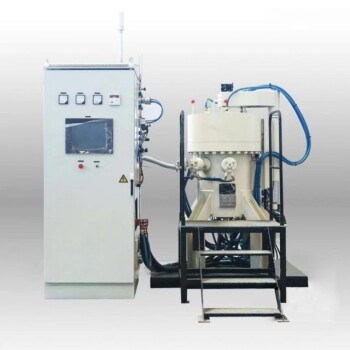
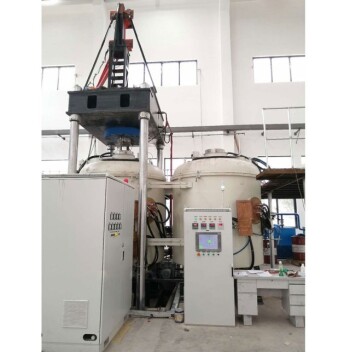
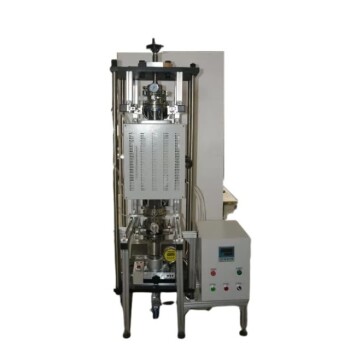
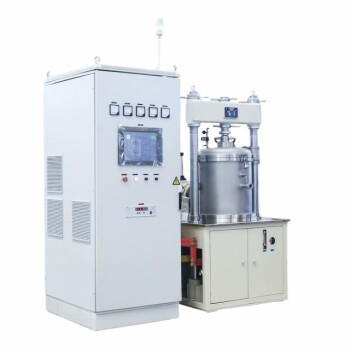
Struggling with residual porosity or grain growth during composite fabrication? KINTEK offers state-of-the-art laboratory equipment and customizable high-temperature furnaces—including vacuum, hot pressing, atmosphere, tube, CVD, and muffle furnaces designed for precise thermal and pressure control.
Whether you are scaling up material synthesis or conducting advanced research, our fully customizable furnace solutions ensure maximum density, superior microstructure control, and reliable repeatability.
Contact KINTEK Experts Today for Custom Solutions
Related Products
- High Pressure Laboratory Vacuum Tube Furnace
- 1400℃ High Temperature Laboratory Tube Furnace with Alumina Tube
- 1700℃ High Temperature Muffle Oven Furnace for Laboratory
- 9MPa Air Pressure Vacuum Heat Treat and Sintering Furnace
- 1800℃ High Temperature Muffle Oven Furnace for Laboratory
People Also Ask
- What role does a high vacuum tube furnace play in Co-Al sintering? Master High-Purity Porous Material Synthesis
- What are the different types of tube furnaces available? Find the Perfect Fit for Your Lab's Needs
- What are the main advantages of vacuum tube furnaces in the market? Achieve Purity and Precision in Material Processing
- What is the role of a vacuum tube furnace during the final thermal treatment stage of Fe3O4@CSAC catalysts?
- What conditions do tube furnaces provide for Au-Seeded TiO2 nanowires? Master Precision Thermal Synthesis