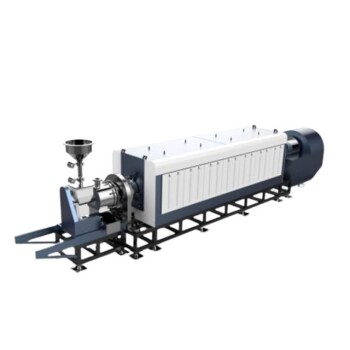
The precise management of a droplet's thermal journey is the difference between an engineered nanoparticle and a fractured fragment. In tubular spray pyrolysis, multi-zone temperature control is not just a parameter—it is the primary tool for decoupling the sequential physical and chemical transformations a droplet undergoes. It allows you to gently drive off solvent at low temperatures before subjecting the particle to the high heat needed for reaction and densification, thereby preventing the catastrophic shell rupture caused by a violent internal pressure buildup.
The core problem is that uncontrolled heating causes the droplet surface to form a premature solid crust too quickly. Precise, zonal temperature control solves this by orchestrating the process—first enabling controlled, gradual solvent evaporation in a cooler zone, and only then transitioning the dried or gel-like particle to a high-temperature zone for calcination. This sequential thermal strategy prevents shell fracturing and ensures uniform particle morphology.
The Critical Droplet-to-Particle Lifecycle
To understand the need for precision, you must first follow the journey of a single precursor droplet into a high-temperature environment. This transformation is a delicate chain of events, and any break in the chain leads to defects.
The Sequence of Physical Transformations
A droplet entering a furnace immediately begins to lose solvent. This is straightforward evaporation. However, as the solvent leaves, the precursor solute concentration at the droplet's surface soars.
Once the surface concentration reaches critical saturation, a solid shell or crust forms. This moment is the most dangerous point in the particle’s lifecycle. This newly formed crust suddenly becomes a formidable barrier, drastically increasing resistance to both mass and heat transfer.
The remaining solvent trapped inside the core continues to vaporize. With a rigid shell now blocking its escape, the internal pressure spikes. Simultaneously, the shell’s insulating effect causes the droplet's internal temperature to rise rapidly, further accelerating vaporization in a runaway scenario.
The Inevitable Failure of Uncontrolled Heating
Without precise zonal control, these evaporation and crust formation stages happen chaotically. A droplet might form a thick, low-porosity shell before its core is dry. This directly leads to one of three failure modes:
- Massive Fracturing: The internal pressure exceeds the shell's mechanical strength, causing the particle to explode into irregular fragments.
- Spalling: Cracks form in the shell, releasing pressure but leaving behind a shattered, non-spherical particle.
- Hollow Shell Formation: The shell remains intact but the particle becomes a hollow sphere, a morphology often unsuitable for applications like solid oxide fuel cell (SOFC) electrodes.
The result is a powder with a wide particle size distribution, unpredictable shapes (from shards to hoops), and poor batch-to-batch reproducibility.
Engineering the Solution: The Multi-Zone Thermal Gradient
The solution is not simply applying less heat; it is applying the right heat at the right time. This is exactly what a multi-zone tubular spray pyrolysis furnace achieves by creating a deliberate, multi-stage thermal profile.
Stage 1: Controlled Evaporation in a Low-Temperature Zone
The first zone is designed for gentleness. Its purpose is to drive off the majority of the solvent before a solid crust forms precipitously. By setting a lower temperature—for instance, an initial zone at 350°C as mentioned for complex oxides—you allow the droplet to shrink uniformly as a liquid, concentrating the solute gradually.
This prevents the immediate formation of a thick, impermeable shell. Instead, the droplet can transition to a highly viscous gel or a porous, softer shell, creating micro-channels that allow the remaining vapors to escape more easily later on.
Stage 2: High-Temperature Reaction and Densification
Once the risk of boiling and bursting is mitigated, the now dried or gel-like particle enters the high-temperature zone. Here, the thermal gloves are off. In a zone ramped to a high reaction temperature—like 840°C—the real chemistry begins.
This is where thermolysis (decomposition of the precursor salt) and calcination happen. The solid-state reactions proceed, organic volatiles are removed, and the particle sinters and densifies into its final, dense ceramic state. Because the particle’s structural integrity was preserved in the first zone, this high-temperature step produces a dense, spherical particle, not a fractured one.
Understanding the Trade-offs
Implementing multi-zone control is powerful, but it’s not a universal, plug-and-play solution. It demands significant process development.
- Axial Gradients are Parameter-Specific: The "perfect" thermal profile is a function of the precursor's chemistry, the solvent's boiling point, the droplet size, and the carrier gas flow rate. A profile developed for a nitrate-based precursor will likely fail for a chloride-based one, demanding a separate development cycle.
- Throughput vs. Precision: Lower temperatures in the initial zone to ensure a gentle evaporation often mean requiring a longer residence time. This can directly reduce the overall throughput of your synthesis process compared to a single-temperature furnace. You are trading production rate for morphological perfection.
- Atmosphere Management Complexity: For systems converting preceramic polymers, the temperature profile is deeply coupled with the atmospheric gas composition. An ideal evaporation profile under argon might promote unwanted side reactions if switched to a reactive gas like ammonia, adding another layer of optimization.
Making the Right Choice for Your Goal
Your specific application dictates how you should leverage this capability. The control strategy must be in service of your final material’s functional property.
- If your primary focus is synthesizing dense, spherical particles for applications like SOFC electrodes: Prioritize a pronounced two-step profile. Establish a deep, low-temperature zone for complete drying, followed by a sharp ramp to the sintering temperature to achieve full density before the particle exits the furnace.
- If your primary focus is producing multi-component oxide powders with controlled stoichiometry: Use a gradual, multi-step ramp or a smooth "humped" temperature profile. This ensures each sequential chemical decomposition reaction occurs independently without sudden gas release disrupting the structure, preserving the elemental uniformity of the product.
- If your primary focus is preventing agglomeration in high-throughput synthesis: Combine the thermal gradient with controlled gas flow dynamics. Use the zonal temperatures to ensure the solidification point occurs at a predictable location in the tube where droplet collisions are less likely, preventing liquid-phase particles from hitting a dried crust and sticking together.
Precise temperature control is the key that transforms spray pyrolysis from a chaotic droplet dryer into a sophisticated chemical reactor capable of exquisite morphological and compositional engineering.
Summary Table:
| Synthesis Stage | Thermal Profile | Process Mechanism | Morphological Outcome |
|---|---|---|---|
| Stage 1: Evaporation | Low Temp Zone (e.g., ~350°C) | Gradual solvent removal avoiding premature rigid crusts | Porous/soft gel particle with preserved integrity |
| Stage 2: Reaction & Sintering | High Temp Zone (e.g., ~840°C) | Precursor thermolysis, calcination, and densification | Dense, uniform spherical ceramic nanoparticles |
| Uncontrolled Heating | Single / Sudden High Temp | Internal pressure spike causing rapid shell explosion | Fractured shards, hollow spheres, irregular shapes |
Take full control of your material synthesis with KINTEK's high-precision heating solutions! Specializing in advanced laboratory equipment and consumables, KINTEK offers fully customizable multi-zone tube furnaces, as well as muffle, rotary, vacuum, CVD, atmosphere, and induction melting furnaces tailored to your exact thermal profiling needs. Prevent particle defects and ensure flawless batch-to-batch reproducibility—contact KINTEK today to engineer your custom furnace!
Related Products
- Vertical Laboratory Quartz Tube Furnace Tubular Furnace
- Custom Made Versatile CVD Tube Furnace Chemical Vapor Deposition CVD Equipment Machine
- Electric Rotary Kiln Small Rotary Furnace Biomass Pyrolysis Plant Rotating Furnace
- Multi Zone Laboratory Quartz Tube Furnace Tubular Furnace
- High Pressure Laboratory Vacuum Tube Furnace
People Also Ask
- What are the key differences between single-zone and multi-zone vertical tube furnaces? Choose the Right Furnace for Your Lab
- How are wafers loaded and unloaded in a vertical tube furnace? Achieve Precision and Purity in Wafer Processing
- How are metal support wires selected for sample suspension? Expert Guide to High-Temp Furnace Materials
- What are the main characteristics of vertical tube furnaces? Optimize Your Lab with Space-Saving, Uniform Heating
- How do heat treatment processes influence the configuration of a vertical tube furnace? Optimize for Quenching, Annealing, and More