
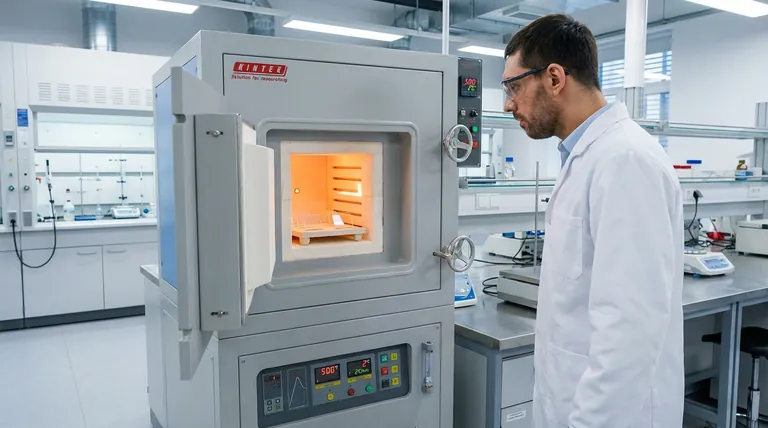
An industrial high-temperature muffle furnace is strictly required to ensure the successful phase transformation of titanium dioxide thin films without damaging their structural integrity. At 500 degrees Celsius, this equipment provides the stable thermal environment necessary to convert amorphous sol-gel coatings into the photocatalytically active anatase phase.
Success in treating titanium dioxide thin films relies on minimizing thermal shock while inducing crystallization. A muffle furnace provides the uniform heating rate and stable environment necessary to grow anatase crystals without causing the film to crack or peel.
The Mechanism of Phase Transformation
Converting Amorphous Material
Titanium dioxide coatings often begin as an amorphous sol-gel. This state lacks the defined crystal structure required for high-performance applications.
Achieving the Anatase Phase
To activate the material, it must undergo a phase change. Heating the film to 500 degrees Celsius triggers the conversion from the amorphous phase to the anatase phase.
Unlocking Photocatalytic Activity
This specific crystalline structure is critical. The anatase phase is highly desirable because it renders the titanium dioxide photocatalytically active, allowing it to function effectively in its intended application.
The Importance of Thermal Control
Preventing Thermal Shock
The primary risk during heat treatment is structural failure. Rapid temperature changes can cause thin films to experience extreme stress.
Ensuring Uniform Crystal Growth
A muffle furnace is designed to maintain a constant heating rate, such as 2 degrees Celsius per minute. This gradual increase allows crystals to grow uniformly across the substrate.
Avoiding Physical Defects
Precise control prevents the detrimental effects of temperature fluctuations. By maintaining stability, the furnace ensures the thin films do not crack or peel during the critical transformation process.
Understanding the Trade-offs
Process Speed vs. Film Integrity
Using a muffle furnace for this application prioritizes quality over speed. The requirement for a slow, controlled ramp rate (e.g., 2 degrees per minute) significantly extends the processing time compared to rapid heating methods.
Batch Processing Limitations
Unlike continuous flow systems, industrial muffle furnaces typically operate as batch processes. While this ensures a highly controlled environment for complex metallurgical tasks like sintering or debinding, it may limit throughput in high-volume manufacturing scenarios.
Making the Right Choice for Your Goal
To achieve optimal results with titanium dioxide thin films, align your process parameters with your specific performance objectives.
- If your primary focus is Structural Integrity: Prioritize a slow, constant heating rate to prevent cracking and peeling during the expansion of the crystal lattice.
- If your primary focus is Photocatalytic Efficiency: Ensure the furnace reaches and stabilizes exactly at 500 degrees Celsius to guarantee a complete transition to the anatase phase.
Precision in thermal management is the difference between a functional coating and a failed substrate.
Summary Table:
| Parameter | Requirement | Impact on Titanium Dioxide (TiO2) |
|---|---|---|
| Temperature | 500°C | Triggers transformation from amorphous to anatase phase |
| Heating Rate | 2°C per minute | Prevents thermal shock and ensures uniform crystal growth |
| Atmosphere | Stable/Muffled | Protects film from contaminants and ensures chemical purity |
| Cooling | Controlled | Minimizes stress to prevent cracking or peeling |
Elevate Your Material Research with KINTEK
Precise thermal management is the cornerstone of high-performance thin film development. KINTEK provides industry-leading muffle, tube, and vacuum furnaces designed specifically for delicate processes like the crystallization of titanium dioxide.
Backed by expert R&D and manufacturing, our systems offer the precision heating rates and temperature stability required to prevent structural defects and maximize photocatalytic activity. Whether you need a standard laboratory furnace or a fully customized high-temperature system, KINTEK delivers the reliability your research demands.
Ready to optimize your heat treatment process? Contact us today to discuss your unique needs with our technical team!
Visual Guide

References
- Theodoros Giannakis, M. Kandyla. Enhancing the Photocatalytic Activity of Immobilized TiO2 Using Laser-Micropatterned Surfaces. DOI: 10.3390/app14073033
This article is also based on technical information from Kintek Furnace Knowledge Base .
Related Products
- High Temperature Muffle Oven Furnace for Laboratory Debinding and Pre Sintering
- 1400℃ Muffle Oven Furnace for Laboratory
- 1700℃ High Temperature Muffle Oven Furnace for Laboratory
- 1800℃ High Temperature Muffle Oven Furnace for Laboratory
- Laboratory Muffle Oven Furnace with Bottom Lifting
People Also Ask
- What thermal phenomena occur during polymer binder burnout in ceramic green bodies? Lab Furnace Guide
- Why is controlled heat treatment in a muffle furnace necessary for calcined clay? Achieve Optimal Pozzolanic Activity
- What role does a high-temperature muffle furnace play in STFO synthesis? Achieve Pure Perovskite Results
- How does a high-temperature muffle furnace facilitate the formation of LaNbxAl1−xO3+δ perovskite structures? Key Roles
- What role does a high-temperature muffle furnace play in the multi-stage synthesis of Li0.5MnFe1.5O4? Key to Pure Spinel



















