
Precision control determines quality. A vacuum heat treatment furnace is necessary for gas nitriding AISI 5140 steel because it creates a contaminant-free, low-pressure environment that allows nitrogen atoms to diffuse uniformly into the steel surface. This specific equipment removes interfering gases and maintains the exact thermal conditions required to harden the material without causing deformation.
The vacuum furnace is critical for gas nitriding because it eliminates atmospheric interference and ensures precise temperature regulation. This results in a dense, uniform compound layer that significantly enhances chemical stability and corrosion resistance while minimizing physical distortion.
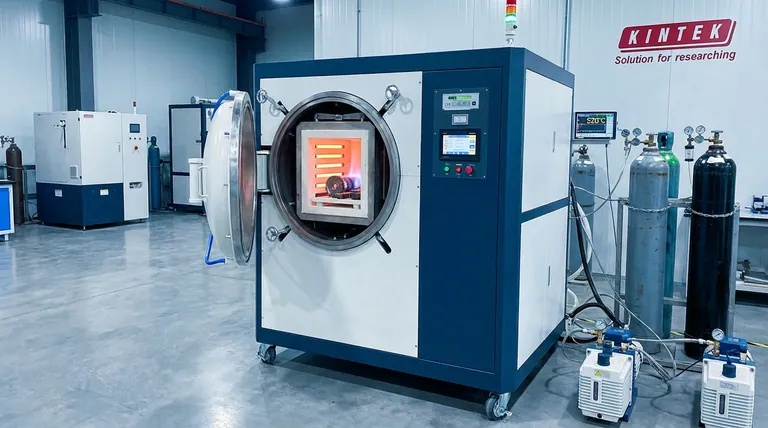
Achieving Surface Purity and Uniformity
Eliminating Contaminants
The primary function of the vacuum furnace is to establish a controlled low-pressure environment. By evacuating the chamber, the system removes interfering gases that naturally occur in the atmosphere.
Removing these gases is essential to prevent surface oxidation or contamination. This ensures the steel surface is chemically active and ready to accept nitrogen atoms.
Regulating Ammonia Flow
Once the vacuum is established, the furnace introduces ammonia gas with high precision. The low-pressure setting allows for the precise control of ammonia flow.
This control ensures that the nitrogen source is distributed evenly across the workpiece. This is the fundamental requirement for achieving a consistent hardened layer across complex geometries.
Temperature Control and Dimensional Stability
Maintaining the Critical Window
Gas nitriding AISI 5140 steel requires a stable temperature of approximately 520°C. The vacuum furnace is designed to hold this specific temperature within tight tolerances.
This heat must be maintained for extended periods—typically 3 hours or more. The vacuum furnace ensures there are no thermal fluctuations during this soak time, which is critical for uniform diffusion.
Preventing Distortion
One of the most significant advantages of using a vacuum furnace is the prevention of deformation. Because the heating is uniform and controlled, the steel does not experience the thermal shock often associated with other methods.
This allows the part to maintain its dimensional accuracy. This is vital for precision components that cannot be machined after treatment.
Formation of the Hardened Case
The White Layer (Compound Layer)
The precise environment of the vacuum furnace promotes the formation of a dense white layer, also known as the compound layer. This layer is rich in nitrides.
This dense layer provides the steel with improved chemical stability. It is directly responsible for significantly enhancing the material's corrosion resistance.
The Diffusion Layer
Beneath the white layer, the vacuum process enables uniform nitrogen atom diffusion into the substrate. This creates a diffusion layer that supports the harder surface.
While the supplementary quenching and tempering process provides the core toughness (sorbite structure), the vacuum nitriding process provides the necessary surface hardness to resist wear.
Understanding the Process Requirements
Time Intensity
It is important to note that this is not a rapid process. The primary reference highlights that the process requires 3 hours or more at temperature.
Achieving deep, uniform diffusion takes time. Shortcuts in processing time within the vacuum furnace will result in a thinner, less effective case depth.
Equipment Distinction
It is critical to distinguish this stage from the preliminary heat treatment. As noted in the supplementary data, the core toughness is achieved via a controlled atmosphere furnace and oil quenching, not the vacuum furnace.
The vacuum furnace is a specialized tool specifically for the surface hardening phase. It cannot replace the initial quenching and tempering steps required to build the underlying sorbite structure.
Making the Right Choice for Your Goal
To maximize the performance of your AISI 5140 components, consider which property is most critical to your application:
- If your primary focus is Dimensional Accuracy: Utilize the vacuum furnace to maintain precise temperature control, which prevents deformation and warping during the hardening process.
- If your primary focus is Corrosion Resistance: Ensure the process runs for the full duration (3+ hours) to form a dense, stable white layer (compound layer).
- If your primary focus is Structural Integrity: Verify that the steel has undergone proper quenching and tempering in a controlled atmosphere furnace before it enters the vacuum furnace for nitriding.
The vacuum furnace is not just a heater; it is a precision instrument that transforms the surface chemistry of steel without compromising its shape.
Summary Table:
| Feature | Benefit for AISI 5140 Gas Nitriding |
|---|---|
| Vacuum Environment | Eliminates oxidation and surface contaminants for active nitrogen diffusion. |
| Precise Ammonia Control | Ensures uniform ammonia flow and distribution across complex geometries. |
| Thermal Stability | Maintains exact 520°C window to prevent thermal shock and distortion. |
| White Layer Formation | Promotes a dense compound layer for superior chemical and corrosion resistance. |
| Dimensional Accuracy | Uniform heating preserves part geometry, eliminating post-treatment machining. |
Elevate Your Material Performance with KINTEK
Precision in gas nitriding starts with the right thermal environment. KINTEK provides industry-leading laboratory and industrial furnace solutions designed to meet the rigorous demands of AISI 5140 steel treatment.
Backed by expert R&D and world-class manufacturing, we offer Muffle, Tube, Rotary, Vacuum, and CVD systems—all fully customizable to your specific case depth and dimensional stability requirements. Whether you are looking to enhance corrosion resistance or ensure zero-distortion hardening, our team is ready to help you optimize your process.
Ready to achieve superior surface hardness? Contact KINTEK today to discuss your custom furnace needs!
References
- Talha İkbal Çığır, Mustafa Acarer. Comparison of Surface Hardening Processes Applied to AISI 5140 Steel withSide Load Test. DOI: 10.30939/ijastech..1370591
This article is also based on technical information from Kintek Furnace Knowledge Base .
Related Products
- Vacuum Heat Treat Furnace with Ceramic Fiber Liner
- 2200 ℃ Graphite Vacuum Heat Treat Furnace
- Molybdenum Vacuum Heat Treat Furnace
- 2200 ℃ Tungsten Vacuum Heat Treat and Sintering Furnace
- Vacuum Heat Treat Sintering Furnace with Pressure for Vacuum Sintering
People Also Ask
- How does vacuum heat treating affect the grain structure of metal alloys? Achieve Precise Microstructure Control
- What are the benefits of using vacuum heat treating furnaces for metal alloys? Achieve Superior Metal Properties and Performance
- What is one of the most important uses of vacuum heat treating furnaces in aerospace? Achieve Superior Strength in Aircraft Alloys
- How does a vacuum heat treat furnace work? Achieve Pristine, High-Performance Results
- What is the difference between heat treat and vacuum heat treat? Achieve Superior Metal Properties with Pristine Finishes



















