
Vacuum drying is the preferred method for processing BC-CFO composite powders because it operates under low pressure to significantly reduce the boiling point of residual solvents. This allows moisture and ethanol to evaporate rapidly at relatively low temperatures (approximately 60°C), protecting the material from the thermal damage associated with standard drying methods.
By decoupling heat from evaporation, vacuum drying solves the critical challenge of removing solvents without triggering oxidation or destroying the delicate microscopic architecture of the composite.
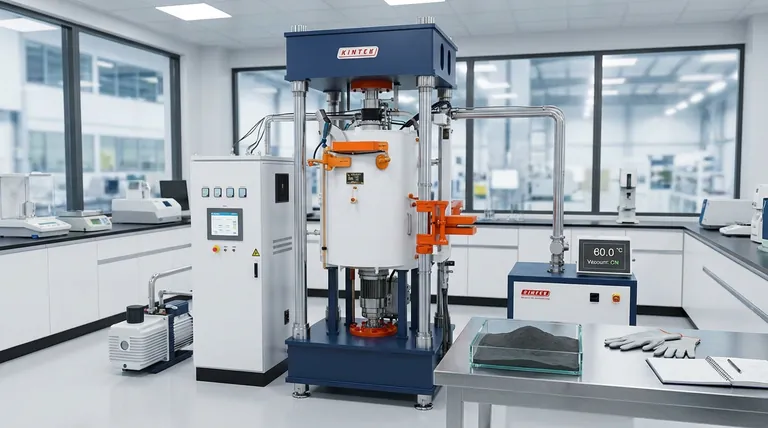
The Mechanics of Low-Temperature Evaporation
Leveraging Reduced Pressure
The core principle driving this preference is the physical relationship between pressure and boiling points. By creating a vacuum, the oven lowers the atmospheric pressure surrounding the wet powder.
This reduction allows solvents—typically water and ethanol used during synthesis—to boil off at temperatures far below their standard boiling points.
Rapid Drying at 60°C
Because the solvents become volatile at lower temperatures, the drying process becomes both fast and gentle.
The primary reference indicates that drying can be effectively conducted at 60°C. This creates a thermal environment that is sufficient to dry the powder but cool enough to prevent thermal degradation of the biological (BC) or inorganic (CFO) components.
Critical Benefits for BC-CFO Integrity
Preventing Oxidation of Magnetic Nanoparticles
The most significant risk during the drying of ferrite-based composites (like CFO) is oxidation. Exposure to high heat in an oxygen-rich environment can alter the chemical valency of the metal ions.
Vacuum drying mitigates this by removing the air (oxygen) and keeping the temperature low. This preserves the magnetic properties of the nanoparticles, ensuring the final material performs as intended.
Avoiding High-Temperature Agglomeration
When nanomaterials are subjected to high heat, particles tend to clump together, a process known as agglomeration. This reduces the effective surface area and limits the material's performance.
The gentle drying conditions of a vacuum oven prevent this "hard agglomeration." This ensures the particles remain loose and the microscopic pore structure is preserved.
Preserving Structural Morphology
For composites involving bacterial cellulose (BC), maintaining the structural framework is vital.
High temperatures can collapse the fine micro-nano structures. Vacuum drying maintains the structural integrity and high specific surface area of the composite, which is essential if the material is intended for use in catalysis or adsorption applications.
Operational Considerations and Trade-offs
The Necessity of Temperature Control
While vacuum drying allows for lower temperatures, it does not automatically guarantee safety. Operators must still strictly monitor the temperature range (typically 60°C to 80°C).
Exceeding these temperatures, even in a vacuum, can still risk damaging the delicate organic components of the BC matrix.
Equipment vs. Throughput
Vacuum drying is generally a batch process that may have lower throughput compared to continuous air drying methods.
However, for high-value nanocomposites like BC-CFO, the trade-off favors quality over sheer volume. The cost of a slower process is outweighed by the prevention of material waste due to oxidation or structural collapse.
Making the Right Choice for Your Goal
To ensure optimal processing of your BC-CFO powders, align your drying parameters with your specific performance targets:
- If your primary focus is Magnetic Performance: Prioritize the vacuum environment to eliminate oxygen exposure, ensuring the cobalt ferrite nanoparticles do not undergo secondary oxidation.
- If your primary focus is Surface Area and Porosity: Focus on maintaining the temperature strictly at 60°C to prevent capillary forces and thermal stress from collapsing the delicate porous network.
Vacuum drying is not just a drying step; it is a preservation technique essential for maintaining the functional identity of advanced composite materials.
Summary Table:
| Feature | Vacuum Drying (at 60°C) | Atmospheric Oven | Benefit for BC-CFO |
|---|---|---|---|
| Temperature | Low (approx. 60°C) | High (>100°C) | Prevents thermal degradation of cellulose |
| Atmosphere | Reduced Pressure (O2-free) | Ambient Air | Prevents oxidation of CFO nanoparticles |
| Particle State | Dispersed/Loose | Hard Agglomeration | Maintains high specific surface area |
| Structure | Preserved Morphology | Structural Collapse | Retains microscopic pore architecture |
Elevate Your Material Research with KINTEK Precision
Don't compromise the magnetic properties or structural integrity of your advanced composites. Backed by expert R&D and manufacturing, KINTEK offers a comprehensive range of lab high-temp equipment including Vacuum, Muffle, Tube, Rotary, and CVD systems, all fully customizable to meet your unique drying and synthesis needs.
Whether you are processing BC-CFO powders or developing next-generation nanomaterials, our vacuum drying solutions provide the precise temperature control and atmospheric stability required for high-value results. Contact KINTEK today to find the perfect system for your laboratory!
References
- Porous Biomass Carbon Composites Derived from Canadian Goldenrod and Their Excellent Microwave Absorption. DOI: 10.3390/app15179474
This article is also based on technical information from Kintek Furnace Knowledge Base .
Related Products
- Vacuum Heat Treat Sintering and Brazing Furnace
- Vacuum Heat Treat Sintering Furnace Molybdenum Wire Vacuum Sintering Furnace
- Dental Porcelain Zirconia Sintering Ceramic Vacuum Press Furnace
- Molybdenum Vacuum Heat Treat Furnace
- Vacuum Hot Press Furnace Machine Heated Vacuum Press
People Also Ask
- What is one of the most important uses of vacuum heat treating furnaces in aerospace? Achieve Superior Strength in Aircraft Alloys
- What are the benefits of using vacuum heat treating furnaces for metal alloys? Achieve Superior Metal Properties and Performance
- How does vacuum heat treating affect the grain structure of metal alloys? Achieve Precise Microstructure Control
- What is the temperature of a vacuum furnace brazing? Optimize Your Joint Strength and Cleanliness
- What are the steps involved in a typical vacuum brazing treatment? Master the Process for Strong, Clean Joints












