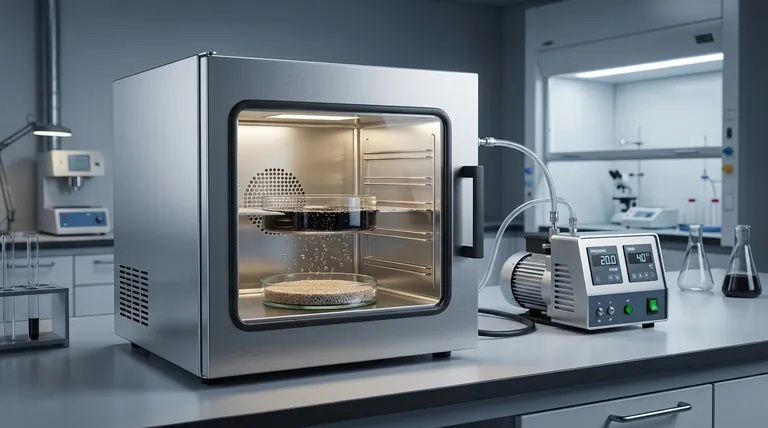
A vacuum drying apparatus is mandatory for the iridium salt precursor impregnation process because it fundamentally alters the physics of how the liquid interacts with the porous template. By operating at a reduced pressure—specifically around 20 mbar—you simultaneously force the iridium acetate solution into the microscopic gaps between polymer microspheres and accelerate the removal of the solvent.
Utilizing a reduced-pressure environment is the definitive method to drive the iridium precursor deep into complex pore structures. It ensures high material loading and uniform distribution, critical factors for preventing structural defects during the final transformation.
The Mechanics of Vacuum Impregnation
Accelerating Solution Penetration
The primary physical barrier in this process is the difficulty of getting a liquid solution into tiny voids. The vacuum apparatus removes air resistance within the template.
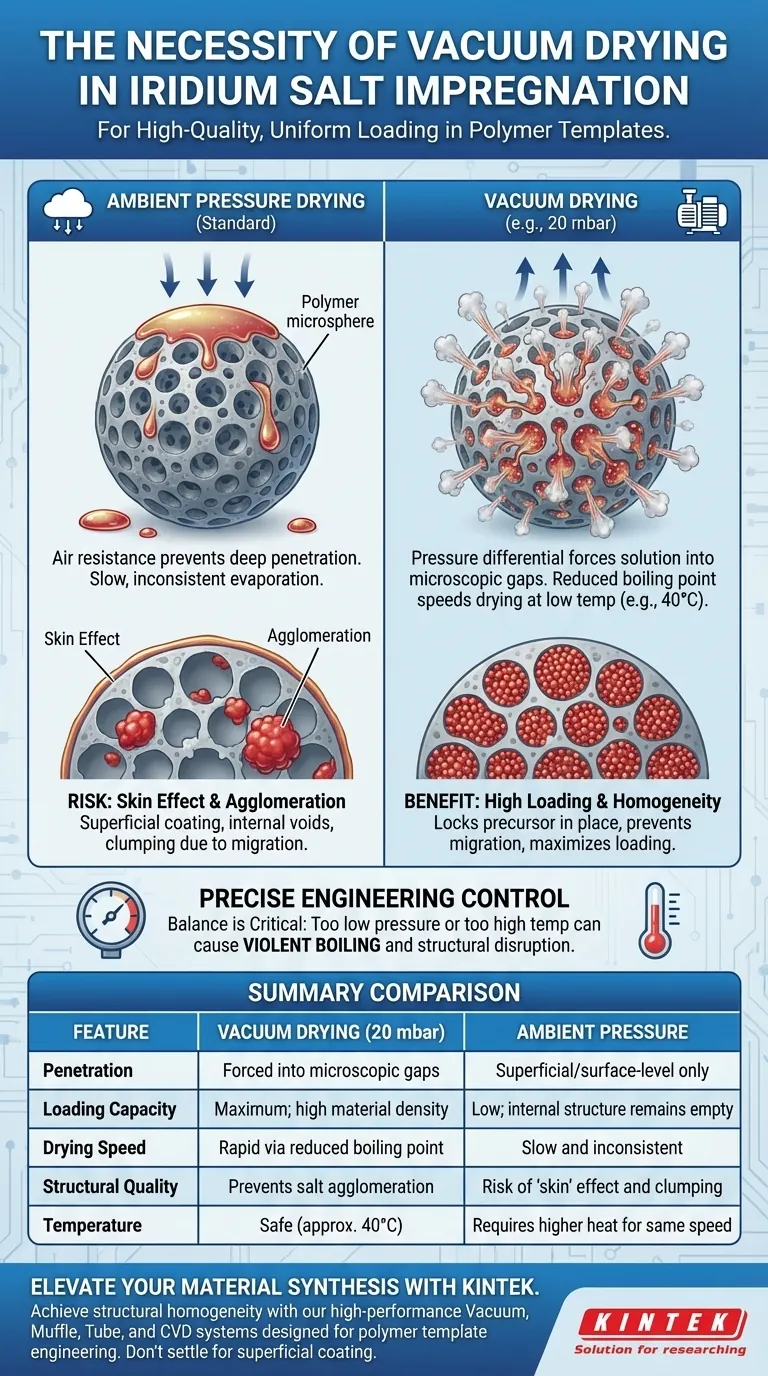
This creates a pressure differential that actively pulls the iridium acetate solution into the minute gaps between the polymer microspheres.
Facilitating Rapid Evaporation
At standard atmospheric pressure, solvent evaporation can be slow and inconsistent. By lowering the pressure to approximately 20 mbar, the boiling point of the solvent drops significantly.
This allows for efficient evaporation at moderate temperatures, such as 40 degrees Celsius, speeding up the drying phase without requiring excessive heat that might damage the polymer.
Ensuring Material Quality and Uniformity
Achieving High Loading Capacity
To create an effective final product, you need to maximize the amount of iridium deposited within the template.
The vacuum environment ensures that the precursor solution occupies the maximum available volume within the pore structure, leading to a superior loading capacity.
Preventing Macroscopic Agglomeration
One of the biggest risks in precursor impregnation is the tendency for metal salts to clump together as they dry.
Rapid, vacuum-assisted drying locks the iridium precursor in place quickly. This prevents the solution from migrating and pooling, which would otherwise cause macroscopic agglomeration and uneven material properties.
Understanding the Risks of Improper Drying
The Pitfall of Ambient Pressure
Attempting this process without a vacuum often results in superficial coating. Surface tension may prevent the solution from entering the deeper pores of the polymer template.
This leads to a "skin" effect where the outer layer is coated, but the internal structure remains empty, wasting the potential of the template.
Balancing Evaporation Speed
While vacuum accelerates evaporation, there is a balance to be maintained. The conditions (e.g., 40°C at 20 mbar) are specific for a reason.
If the pressure is too low or the temperature too high, the solvent may boil violently, potentially disrupting the delicate arrangement of the polymer microspheres before the structure sets.
Making the Right Choice for Your Goal
If your primary focus is Structural Homogeneity: Ensure you maintain a consistent negative pressure to prevent the precursor from migrating and forming clumps (agglomeration) during drying.
If your primary focus is Maximizing Catalytic Potential: Use the vacuum apparatus to drive the solution deep into the microsphere gaps, ensuring the highest possible loading capacity of the active iridium material.
By controlling the pressure environment, you transform a simple drying step into a precise engineering control for material quality.
Summary Table:
| Feature | Vacuum Drying (20 mbar) | Ambient Pressure Drying |
|---|---|---|
| Penetration | Forced into microscopic gaps | Superficial/surface-level only |
| Loading Capacity | Maximum; high material density | Low; internal structure remains empty |
| Drying Speed | Rapid via reduced boiling point | Slow and inconsistent |
| Structural Quality | Prevents salt agglomeration | Risk of 'skin' effect and clumping |
| Temperature | Safe (approx. 40°C) | Requires higher heat for same speed |
Elevate Your Material Synthesis with KINTEK
Achieving structural homogeneity in iridium salt impregnation requires precise control over pressure and temperature. KINTEK provides the high-performance laboratory solutions needed to master these complex processes. Backed by expert R&D and manufacturing, we offer a comprehensive range of customizable Vacuum, Muffle, Tube, and CVD systems designed to meet the unique needs of polymer template engineering. Don't settle for superficial coating—ensure maximum loading and catalytic potential with our precision-engineered high-temp furnaces. Contact KINTEK experts today to discuss your project requirements!
Visual Guide
References
- Sebastian Möhle, Peter Strasser. Iridium Oxide Inverse Opal Anodes with Tailored Porosity for Efficient PEM Electrolysis. DOI: 10.1002/adfm.202501261
This article is also based on technical information from Kintek Furnace Knowledge Base .
Related Products
- Stainless Steel Quick Release Vacuum Chain Three Section Clamp
- Vacuum Hot Press Furnace Machine for Lamination and Heating
- Vacuum Hot Press Furnace Machine Heated Vacuum Press
- Vacuum Hot Press Furnace Machine Heated Vacuum Press Tube Furnace
- 304 316 Stainless Steel High Vacuum Ball Stop Valve for Vacuum Systems
People Also Ask
- What is the function of quartz vacuum encapsulation in RhSeCl CVT? Mastering Pure Crystal Growth
- What type of pump is used in water circulating vacuum pumps and how is it installed? Discover Robust Fluid-Based Vacuum Solutions
- What role do vacuum-sealed high-purity silica ampoules play in phase equilibrium experiments? Enhance Sample Integrity
- What is the operating principle of a vacuum freeze-dryer in the fabrication of carbon aerogels? Master Sublimation
- What role does a vacuum atmosphere play in Sn-Ag-Co TLP soldering? Optimize Bond Purity and Joint Strength