
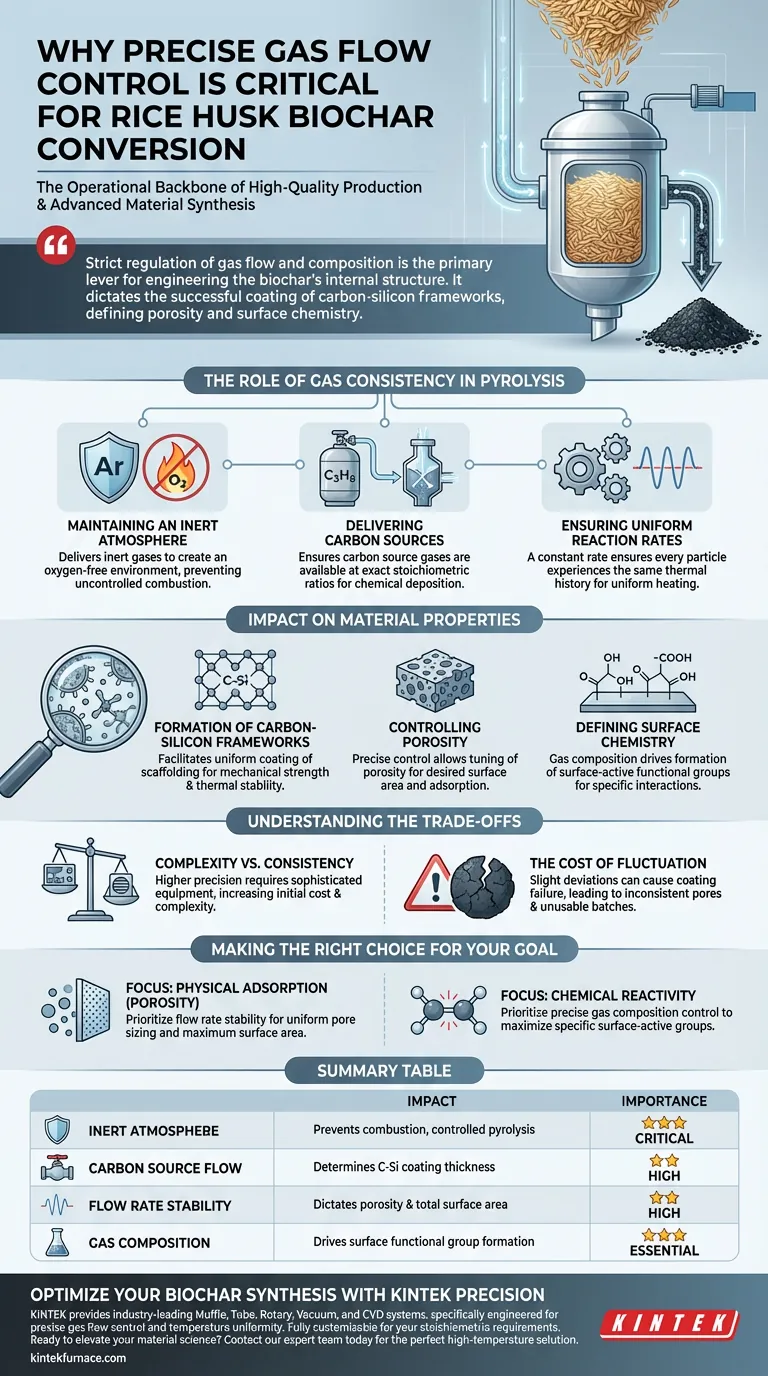
A precise gas flow control and supply system is the operational backbone of high-quality rice husk biochar production. It ensures the unwavering delivery of inert gases (such as argon) or carbon source gases (such as propane) at a constant, predetermined rate. Without this mechanical stability, the thermochemical conversion process becomes erratic, making it impossible to achieve the controlled pyrolysis environment necessary for advanced material synthesis.
Strict regulation of gas flow and composition is the primary lever for engineering the biochar’s internal structure. It dictates the successful coating of carbon-silicon frameworks, which in turn defines the material's porosity and surface chemistry.
The Role of Gas Consistency in Pyrolysis
To transform raw rice husk into engineered biochar, the reaction environment must remain stable. The gas supply system is the primary tool for maintaining this equilibrium.
Maintaining an Inert Atmosphere
The system must deliver inert gases, like argon, to create an oxygen-free environment. This prevents uncontrolled combustion of the biomass, ensuring the material undergoes pyrolysis rather than burning away.
Delivering Carbon Sources
For specific applications, carbon source gases like propane are introduced. A precise flow ensures these gases are available at the exact stoichiometric ratios required for chemical deposition.
Ensuring Uniform Reaction Rates
Fluctuations in gas flow lead to uneven heating and reaction speeds within the reactor. A constant rate ensures that every particle of rice husk experiences the same thermal history.
Impact on Material Properties
The ultimate goal of the gas system is to engineer the microscopic properties of the final product. The precision of the flow directly correlates to the quality of the biochar microcapsules.
Formation of Carbon-Silicon Frameworks
Rice husks are unique due to their high silica content. Precise gas flow facilitates the uniform coating of carbon-silicon frameworks, a structural scaffolding that provides mechanical strength and thermal stability.
Controlling Porosity
The flow rate determines how volatiles escape and how new structures form. Precise control allows you to "tune" the porosity, determining the surface area available for adsorption or catalytic activity.
Defining Surface Chemistry
The composition of the gas stream drives the formation of surface-active functional groups. These chemical groups determine how the biochar interacts with other substances, such as pollutants in water filtration or nutrients in soil amendment.
Understanding the Trade-offs
While high-precision gas systems offer superior control, they introduce specific challenges that must be managed.
Complexity vs. Consistency
Implementing a system capable of nanometer-level precision requires sophisticated mass flow controllers and monitoring equipment. This increases the initial capital cost and operational complexity compared to simple, passive venting systems.
The Cost of Fluctuation
If the gas flow deviates even slightly, the "coating" mechanism can fail. This results in biochar with inconsistent pore sizes or incomplete surface activation, rendering the batch unsuitable for high-performance applications.
Making the Right Choice for Your Goal
The level of precision required in your gas supply system depends on the intended application of your rice husk biochar.
- If your primary focus is Physical Adsorption (Porosity): Prioritize flow rate stability to ensure uniform pore sizing and maximum surface area within the carbon-silicon framework.
- If your primary focus is Chemical Reactivity: Prioritize precise gas composition control to maximize the formation of specific surface-active functional groups.
Mastering gas flow is not just about keeping the process running; it is the difference between burning waste and engineering a functional nanomaterial.
Summary Table:
| Feature | Impact on Biochar Production | Importance Level |
|---|---|---|
| Inert Atmosphere | Prevents combustion and ensures controlled pyrolysis. | Critical |
| Carbon Source Flow | Determines the thickness of carbon-silicon coating layers. | High |
| Flow Rate Stability | Dictates internal porosity and total surface area. | High |
| Gas Composition | Drives the formation of specific surface-active functional groups. | Essential |
Optimize Your Biochar Synthesis with KINTEK Precision
High-performance biochar requires the unwavering stability of professional thermal processing equipment. KINTEK provides industry-leading Muffle, Tube, Rotary, Vacuum, and CVD systems, specifically engineered to deliver the precise gas flow control and temperature uniformity your research demands. Our systems are fully customizable to meet the unique stoichiometric requirements of your carbon-silicon framework engineering.
Ready to elevate your material science? Contact our expert team today to find the perfect high-temperature solution tailored to your laboratory's needs.
Visual Guide
References
- Alibek Mutushev, Dauren Mukhanov. Development and application of microcapsules based on rice husk and metallurgical sludge to improve soil fertility. DOI: 10.1038/s41598-024-73329-4
This article is also based on technical information from Kintek Furnace Knowledge Base .
Related Products
People Also Ask
- What are the advantages of electric rotary kilns compared to fuel-fired ones? Boost Precision and Efficiency in Your Process
- What materials can be processed in an electric rotary kiln? Versatile Solutions for Advanced Materials
- What advantages do electric rotary kilns offer over fuel-based kilns? Boost Efficiency and Purity in Your Process
- What are the primary applications of electric rotary kilns? Precision Thermal Processing for High-Value Materials
- In what ways are electric rotary kilns more environmentally friendly? Achieve Zero On-Site Emissions
