
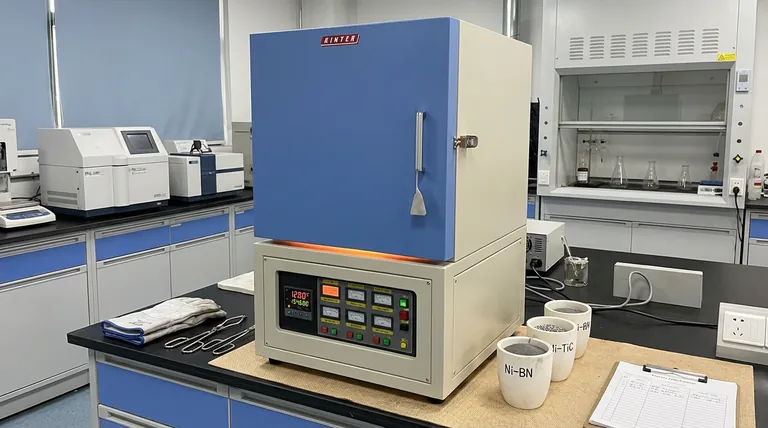
A muffle furnace is utilized for the high-temperature preheating of Ni-BN or Ni-TiC powder mixtures to ensure the absolute dehydration and degassing of the material prior to cladding. By subjecting the powders to temperatures around 1200°C for extended periods, typically up to 20 hours, the furnace eliminates deep-seated moisture and volatile impurities that would otherwise cause catastrophic defects during the coating process.
The rapid heating involved in cladding turns residual moisture into pressurized steam instantly. A muffle furnace prevents this by rigorously removing all volatiles beforehand, ensuring the final coating is dense, defect-free, and structurally sound.
The Mechanics of Defect Prevention
Eliminating Moisture and Volatiles
The primary function of the muffle furnace in this context is deep purification.
Powder mixtures like Ni-BN (Nickel-Boron Nitride) and Ni-TiC (Nickel-Titanium Carbide) are porous and naturally hygroscopic. They absorb moisture from the atmosphere which cannot be removed by simple surface drying.
The furnace provides a stable thermal environment at approximately 1200°C.
This high temperature must be maintained for extended durations, often reaching 20 hours. This ensures that not only surface water but also chemically bound moisture and other volatile impurities are completely driven out of the powder matrix.
preventing Rapid Vaporization Defects
This preheating step is dictated by the requirements of the subsequent process: microwave cladding.
Microwave cladding generates heat extremely rapidly. If moisture remains within the powder, it vaporizes instantly upon exposure to microwave energy.
This rapid expansion of gas creates internal pressure.
Without the preheating step, this gas becomes trapped in the solidifying metal, resulting in pores and bubbles. These defects significantly weaken the mechanical properties and corrosion resistance of the final coating.
Understanding the Trade-offs
Process Bottlenecks
While essential for quality, utilizing a muffle furnace for this purpose introduces a significant time constraint.
The requirement for a 20-hour cycle at 1200°C creates a bottleneck in production flow compared to the relatively fast cladding process itself.
Energy Consumption
The energy demand for maintaining such high temperatures for long durations is substantial.
Operators must weigh the cost of energy against the cost of scrapped parts due to porosity. There is no "shortcut" here; reducing temperature or time significantly increases the risk of coating failure.
Making the Right Choice for Your Goal
The use of a muffle furnace is a critical quality control gate in powder metallurgy cladding. Depending on your operational priorities, consider the following:
- If your primary focus is Coating Integrity: Adhere strictly to the 1200°C/20-hour protocol to guarantee zero porosity and maximum density in the final layer.
- If your primary focus is Process Efficiency: Do not attempt to shorten the heating duration; instead, batch process larger quantities of powder during the preheating phase to ensure a steady supply for the faster cladding station.
Success in high-quality cladding relies not just on the application method, but on the rigorous preparation of the raw materials.
Summary Table:
| Feature | Specification | Purpose |
|---|---|---|
| Powder Types | Ni-BN & Ni-TiC | Base materials for cladding |
| Preheating Temp | Approx. 1200°C | Complete degassing & dehydration |
| Duration | Up to 20 Hours | Removal of deep-seated moisture |
| Goal | Defect Prevention | Eliminate pores, bubbles, and cracks |
| Process Step | Pre-cladding Stage | Ensures coating density and integrity |
Elevate Your Material Integrity with KINTEK
Don't let moisture compromise your cladding quality. KINTEK provides high-performance, customizable Muffle, Tube, Rotary, Vacuum, and CVD systems engineered to withstand rigorous 1200°C cycles. Our lab high-temp furnaces are backed by expert R&D and manufacturing, ensuring your powder mixtures are perfectly prepared for defect-free results.
Ready to optimize your heat treatment process? Contact our specialists today to find the ideal thermal solution for your unique laboratory or industrial needs.
References
- Laith Jasim, Ankit Meheta. Advancing Surface Hardness and Wear Resistance: Microwave-Assisted Cladding of Ni-TiC Mixture onto SS-304. DOI: 10.1051/e3sconf/202450701017
This article is also based on technical information from Kintek Furnace Knowledge Base .
Related Products
- 1400℃ Muffle Oven Furnace for Laboratory
- 1700℃ High Temperature Muffle Oven Furnace for Laboratory
- 1800℃ High Temperature Muffle Oven Furnace for Laboratory
- 1200℃ Muffle Oven Furnace for Laboratory
- High Temperature Muffle Oven Furnace for Laboratory Debinding and Pre Sintering
People Also Ask
- How does a high-temperature laboratory muffle furnace affect material properties? Transform Anodic Oxide Films Fast
- What is the primary function of a high-temperature laboratory muffle furnace in chemical synthesis? Achieve Precision.
- What is the muffle furnace function in ilmenite oxidative roasting? Enhance Phase Change & Magnetic Separation
- What is the purpose of using a laboratory high-temperature muffle furnace for drying Fe-Ni-Co catalysts? Boost Purity
- What function does a muffle furnace perform in perovskite formation? Optimize Your Thermal Synthesis



















