
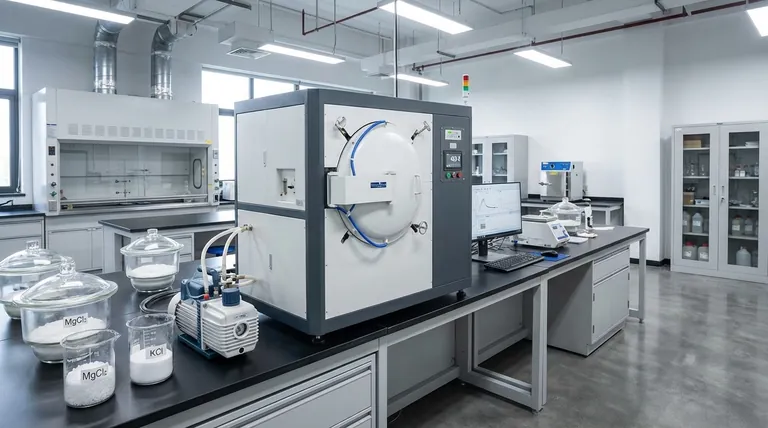
A laboratory vacuum oven is strictly required to process chloride salt media like MgCl2 and KCl because these materials are highly hygroscopic, meaning they aggressively absorb moisture from the environment. To prepare high-purity Titanium Hydride (TiH2), you must utilize reduced pressure and elevated temperatures (specifically 453 K) to completely dehydrate these salts, preventing the introduction of oxygen impurities during subsequent processing steps.
Core Insight: The use of a vacuum oven is not merely for drying; it is a chemical necessity to prevent hydrolysis. If moisture remains within the salts during the high-temperature molten phase, it triggers a reaction that contaminates the final TiH2 product with oxygen, compromising its quality.
The Challenge of Hygroscopic Media
The Nature of Chloride Salts
Magnesium chloride (MgCl2) and potassium chloride (KCl) are used as the medium for preparing TiH2. However, these salts are highly hygroscopic.
They do not just sit on the surface; they bind moisture from the atmosphere. This trapped water is difficult to remove through standard heating methods alone.
The Risk of Incomplete Drying
If you attempt to use these salts without thorough dehydration, the retained moisture becomes a contaminant.
Standard ovens operating at atmospheric pressure often fail to remove the tightly bound water molecules required for high-purity material science applications.
The Mechanism of Vacuum Dehydration
Utilizing Reduced Pressure
The laboratory vacuum oven operates by lowering the pressure around the salts.
This reduced pressure significantly lowers the boiling point of water, allowing moisture to evaporate more easily and thoroughly than it would at atmospheric pressure.
Optimal Thermal Conditions
The process specifically requires a temperature of 453 K.
At this temperature, combined with a vacuum environment, the system creates the ideal thermodynamic conditions to force moisture out of the salt structure without damaging the salts themselves.
Preventing Chemical Degradation
The Danger of Hydrolysis
The most critical reason for using a vacuum oven is to prevent hydrolysis when the salts are later melted.
If water is present when the salts enter the molten state at high temperatures, the water reacts chemically with the chloride salts. This reaction is irreversible and fundamentally alters the composition of the medium.
Avoiding Oxygen Impurities
Hydrolysis introduces oxygen impurities into the melt.
For Titanium Hydride (TiH2) production, oxygen is a detrimental contaminant. To obtain a low-oxygen TiH2 product, the molten salt medium must be chemically pure and completely anhydrous (water-free) before the synthesis reaction begins.
Understanding the Trade-offs
Process Complexity vs. Product Purity
Using a vacuum oven adds a layer of complexity and equipment cost compared to standard drying ovens. It requires precise control of both temperature (453 K) and pressure levels.
However, skipping this step creates a direct trade-off with quality. While standard drying is faster and cheaper, it inevitably leads to oxygen contamination in the final TiH2 product. In the context of high-performance materials, this impurity is often unacceptable, making the vacuum process non-negotiable despite the extra effort.
Making the Right Choice for Your Goal
To ensure the success of your TiH2 preparation, consider your specific purity requirements:
- If your primary focus is High-Purity TiH2: You must use a vacuum oven at 453 K to ensure zero hydrolysis and minimal oxygen content.
- If your primary focus is Process Speed: You might be tempted to use standard drying, but you must accept that the resulting product will contain significant oxygen impurities due to salt hydrolysis.
The vacuum oven is the only reliable method to safeguard the chemical integrity of molten chloride salts against oxygen contamination.
Summary Table:
| Feature | Requirement for TiH2 Preparation | Impact of Failure |
|---|---|---|
| Salt Media | MgCl2 and KCl (Highly Hygroscopic) | Absorbs atmospheric moisture |
| Equipment | Laboratory Vacuum Oven | Incomplete dehydration at atmospheric pressure |
| Process Temp | 453 K (Controlled) | Residual water remains in salt structure |
| Key Outcome | Prevention of Hydrolysis | Oxygen impurities contaminate final product |
| Product Goal | High-Purity Titanium Hydride | Compromised material integrity |
Elevate Your Material Purity with KINTEK Precision
Don't let oxygen impurities compromise your high-performance materials. Backed by expert R&D and manufacturing, KINTEK offers specialized Vacuum, Muffle, Tube, and CVD systems designed to meet the rigorous dehydration requirements of chloride salts like MgCl2 and KCl.
Whether you need standard laboratory solutions or fully customizable high-temperature furnaces, our equipment ensures the precise pressure and thermal control necessary to prevent hydrolysis and guarantee anhydrous media for TiH2 production.
Ready to optimize your synthesis process? Contact KINTEK today to discuss your unique needs!
References
- Sung-Hun Park, Jungshin Kang. Direct TiH2 powder production by the reduction of TiO2 using Mg in Ar and H2 mixed gas atmosphere. DOI: 10.1038/s41598-024-84433-w
This article is also based on technical information from Kintek Furnace Knowledge Base .
Related Products
- 1200℃ Muffle Oven Furnace for Laboratory
- Laboratory Muffle Oven Furnace with Bottom Lifting
- 1400℃ Muffle Oven Furnace for Laboratory
- High Temperature Muffle Oven Furnace for Laboratory Debinding and Pre Sintering
- 1700℃ High Temperature Muffle Oven Furnace for Laboratory
People Also Ask
- What is the primary function of a high-temperature laboratory muffle furnace in chemical synthesis? Achieve Precision.
- How does a high-temperature laboratory muffle furnace affect material properties? Transform Anodic Oxide Films Fast
- How is a laboratory muffle furnace used in 3D-printed PP-CF cross-linking? Achieve Thermal Stability at 150 °C
- Why is a laboratory high-temperature muffle furnace used for BaTiO3? Achieve Optimal Tetragonal Crystalline Phases
- What functions does a laboratory muffle furnace perform for AISI 1025 steel post-processing? Precision Thermal Control













