
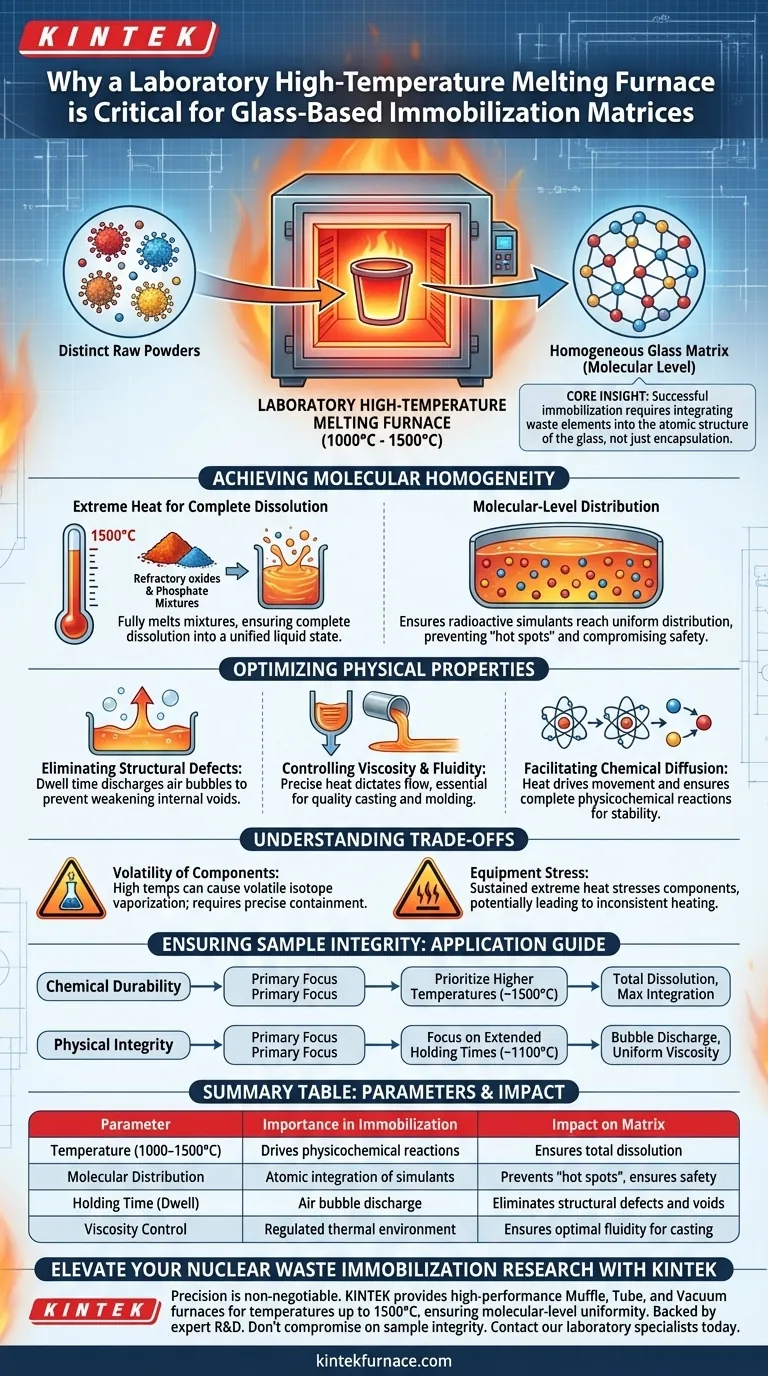
A laboratory high-temperature melting furnace is the foundational tool for creating effective glass-based immobilization matrices. It provides a strictly controlled thermal environment, typically operating between 1000°C and 1500°C, which is necessary to thoroughly melt oxide and phosphate mixtures. This intense, regulated heat ensures that radioactive element simulants are distributed uniformly at a molecular level, a requirement for producing high-performance solidification samples that can safely contain hazardous materials.
Core Insight: Successful immobilization is not merely about encapsulation; it requires integrating waste elements into the atomic structure of the glass. The furnace provides the precise energy required to drive the physicochemical reactions that transform distinct raw powders into a single, homogeneous, and stable glass phase.

Achieving Molecular Homogeneity
The Necessity of Extreme Heat
To immobilize radioactive simulants effectively, you cannot simply suspend them in a binder; they must become part of the glass network.
The furnace generates temperatures up to 1500°C to fully melt refractory oxide and phosphate mixtures. This ensures the complete dissolution of raw materials into a unified liquid state.
Molecular-Level Distribution
The primary goal of this thermal process is uniformity.
By maintaining high temperatures, the furnace ensures that radioactive element simulants reach a molecular-level uniform distribution within the melt. Without this, the final solid would have "hot spots" of concentrated waste, compromising the safety and stability of the matrix.
Optimizing Physical Properties
Eliminating Structural Defects
A stable glass matrix must be free of voids and internal weaknesses.
The furnace allows for specific holding times, such as 60 minutes at constant heat. This dwell time is critical for discharging internal air bubbles that would otherwise weaken the final structure.
Controlling Viscosity and Fluidity
The quality of the final casting relies heavily on the flow characteristics of the molten glass.
Precise temperature control dictates the viscosity and fluidity of the melt. If the temperature fluctuates, the viscosity changes, potentially leading to poor molding or incomplete casting of the final sample.
Facilitating Chemical Diffusion
Heat drives the movement of atoms within the mixture.
The controlled environment facilitates the diffusion of chemical components throughout the batch. This diffusion is essential for thermal decomposition and ensuring the physicochemical reactions required to stabilize the waste elements occur completely.
Understanding the Trade-offs
While high-temperature furnaces are critical, relying on thermal processing introduces specific challenges that must be managed.
Volatility of Components Operating at temperatures between 1000°C and 1500°C promotes thorough melting, but it can also cause volatile radioactive isotopes (such as Cesium or Technetium simulants) to vaporize. Precise temperature ramping and containment are required to prevent the loss of these elements before they are immobilized.
Equipment Stress The requirement for sustained, extreme heat places immense stress on heating elements and crucibles. Inconsistent heating due to equipment degradation can lead to temperature gradients within the melt, resulting in a non-uniform product despite correct settings.
Ensuring Sample Integrity
How to Apply This to Your Project
Selecting the right thermal profile is as important as the furnace itself. Use the following guide to prioritize your processing parameters:
- If your primary focus is Chemical Durability: Prioritize higher temperatures (closer to 1500°C) to ensure total dissolution of oxides and maximum molecular integration of the waste simulants.
- If your primary focus is Physical Integrity: Focus on extended holding times at stable temperatures (around 1100°C) to allow for complete bubble discharge and uniform viscosity for casting.
The ultimate success of your immobilization matrix depends on utilizing the furnace not just as a heater, but as a precision instrument for chemical synthesis.
Summary Table:
| Parameter | Importance in Immobilization | Impact on Matrix |
|---|---|---|
| Temperature (1000-1500°C) | Drives physicochemical reactions | Ensures total dissolution of refractory oxides |
| Molecular Distribution | Atomic integration of simulants | Prevents "hot spots" and ensures safety |
| Holding Time (Dwell) | Air bubble discharge | Eliminates structural defects and voids |
| Viscosity Control | Regulated thermal environment | Ensures optimal fluidity for casting and molding |
Elevate Your Nuclear Waste Immobilization Research with KINTEK
Precision is non-negotiable when dealing with radioactive element simulants. KINTEK provides high-performance Muffle, Tube, and Vacuum furnaces specifically engineered for temperatures up to 1500°C, ensuring the molecular-level uniformity your research demands.
Backed by expert R&D and world-class manufacturing, our systems are fully customizable to handle volatile isotopes and eliminate thermal gradients. Don't compromise on sample integrity.
Contact our laboratory specialists today to find the perfect thermal solution for your immobilization matrices.
Visual Guide
References
- S. V. Yudintsev, V. I. Malkovsky. Thermal Effects and Glass Crystallization in Composite Matrices for Immobilization of the Rare-Earth Element–Minor Actinide Fraction of High-Level Radioactive Waste. DOI: 10.3390/jcs8020070
This article is also based on technical information from Kintek Furnace Knowledge Base .
Related Products
- 1200℃ Muffle Oven Furnace for Laboratory
- 1400℃ High Temperature Laboratory Tube Furnace with Alumina Tube
- 1800℃ High Temperature Muffle Oven Furnace for Laboratory
- 1700℃ High Temperature Muffle Oven Furnace for Laboratory
- 1700℃ High Temperature Laboratory Tube Furnace with Alumina Tube
People Also Ask
- What is the primary function of a high-temperature laboratory muffle furnace in chemical synthesis? Achieve Precision.
- How does a high-temperature laboratory muffle furnace affect material properties? Transform Anodic Oxide Films Fast
- How is a laboratory muffle furnace used in 3D-printed PP-CF cross-linking? Achieve Thermal Stability at 150 °C
- Why is a laboratory high-temperature muffle furnace required for LaNixFe1-xO3 catalysts? Optimize Two-Stage Synthesis
- What role does a muffle furnace play in plant bark mineral analysis? Essential for Precise Dry Ashing & Trace Extraction



















