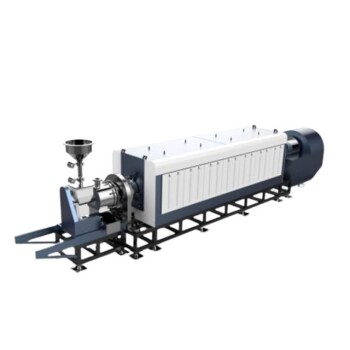
Rapid heating to 550°C is critical because it forces the biomass to undergo pyrolysis rather than slow combustion. By reaching this temperature within approximately 10 minutes, the furnace creates a thermal shock that efficiently separates combustible gases from the solid organic structure, providing an accurate baseline for a material's potential as a biofuel.
To determine the volatile matter of biomass, a furnace must provide a high-intensity, oxygen-limited environment that triggers instantaneous thermal decomposition. This process ensures that organic components are released as measurable gases, which is essential for calculating energy yield and combustion behavior.
The Role of Rapid Pyrolysis
Mimicking Thermal Decomposition
A high-temperature furnace is designed to simulate the pyrolysis process, where biomass is chemically decomposed by heat in the absence of oxygen. Reaching 550°C rapidly ensures that the components are released in a way that mimics their behavior during actual industrial gasification or combustion.
Preventing Oxidative Loss
If the heating process is too slow, the biomass may undergo gradual chemical changes that do not accurately represent its volatile potential. Rapid heating minimizes the time the sample spends at intermediate temperatures, ensuring a cleaner transition into gaseous volatile matter.
Achieving Chemical Stability
At 550°C, the organic structures within materials like Broom weed are completely broken down. This specific temperature allows for the mineralization of organic matter, enabling researchers to distinguish between what will burn as gas and what will remain as stable ash.
Ensuring Data Accuracy in Biofuel Evaluation
Isolating Combustible Components
The primary goal of volatile matter determination is to separate non-condensable vapors (like methane and carbon monoxide) from the solid carbon. A high-performance furnace maintains the sample in an anaerobic state using sealed crucibles, allowing these gases to escape without being consumed by flames.
Predicting Ignition and Flame Performance
The speed at which a sample releases its volatile gases at 550°C is a key indicator of its ignition difficulty. Technicians use this data to optimize the design of combustion chambers and determine how easily a biomass briquette will catch fire and maintain a flame.
Calculating Biogas Potential
In applications such as anaerobic digestion, reaching these temperatures helps calculate volatile solids (VS) content. This measurement is a fundamental predictor of how much biogas a specific biomass source can produce, making the furnace's precision vital for economic forecasting.
Common Pitfalls to Avoid
Inadequate Oxygen Exclusion
If the furnace or crucible is not properly sealed, oxygen will enter and cause the sample to burn rather than pyrolyze. This results in an overestimation of volatile matter because the solid carbon (fixed carbon) is being consumed by oxidation.
Fluctuating Temperature Ramps
Using a furnace that cannot reach 550°C within the 10-minute window can lead to incomplete decomposition. Inconsistent heating rates make it impossible to compare results between different batches or labs, undermining the reliability of the biofuel's energy profile.
Misidentifying Mineralization Points
While 550°C is standard for many biomass types, some high-carbon fuels require temperatures up to 950°C. Using the wrong temperature for a specific material can lead to residual organic matter remaining in the ash, which skews the final mineral content analysis.
How to Apply This to Your Project
When selecting or operating a laboratory furnace for volatile matter analysis, consider your specific analytical goals to ensure the equipment meets the necessary thermal demands.
- If your primary focus is Biofuel Energy Potential: Ensure the furnace can reach 550°C-950°C within 7-10 minutes to accurately capture the release of combustible gases.
- If your primary focus is Compost Mineralization: Use the 550°C setting to ensure organic structures are fully oxidized into carbon dioxide and water for accurate ash weighing.
- If your primary focus is Combustion Chamber Design: Prioritize furnaces with high-intensity heat capabilities to better simulate the instantaneous thermal decomposition seen in industrial boilers.
Precision in both the speed and environment of heating is the only way to transform raw biomass data into a definitive energy strategy.
Summary Table:
| Feature | Requirement | Impact on Biomass Analysis |
|---|---|---|
| Heating Speed | Reach 550°C within 10 mins | Triggers rapid pyrolysis and prevents slow combustion |
| Temperature Goal | Stable 550°C (up to 950°C) | Ensures complete mineralization of organic structures |
| Environment | Oxygen-limited (Anaerobic) | Prevents oxidative loss of fixed carbon for accurate data |
| Data Output | Volatile Matter & VS Content | Predicts biogas potential and industrial ignition behavior |
Achieve Precision in Biofuel Analysis with KINTEK
Accurate volatile matter determination hinges on the speed and precision of your thermal equipment. KINTEK specializes in high-performance laboratory furnaces and consumables designed to meet the rigorous demands of biomass research. From muffle and tube furnaces capable of rapid ramp-up to vacuum, CVD, and atmosphere-controlled furnaces, our equipment ensures the oxygen-free, high-intensity environment necessary for definitive pyrolysis.
Whether you are calculating biogas potential or optimizing industrial combustion, KINTEK offers customizable solutions tailored to your unique laboratory needs.
Ready to upgrade your lab’s thermal capabilities? Contact KINTEK today for a consultation!
References
- A. A. Adewumi, N. A. Akinrinade. Influence of Selected Parameters on the Product Yields of Broom Weed (Sida acuta) Pyrolysis. DOI: 10.9734/jerr/2023/v25i7947
This article is also based on technical information from Kintek Furnace Knowledge Base .
Related Products
- Vertical Laboratory Quartz Tube Furnace Tubular Furnace
- 1400℃ High Temperature Laboratory Tube Furnace with Alumina Tube
- 1700℃ High Temperature Laboratory Tube Furnace with Alumina Tube
- 1800℃ High Temperature Muffle Oven Furnace for Laboratory
- 1200℃ Muffle Oven Furnace for Laboratory
People Also Ask
- What are the key differences between single-zone and multi-zone vertical tube furnaces? Choose the Right Furnace for Your Lab
- Why is a vertical tube furnace preferred for quenching tests? Achieve Rapid, Repeatable Cooling for Accurate Results
- How are wafers loaded and unloaded in a vertical tube furnace? Achieve Precision and Purity in Wafer Processing
- What physical conditions does a vertical tube furnace provide for desulfurization experiments? Precision Heat Control
- How does a vertical single-temperature zone tube furnace facilitate the growth of high-quality PdSe2 single crystals?