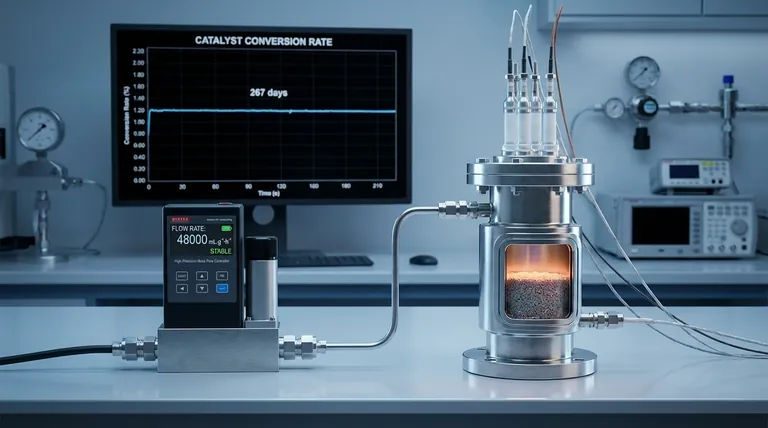
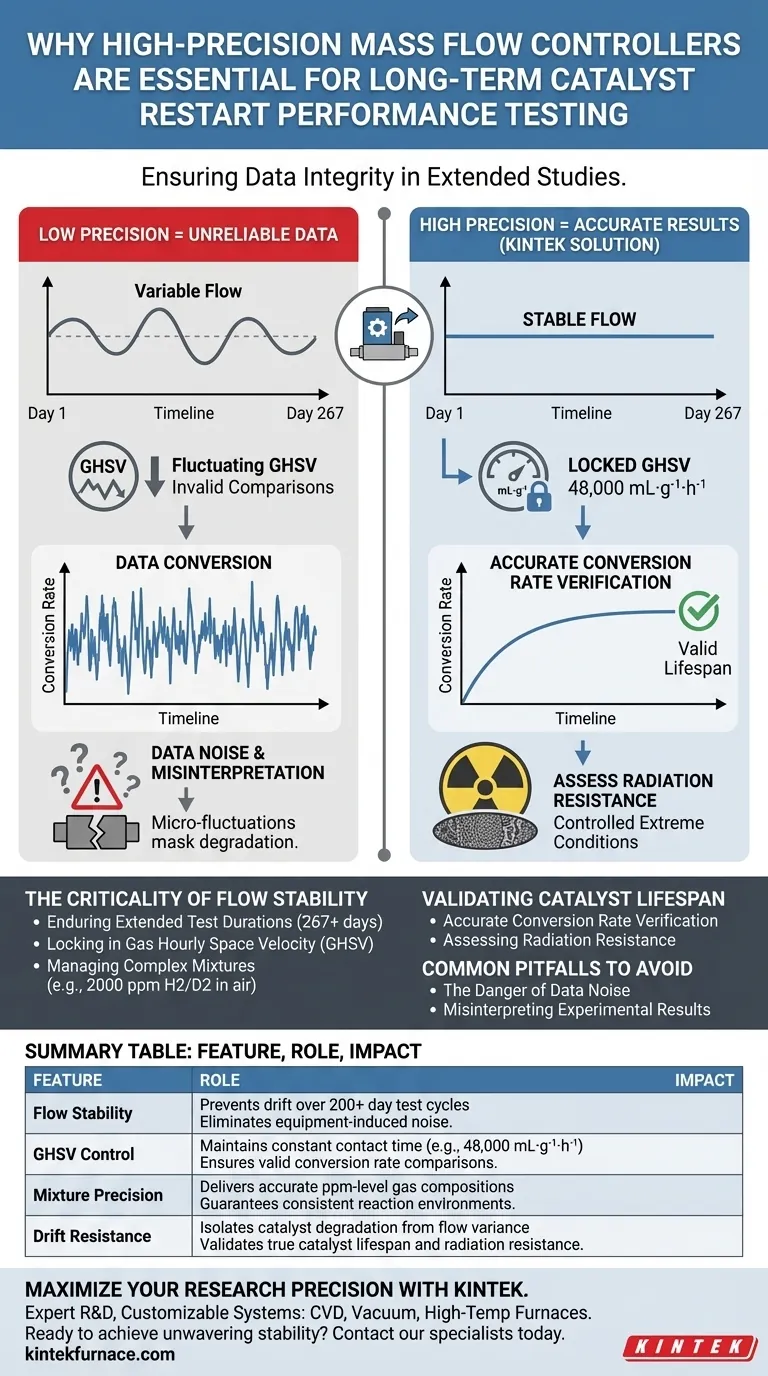
High-precision mass flow controllers are the linchpin of data integrity in long-term catalyst studies. They ensure that reaction gas flow remains absolutely constant throughout extended testing periods, such as a 267-day lifespan test. By maintaining a stable Gas Hourly Space Velocity (GHSV), these controllers allow researchers to isolate catalyst performance from environmental variables, ensuring that conversion rate data accurately reflects the material's true capabilities.
In long-term experiments, consistency is the prerequisite for validity. A high-precision controller eliminates flow rate variance, ensuring that any observed changes in conversion rates are the result of catalyst degradation or radiation effects, rather than equipment fluctuation.
The Criticality of Flow Stability
Enduring Extended Test Durations
Long-term restart performance testing is a marathon, not a sprint. A typical test may run continuously for as long as 267 days.
During such extended periods, even minor drifts in gas flow can compound into significant data errors. High-precision controllers maintain uniformity from day one to the final day of testing.
Locking in Gas Hourly Space Velocity (GHSV)
The reliability of your data hinges on maintaining a specific GHSV. In high-stakes testing, this value often needs to be held at precise levels, such as 48,000 mL·g⁻¹·h⁻¹.
If the mass flow controller wavers, the GHSV fluctuates. This fluctuation alters the contact time between the gas and the catalyst, rendering conversion rate comparisons invalid.
Managing Complex Mixtures
These tests often involve specific gas mixtures, such as 2000 ppm H2/D2 in air.
Precise control is required not just for volume, but to ensure the mixture composition remains consistent as it is delivered to the reaction chamber.
Validating Catalyst Lifespan
Accurate Conversion Rate Verification
The primary goal of these tests is to verify the conversion rate of the catalyst over time.
To claim a specific lifespan or efficiency, the input variables must remain static. High-precision flow control provides the baseline stability required to prove that a catalyst meets its performance targets.
Assessing Radiation Resistance
Testing often pushes catalysts to their limits to verify radiation resistance under extreme operating conditions.
In these volatile environments, the equipment must be more robust than the variables being tested. A precise flow controller ensures that the "extreme conditions" remain controlled and measurable parameters rather than chaotic variables.
Common Pitfalls to Avoid
The Danger of Data Noise
A common error in long-term testing is underestimating the impact of micro-fluctuations.
If a controller lacks high precision, it introduces "noise" into the conversion rate data. This noise can mask subtle signs of catalyst degradation or, conversely, create false positives where the catalyst appears to fail simply because flow rates dropped.
Misinterpreting Experimental Results
Without strict flow control, it becomes impossible to distinguish between equipment behavior and catalyst behavior.
You risk attributing a drop in performance to the catalyst's inability to handle radiation or age, when it may simply be a result of inconsistent gas delivery.
Ensuring Success in Catalyst Verification
To ensure your long-term restart performance testing yields valid, publishable results, align your equipment choice with your specific experimental goals.
- If your primary focus is determining accurate lifespan: Prioritize a controller capable of maintaining drift-free operation over multi-month durations (e.g., 200+ days).
- If your primary focus is analyzing radiation resistance: Ensure the controller can maintain exact GHSV targets (like 48,000 mL·g⁻¹·h⁻¹) to rigorously stress-test the material under stable conditions.
Ultimate reliability in catalyst research is not achieved by the catalyst alone, but by the unwavering precision of the environment you create around it.
Summary Table:
| Feature | Role in Catalyst Testing | Impact on Data Quality |
|---|---|---|
| Flow Stability | Prevents drift over 200+ day test cycles | Eliminates equipment-induced noise |
| GHSV Control | Maintains constant contact time (e.g., 48,000 mL·g⁻¹·h⁻¹) | Ensures valid conversion rate comparisons |
| Mixture Precision | Delivers accurate ppm-level gas compositions | Guarantees consistent reaction environments |
| Drift Resistance | Isolates catalyst degradation from flow variance | Validates true catalyst lifespan and radiation resistance |
Maximize Your Research Precision with KINTEK
Don't let equipment fluctuations compromise your long-term catalyst validation. KINTEK provides high-precision laboratory solutions backed by expert R&D and manufacturing. Whether your research involves CVD systems, vacuum environments, or high-temperature furnaces, our customizable systems are designed to meet the most rigorous testing standards.
Ready to achieve unwavering stability in your lab? Contact our specialists today to discuss how our customizable heating and flow solutions can enhance your catalyst performance testing.
Visual Guide
References
- Guilin Wei, Xingwen Feng. Embedding Monodisperse LaO <i> <sub>x</sub> </i> Into Pt Nanoclusters for Ultra‐Stable and Efficient Hydrogen Isotope Oxidation. DOI: 10.1002/advs.202504224
This article is also based on technical information from Kintek Furnace Knowledge Base .
Related Products
- Ultra Vacuum Electrode Feedthrough Connector Flange Power Lead for High Precision Applications
- 915MHz MPCVD Diamond Machine Microwave Plasma Chemical Vapor Deposition System Reactor
- Ultra High Vacuum CF Observation Window Flange with High Borosilicate Glass Sight Glass
- Cylindrical Resonator MPCVD Machine System for Lab Diamond Growth
- MPCVD Machine System Reactor Bell-jar Resonator for Lab and Diamond Growth
People Also Ask
- Why is a high-precision vacuum sealing system necessary for CrSb? Ensure Pure Crystal Growth & Prevent Oxidation
- Why is an Ultra-High Vacuum (UHV) System Required for In2Se3? Achieving Atomic-Level Ferroelectric Clarity
- What is the function of quartz vacuum encapsulation in RhSeCl CVT? Mastering Pure Crystal Growth
- Why is vacuum sealing technology essential for K2In2As3 synthesis? Master High-Purity Solid-State Reactions
- What role do vacuum-sealed high-purity silica ampoules play in phase equilibrium experiments? Enhance Sample Integrity